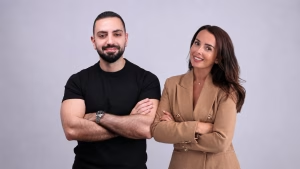
By Angeline Lodhia Shalabi
Founder, Angeline LS Consults | Co-Founder, Semantic Pulse
Angeline has more than twenty years of experience in media and advertising, starting at Virgin Media London, through to launching start-ups like Inskin Media in the UK and APAC. She also has agency-side experience leading APAC partnerships at WPP Media, based in Hong Kong. She now runs Angeline LS Consults, based in Dubai, helping businesses with new market launches and supporting brands, agencies and vendors in the MENA and APAC regions.
I have been fortunate that my full-circle 360 vision of the industry ecosystem built across continents has given me a clear full view of the media global landscape, and importantly, here right now in the Middle East.
In my opinion, the Middle East isn’t just growing; it’s transforming at a pace few other regions can match, but the current climate, shaped heavily by the ongoing conflict, is forcing everyone to get smarter and faster.
The hard numbers still show real momentum. The latest IAB MENA Digital Adspend Study (June 2025) put regional digital advertising at USD 6.95 billion in 2024 — up a healthy 19.8% year on year. Saudi Arabia led the way with 23.5% growth, cracking the world’s top 10 markets, while social still takes roughly 60% of spend. The UAE already matches per-capita levels of many developed economies. Earlier forecasts had us heading for steady double-digit growth through 2026, driven by a young population, high digital penetration, and major national plans such as Saudi Vision 2030 and the UAE’s AI Strategy.
However, you cannot write about the Middle East without being honest about the current climate: tension is everywhere. Geopolitical uncertainty, economic headwinds and rapid tech change were already testing nerves, but now the war in the Middle East is casting a long shadow. From what I’m seeing with clients across the region, we should expect advertising spend to moderate or drop in the short term, particularly in the second half of 2026 and into 2027. International brands are pulling back or pausing campaigns over brand-safety worries, boycott risks and softer consumer confidence in tourism, entertainment and luxury. Tourism-linked marketing, a huge growth driver under Vision 2030, is feeling the pressure hardest. Even domestic advertisers are playing it safer, defaulting more than ever to familiar social platforms.
That said, I don’t see this as the end of the story. Far from it. The impact of the war will be uneven, and in many ways, it is accelerating the very changes the industry needs. In the short term (next 6–12 months), I expect overall growth to soften by around 10–15% outside the core GCC markets, with tourism and experiential categories hit hardest. Yet Saudi Arabia and the UAE are proving remarkably resilient. Mega-projects keep moving, government and PIF-backed campaigns continue, and domestic e-commerce and entertainment spending are holding steady.
Vision 2030, in particular, acts like an anchor, shifting budgets from broad awareness to disciplined, performance-led marketing in entertainment, sports, tourism and new cities. The long-term outlook remains strong because the structural drivers (youthful population, digital infrastructure, diversification plans) haven’t gone away.
This brings me to what I believe is the single biggest opportunity right now: AI transformation. Nowhere is adoption moving faster than in MENA marketing. Generative AI has gone from pilot projects to daily operations — powering hyper-personalised campaigns, real-time Arabic dialect localisation, automated customer journeys and predictive performance modelling. At Semantic Pulse, we see agencies and brands using our synthetic-audience platform every day to test entire campaigns against thousands of unique MENA personas in minutes, with over 90% accuracy and at a fraction of traditional research costs. Smaller agencies and independent advertisers can suddenly iterate and de-risk ideas at the same speed as the big networks.
Beyond AI, I’m still excited about emerging channels — Connected TV, digital out-of-home, retail media and digital audio — which should deliver the strongest incremental growth for those brave enough to invest. E-commerce and social commerce continue to turn online retail into seamless shoppable experiences, while culturally authentic creators remain the most powerful trust signal in the region. And cross-border opportunities are growing: APAC buyers are showing more interest in quality MENA inventory than ever before. The agencies that will win are the ones embedding AI deeply into creative, measurement and strategy while treating Saudi Vision 2030 as a global growth engine rather than just a local market.
The challenges are just as real, and the war has made some of them sharper. Data transparency remains the number-one complaint — 86% of advertisers flag it as their biggest issue — followed by fraud, brand safety and attribution headaches. Over-reliance on social (still over 60% of spend) feels even riskier when algorithms shift or costs rise. Job losses, talented expats moving back to their homes, rising media prices and the constant geopolitical backdrop keep everyone on edge.
The impact falls unevenly: big holding groups can absorb the shocks with scale and proprietary tech, but smaller agencies and independents, start-ups are under real pressure. In my consultancy work, I’m seeing more clients than ever rewriting their business plans right now — moving away from traditional methods, AI-augmented services, productised offerings and smarter global positioning.
Despite everything, I remain genuinely optimistic. The UAE continues to push forward with energy and vision, positioning itself as a global AI and media hub even amid the regional stress. Saudi Vision 2030 provides long-term stability and investment that many other markets would envy. The region’s youthful dynamism and digital infrastructure are still unmatched.
In my view, this isn’t the moment for small adjustments. It’s time to rewrite the playbook completely. Integrate AI at the core. Double down on transparency and brand safety. Look beyond borders. Partner with agile tech that delivers speed and real insight. The biggest winners will be those who combine the Middle East’s natural strengths with global thinking and AI-powered precision.
The story of advertising in the Middle East is still being written — and even with the shadow of conflict, I believe the next chapter will be extraordinarily bright for those with the courage and intelligence to shape it.