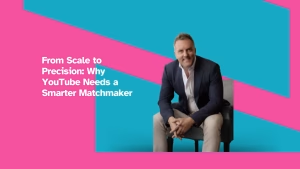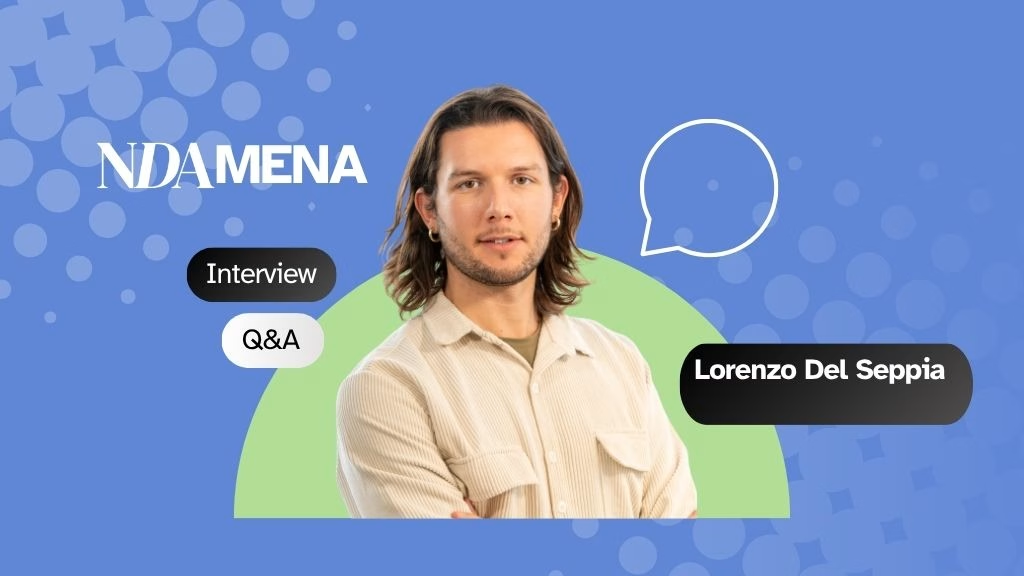
We sat down with Lorenzo Del Seppia, Commercial Director – Italy, Spain and MENA, Magnite to discuss both the region and the biggest trends in digital marketing.
Tell us about yourself and your background, and what led you into digital advertising?
My educational background is in economics and marketing. I specialised in media and advertising during my master’s degree in London, which is when I began to develop an interest in digital media. My dissertation was an academic study of perceptions of ads across Google and Facebook, and the fine line between useful and disruptive ads.
This sparked my interest, and that’s when I started working in digital marketing over 10 years ago.
You are the Commercial Director at Magnite across Italy, Spain and MENA – how do you navigate cultural and market differences when building commercial strategies?
Being in charge of such a vast region forces you to adapt and take into account the diverse cultural aspects of the markets we operate in. I find this very fascinating, and it fits really well with my background: having lived in London for over 10 years, a really multicultural city, and now closely with teams and clients across different regions, where cultural nuances and local market maturity vary significantly from country to country.
It is important to consider the dynamics of each market and adapt our strategies to ensure we remain relevant and aligned with market expectations. In MENA in particular, the pace of digital transformation differs widely between markets, which makes localised strategy and strong in-market relationships essential.
With more than 10 years across the industry, what career move or decision has been the most pivotal for you?
Surely, my move to the tech side of the ecosystem, when I joined Magnite (FKA The Rubicon Project) 7 years ago. I worked on the publisher side beforehand and have held a variety of roles within Magnite, giving me a comprehensive understanding of the programmatic ecosystem.
Being on the tech side is really exciting as we build products for our clients, both on the sell and buy sides, to help solve challenges and maximise business outcomes. It’s the opportunity to build true partnerships, which makes my role really dynamic.
What trends do you think are currently under-estimated by brands and agencies in CTV and programmatic advertising?
Education is key. Some agencies struggle to justify the value of CTV and the efficiency of programmatic advertising to their clients, as they only look at “what they know”. This makes it challenging to introduce CTV-first publishers to agency clients especially in some markets, so education from us, the tech partners, is key to making the value of CTV better known amongst clients.
Some clients also struggle to see the added value of CTV compared to linear, especially in more conservative markets, but we can measure this more effectively across CTV.
What’s a common misconception about programmatic advertising that you often encounter, and how do you address it?
Clients not accustomed to using programmatic advertising can associate a lower value and perceive some of the buying via tech pipes as less brand safe. This is completely untrue, and over the years, programmatic has become the most efficient and safest way to buy and sell media, creating huge value for everyone in the supply chain.
Clients that are more sceptical towards programmatic have to see the value technology can bring in their strategy, and we have the ability to do that, via testing and measurement, something some of the traditional media struggle to deliver. It’s about education, testing, and learning, and about bringing value rather than only extra “costs” in the supply chain, and that’s what tech companies like Magnite must deliver.
Which trend in digital advertising are you currently most curious about and why?
Definitely the impact of AI across our industry. In MENA, where some markets are still scaling their programmatic capabilities, AI has the potential to accelerate adoption and improve efficiency, but only if paired with the right local expertise and education.
This is a buzzword right now, as it can impact every aspect of the ad tech industry, but I believe it will be effective only if people with the right skills sit behind the technology, helping and educating our clients on how to best harness the value AI can bring. It is important that we upskill our teams and bring them along on this journey to integrate AI into what we do across our companies and with our clients.
What’s something about your role that people rarely see from the outside, but makes a real difference behind the scenes?
For me, it is about the coaching and support I try to provide to my team. I want to build successful teams and provide them with the best support I can to ensure they can confidently contribute to delivering for our clients.
It is not possible to achieve the success we want on our own, so it is important to create an environment where everyone can flourish, contribute, and feel safe adding their POV and ideas. This becomes even more important when managing teams across regions like Europe and MENA, where communication styles and expectations can vary.
After 10 years in the industry, what keeps you inspired and what still makes you curious?
I am lucky enough to work in an industry that is always evolving. This makes me really curious and definitely not bored for the future. We have gone through many changes in the industry over the last 10 years, and we are not done yet. This forces you to adapt, and I believe adaptability is one of my most prominent skills. Change is an opportunity to improve and to make products and deliver services that make our clients’ lives easier. I love working in such a dynamic industry.
Looking back at your pathway through digital advertising, is there a piece of advice you would give your younger self when you first entered the industry?
My advice is to give yourself the opportunity to try different things to find what makes you happy about going to work and seeing your teams. Do not think you should be clear what you would like to do since you were a kid.
Some people experience that, but the majority of us don’t, and that is ok! Explore, change careers – if you realise what you are doing is not something you enjoy, try something different and find a good fit for yourself, which doesn’t have to be what everybody else is craving. Embrace your uniqueness; this is what I would advise anyone to do.
*Magnite is a client of Blustripe Communications, owned by Bluestripe Group, the publisher of NDA.