Vowmade is an online platform to help mid-market advertisers plan and execute omnichannel strategies across one or more Amazon markets.
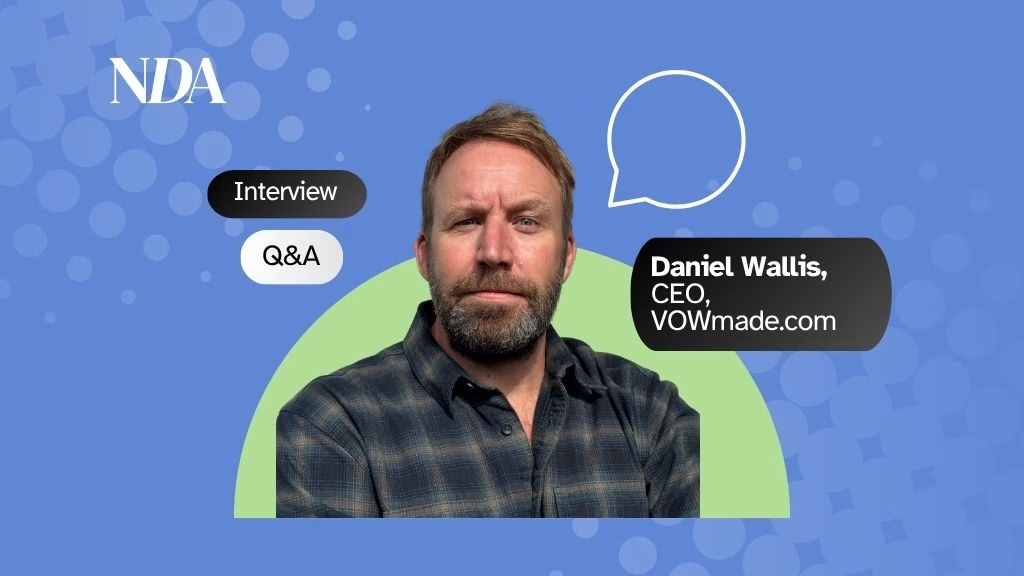
New Digital Age recently spoke with Daniel Wallis, co-founder and CEO, Vowmade, to discuss the challenges facing advertisers in the connected TV (CTV) space and how the new VowStream tool aims to unlock CTV success for mid-sized brands…
What are the main challenges advertisers are facing when it comes to buying CTV inventory today?
The main issue is that CTV supply is exploding. Think Prime Video, Netflix, Disney+, Paramount, Discovery, plus another 50 channels in the UK alone. The problem is campaign execution remains fragmented and opaque.
What that means in practice is advertisers have a few options, none of them ideal. You can go directly to publishers and cut individual deals. You can hire an agency, but that’s operationally heavy and can be cost-prohibitive, especially for small and mid-market advertisers. You could use a managed service, but then you’re dealing with opaque pricing and limited visibility. Or you can get direct access to platforms like Amazon DSP or DV360 – but then you may be tied into minimum spends and complex workflows.
So what does that actually mean? Higher CPMs, lower transparency, lower margins, and slower speed to market. On a global basis, we estimate that between 15% and 25% of CTV ad spend is lost to inefficiency and hidden markups. That’s billions of dollars.
So the key problem is: advertisers have to navigate fragmented supply, opaque pricing, and complex workflows just to run campaigns.
So how does VowStream address those challenges? What’s the core proposition?
We’ve built what we call a control layer for premium CTV. In essence, we’ve unified planning, execution and optimisation into a single interface. A customer can come in and, in under five minutes, plan and execute a CTV campaign across multiple partners.
We’re built on top of the Amazon DSP, so we handle all the heavy lifting in the background. We also integrate with partners to access a wide range of inventory. The key thing is that instead of multiple intermediaries and supply paths, you get a simple, clear supply path with 100% transparency.
Does that open up the CTV market to a broader range of advertisers?
Exactly. If you think about it, the big global brands like Unilever and Procter & Gamble have agency relationships and serious buying power. They can negotiate good deals.
By contrast, mid-market companies (say, those generating between $10 million and $1 billion in revenue) are stuck. They can’t justify a big agency, and they don’t have the resources to manage DSPs themselves.
So we act as an instant solution. We can onboard clients in a couple of days, and suddenly they’re buying CTV across Netflix, Prime Video and Disney. So, yes, we absolutely believe we’re creating more opportunities for more brands to leverage CTV.
Have advertisers fully embraced the capabilities of CTV yet—particularly around targeting and creative?
I don’t think so, not yet at least. There was a stat recently suggesting that by 2027, CTV ad spend will surpass linear TV. That’s incredible when you consider the scale of traditional TV. The reason budgets are shifting is because CTV combines long-form storytelling with the targeting and precision of performance media.
But we’re only just getting started. Today, you can apply things like Amazon audiences, geo-targeting, dayparting, but most campaigns still rely on a set of pre-rendered ads. We’re not yet at the stage where we’re dynamically generating thousands of personalised ads. Maybe we’ll move further in that direction, but it’s not there yet.
Where things get interesting is around retargeting. For example, we can run a CTV campaign, then use Amazon Marketing Cloud to build audiences of users who saw the ad, visited a product page, maybe added to cart but didn’t convert, and then retarget them with lower-cost media.
So there’s a lot of room to grow, and we’re actively building more retargeting capabilities to help customers maximise performance.
What are your key priorities for the year ahead? What would success look like?
We’ve only just launched, but we already have a core product that’s been running for close to a year. Success for us comes down to three things.
First is uptake – we want more brands and independent agencies using the platform.
Second, expansion into the US market. We’re already working on partnerships there.
And third, growing our reseller network across Europe, APAC and the Middle East.
One important thing to highlight is that our platform is fully embeddable. If you’re an agency, say in Glasgow or Dublin, and you’re not yet offering CTV, you can embed our solution into your own platform in less than a week and start selling CTV without adding significant overhead.
Finally, what’s the one piece of advice you’d give to marketers investing in CTV right now?
Don’t settle for the status quo. If you’re paying high CPMs for CTV, there are alternatives. You can come to us with a test budget and benchmark what’s actually available in the market. And don’t think of us as just Amazon. Yes, we’re built on Amazon DSP, but we provide access across Prime Video, Netflix, Disney, Paramount, Discovery, Hulu and dozens of other platforms.
So if you think you’re paying too much, you probably are. And the easiest way to find out is to test it.