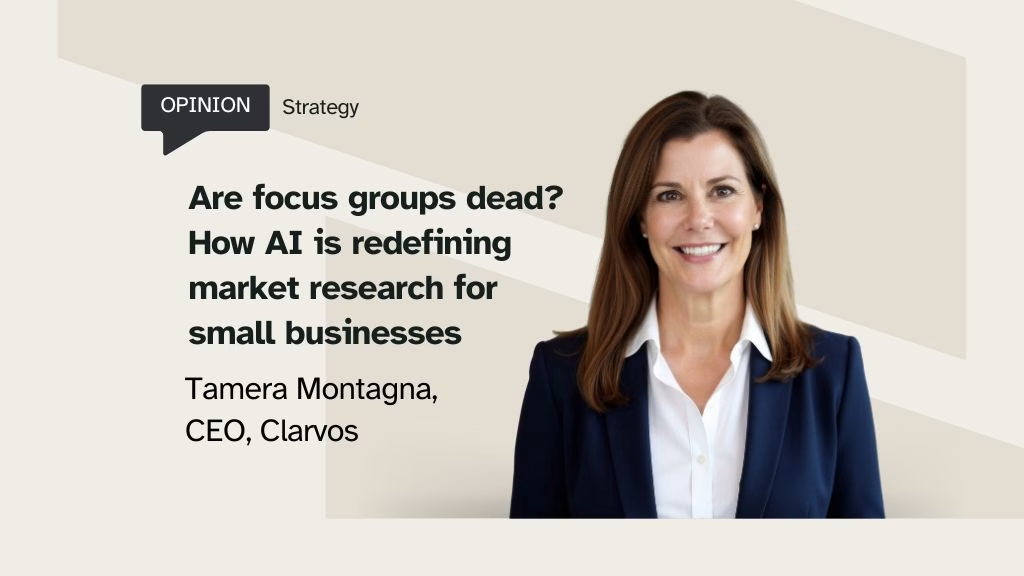
By Tamera Montagna, CEO of Clarvos
For decades, consumer insights have been a luxury reserved for enterprise brands. The barrier to entry for traditional, high-quality market research is often a five-figure sum for a single project. According to BlackRidge Research, in-person focus groups in 2026 cost between $15,000 and $30,000 per session. Even basic online focus groups average $5,000 to $15,000.
Faced with these escalating costs, enterprise companies have begun to adopt and operate different AI capabilities to automate expensive research and deliver more effective ad campaigns, making it harder for smaller businesses to compete. In this environment, AI is becoming a baseline requirement for survival, and those that fail to automate will be left behind in a landscape where data-driven agility is the only currency that matters.
Why traditional market research is outdated
Despite the need for agility, traditional market research has been the go-to method to create impactful ad campaigns, drive product decisions, and develop effective messaging and positioning. But for small businesses, the majority of this research is out of financial reach.
If smaller organizations manage to secure the budget to conduct a focus group, it becomes a process that drags on for weeks, leaving them with outdated insights and wasted budget. Consumers are currently navigating economic uncertainty, causing shopping habits and behaviors to evolve constantly. The EY Future Consumer Index (FCI) found that 73% of U.S. consumers have changed their buying habits over the past year amid growing economic concerns. When consumer sentiment can pivot in weeks, insights gathered last quarter are already obsolete.
Not only do traditional focus groups struggle to keep up with current consumer behaviors, but they can sometimes suffer from confirmation bias. Marketers often create an ideal customer profile and use it to recruit focus group participants. But if they miscalculated that ideal customer profile, they have inaccurate first-party data and may be missing out on additional opportunities for growth.
The problem with fragmented martech stacks
While enterprise companies have the financial stability to do this traditional research, they’re recognizing the savings that come with automating market intelligence. In doing so, they’re building massive martech stacks of multiple AI tools that are managed by dedicated data experts. Smaller companies simply can’t compete with that level of infrastructure, especially with a lean marketing team. There is often not enough bandwidth to manage ten different platforms or available resources to hire specialists that can help to navigate this complexity.
The reality is that many smaller businesses start growing their organization by wearing many different hats. Their teams are already stretched thin and can’t take on additional responsibilities. To compete in this AI-driven world, they need consumer intelligence that is already integrated into their existing workflows, providing the same level of enterprise-grade insight without enterprise-level overhead.
The competitive necessity in marketing
Ultimately, the goal isn’t more tools but better outcomes. Smaller organizations don’t need a larger martech stack to earn market share; they need targeted AI that delivers deeper consumer insights at a fraction of the cost of traditional research.
When AI is integrated directly into lean marketing workflows, small teams spend less time managing multiple fragmented tools and more time focused on growth. By replacing manual, high-cost research with seamless, automated insights, they can launch more impactful campaigns that reach their core audience with greater precision.
These opportunities make AI a competitive necessity. In fact, Business.com’s 2026 Small Business AI Lookout Report found that 57% of U.S. small businesses are investing in AI technology, up from 36% in 2023, and 30% of employees now use AI daily. But adoption alone isn’t enough. The real advantage comes from how small businesses are putting AI to work.
A targeted approach to AI-driven market research
AI can be used with a targeted approach to conduct impactful market research and enhance the performance of marketing strategies in the following ways:
- AI-Generated Consumer Profiles: Companies can achieve focus-group-level insights by using AI-generated consumer profiles that represent key segments of the population. Rather than relying on a static panel, AI continuously analyzes social behavior patterns to build representative models that detect shifts in consumer behavior in real time without collecting personal data.
- De-Risk Campaigns: Use AI to test ad creatives before ad campaigns go live. Simulating how target audiences could react to specific messaging allows businesses to reduce wasted ad spend. They’ll have the confidence that campaigns will perform well, or alternatively, they can use data to effectively tweak them before ad budgets are spent.
- Detect Blind Spots: Traditional focus groups typically feature a small, static sample group with a fixed sentiment. AI can help organizations analyze different sentiments across diverse audiences in real-time. This can aid in detecting blind spots in messaging or creatives that have often been missed with a narrow focus.
By replacing slow, expensive focus groups with targeted, AI-driven tools, smaller businesses can now make smarter, data-driven decisions that allow them to maximize ad spend and grow their business.
A leveled playing field for smaller brands
Gone are the days of being reactive and relying on guesswork. By becoming more agile, small businesses can gain a competitive advantage and respond to consumer shifts as they happen. This flexibility can help capture opportunities they would’ve otherwise missed, creating a path to sustainable growth in an affordable and effective way.
The gap between small businesses and large brands that has existed for decades is closing, and will no longer be defined by research budgets. Smaller companies can now connect with their audiences with the same precision as global enterprises. AI has rewritten the rules, creating a landscape where smaller brands can grow faster than we’ve seen before, if they are willing evolve. In this era, the competitive edge won’t belong to the biggest brand but to the fastest leaner.