New Digital Age (NDA) in association with LiveRamp is spotlighting the men and women championing a data-led revolution in the marketing industry. The ‘Meet the Revolutionaries’ interviews focus on the efforts of the industry executives helping to drive digital marketing forward into a new era of data collaboration.
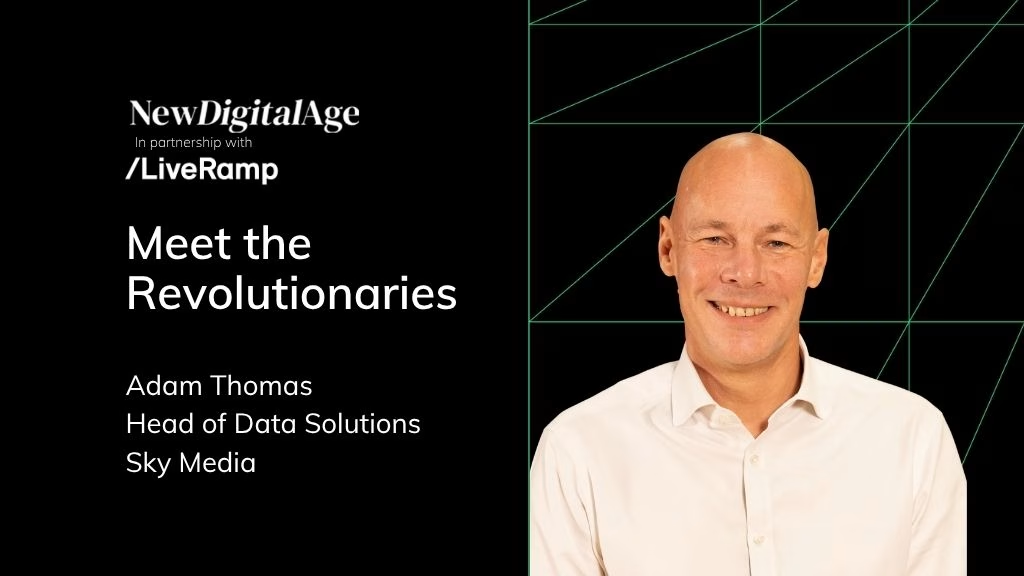
Next up is Adam Thomas, Head of Data Solutions at Sky Media.
What does your role at Sky Media actually involve in practice?
I am really lucky in that I have done various things at Sky, but right now I work across Sky Media’s data solutions, which is exactly what the job title suggests. That covers data compliance, data management, making sure the right data is in the right place at the right time, and then the more interesting bit, what we can actually do with that data to help organisations.
Very often that means our data in conjunction with someone else’s.
If you want the plain English version, my job is to simplify complex stuff. Take something complicated, make it easy to understand, and get it delivered. More recently I have also been involved in how we take things to market, what we launch and when, because there are a lot of moving parts that all have to come together at the same time.
Fundamentally, I am a doer, my job is to help people understand why we are doing something and then get it done.
You call yourself a simplifier, can you share an example of turning innovation into reality?
A great example is the work we have done with Regit and LiveRamp.
Regit built a really smart automotive business and, as a by-product, created a high quality first party data set on car ownership. At first, the conversations were about how we could help them advertise, but quite quickly the idea evolved into something bigger.
You had an organisation with rich automotive data, people who understand that sector inside out, and then Sky Media bringing the marketing muscle to get messages in front of the right households. LiveRamp sat in the middle with the identity spine to connect it all safely.
The result is a very neat, deterministic solution that lets advertisers talk to drivers at the right time, for example when a renewal is coming up. It feels innovative, but it is also beautifully simple. Innovation does not have to be complex.
Even internally, sometimes innovation is just drawing pictures. Our GDPR data sharing agreements looked scary to people, because they are legal documents. So we sketched out the legal entities, customer, advertiser, Sky, and showed what moves where.
Data protection lawyers started nodding along because they could see it. Once they understood the flow, the legal document suddenly made sense. Is that innovation? Partly, but really it is simplification.
What are the biggest challenges you see in making innovation happen?
People, in all senses, are the biggest challenge and also the biggest opportunity. People carry the weight of past experience. Finance teams remember projects that overpromised and under delivered.
Teams remember change that was sold as exciting and turned out to be painful. That makes people wary, quite rightly.
The other big challenge is effort. Change requires real work. It is easy to have a great idea on Monday morning, but if by nine o clock you have not started doing anything about it, it is still just an idea in your head. Once you start, you quickly see how many other people, systems and processes need to be involved.
I love the old story about the zero gravity pen. Someone spent a fortune creating a pen that works in space. The Russians took a pencil. It is a reminder to ask whether we actually need the shiny new thing, or whether it is a waste of time, effort and money. For me, the heart of the challenge is getting people to understand the value of what you are doing and who it is really for.
What practical tips would you give someone trying to get an innovation project off the ground?
The first thing on my list is always that hope is not a strategy. If someone says they are hoping something will work, I remind them that hope is not a plan. You need a clear strategy and concrete steps.
Second, make finance your allies very early. I now sit in the finance and strategy function, and I would always advise people to bring finance in at the start. They help you be rigorous and credible. They also help you get the right budget, which is much better than constantly going back asking for a bit more money.
Third, take feedback and develop a thick skin. Most people are trying to help, not burst your bubble. Work out where their feedback fits. Then know what you do not know, and find people who do know those things. A lot of my job is making sure the team is clear on what we are trying to do, that they have what they need, and then keeping distractions away while they deliver.
Finally, surround yourself with smart, nice people, and where you can, surround yourself with youth. Younger colleagues see the world through different eyes and do not carry the same bias of experience that says something will never work. In a world where tech changes weekly, that perspective is incredibly valuable.
From your perspective, what are the most important digital trends shaping your world right now?
I always start by saying I am not a digital marketing expert, and I am not an expert in most things, but clearly AI is the big driver. Those two letters have been the most overused on the keyboard for the last year, but behind the hype, AI changes what is possible.
For me, the key is that AI requires data, and not just any data, but quality data. That puts attention back on whether organisations have the right first party data in the right shape, and whether they understand what they do not have and who to partner with. That is where identity partners like LiveRamp are so useful, because it is not just about matching data, it is about matching the right person or household.
Alongside that, ethics, compliance and privacy become central. As consumers become more aware of what is happening with their data, organisations have to be comfortable explaining what they do with data in very simple terms. I often ask, would you be happy explaining this in the pub or in a taxi.
If the answer is yes, you are probably in a good place. If not, you may need to rethink.
Do you think data collaboration will become mainstream in marketing?
There is definitely a spectrum. Some organisations are extremely cautious, very focused on risk, and others are more relaxed, or at least clearer on the balance of risk and reward. The key is understanding that risk and how to mitigate it.
When I first joined Sky, the idea that our data might go beyond our walls would have been completely alien. Over time, with the right technology and controls, we have found ways to collaborate safely.
A good example is putting viewing data into TechEdge so agencies can use a familiar tool rather than learning a new one, while still keeping identity protected.
Whenever I talk to partners about collaboration, I start by saying I want the least amount of your data possible for the shortest period of time.
For as long as it is on our systems, I am responsible for it. If both sides share the same slightly paranoid mindset about protecting customers, and if you are absolutely clear on why you are collaborating, when, and what success looks like, you can get amazing results with less data, not more.
Finally, what is your favourite innovation, big or small?
This is a difficult one, but two came to mind.
The first is a simple, brilliant use of 3D printing, a filter that you can print to fit on different water bottles to create clean drinking water. It costs only a few dollars to produce and can generate several litres of safe water a day. In parts of the world that still lack access to clean water, that is an incredible use of technology.
The second is something closer to home, a Veo camera I use when I coach football. It sits on a tall pole, records the match, and then AI tags everything, kick off, corners, goals, the lot. You can jump straight to key moments, and the camera follows the ball. A level of analysis that was once the preserve of professional clubs is now available to grassroots teams. Being able to show young players exactly what happened, whether to celebrate a goal or learn from a mistake, is powerful.
To me, those two examples capture what innovation should be about, using technology to solve real problems and make things better for real people, whether that is access to clean water or helping kids understand the beautiful game.