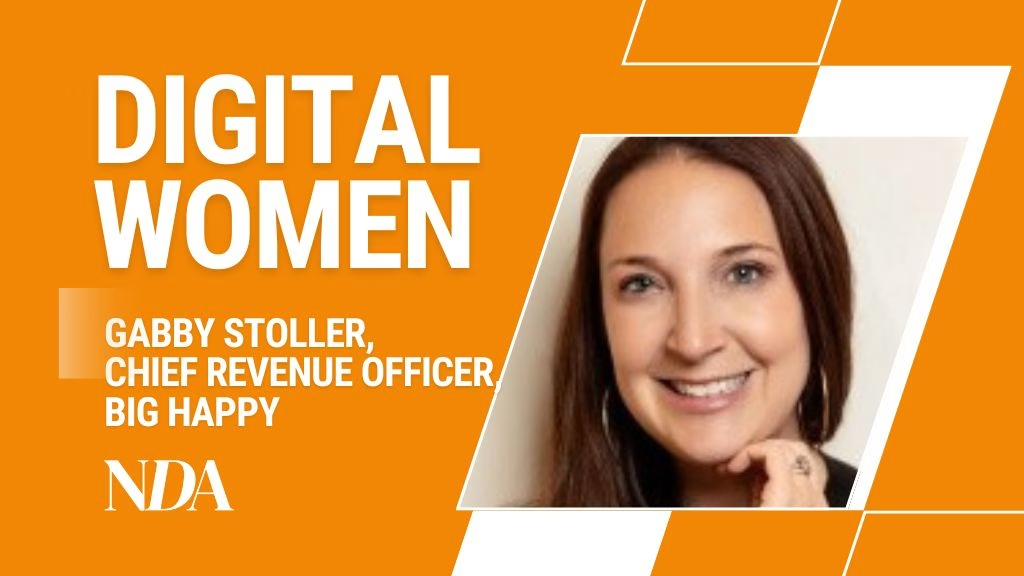
Gabby Stoller is Chief Revenue Officer at Big Happy, a mobile and OOH focused ad tech company.
A seasoned Sales and Media executive with a distinguished career spanning across startups and major corporations, Stolller most recently she served as the Head of Chilled, Alcohol and Convenience at Walmart Connect where she led a sales team that shaped the retailer’s omni-channel strategy across key customer categories. During her tenure, she collaborated with top tier suppliers such as Coca-Cola, PepsiCo, Danone, Chobani, Kraft, ABI, Diageo, Mars, Nestle, and Mondelez.
Prior to Walmart, she gained a wealth of experience across various media organizations including The New York Times, Verve, Placed, and Vistar. Stoller loves building strategy, scaling businesses, leading high impact teams, and mentoring.
What are the biggest opportunities for women in your sector of the digital industry right now?
One of the biggest opportunities for women in the digital industry right now is the ability to shape the next generation of leaders. That comes through being visible, being a strong example, and actively mentoring and bringing other women along on the journey.
I strongly believe that great ideas can come from anywhere in an organization, regardless of tenure. Creating an environment where every voice is heard—and then recognizing where those ideas come from—is critical. It’s not just about acknowledging them, but pulling those individuals into the workstream, giving them exposure, and showing them how decisions are made and how to navigate the business.
That kind of access and inclusion is what accelerates growth.
On a personal level, as a mom of a daughter, that’s especially meaningful to me. I’ve been fortunate to have strong female leaders to look up to since my intern days, and I’m hopeful the next generation will have even more of that—leaders who not only succeed, but bring others with them.
What are some of the challenges that you still see for women in the industry? Any advice as to how to overcome those challenges?
One of the biggest ongoing challenges for women in Ad Tech and Media is that we can still be evaluated and perceived differently—whether it’s our decisiveness, communication style, or leadership presence.
At the same time, this industry moves incredibly fast—revenue pressure, shifting platforms, evolving client expectations—and there can be an added pressure to consistently overperform to maintain credibility.
What’s helped me navigate that is staying grounded in fundamentals. If you deeply understand your product, your numbers, your customer, and your team, you can move through almost any level of complexity with confidence. Preparation creates clarity—and clarity builds trust.
I also focus on simplifying high-pressure moments. Teams don’t need panic—they need direction. Slowing things down, identifying what actually moves the needle, and aligning everyone around that is critical.
And finally, confidence isn’t about having every answer. It’s about trusting that you can figure it out—and trusting your team to do the same. That mindset doesn’t just help you navigate challenges—it helps you lead through them.
What support structures and organizations are most important and effective to you as a woman in the digital industry?
For me, the most important support structures are the ones that understand success isn’t one-dimensional. You can be a high-performing leader and have a full life outside of work—and the best companies make space for both.
That means supporting working moms, prioritizing women’s health, and most importantly, building a culture of trust and flexibility. Because the reality is—life doesn’t pause. And when organizations acknowledge that instead of fighting it, they end up with stronger, more resilient leaders.
On a personal level, this is something I don’t just talk about—I’ve lived it. As a breast cancer survivor and a mom of two, I’ve still been able to show up, lead, and have a seat in the boardroom.
For me, uplifting women isn’t a separate initiative—it’s embedded in how I hire, how I promote, how I lead, and how I show up every day.
And that’s the point—it can all be achieved. But it requires trust. When companies trust women to deliver, to lead, and to manage both life and career, you don’t get less—you get more.
What is the biggest misconception (a) about women in the digital industry, and (b) by women in the digital industry?
I think one of the biggest misconceptions about women in the digital industry is that leadership has to look a certain way—more aggressive or traditionally dominant—to be effective. In reality, some of the strongest leaders drive impact through clarity, consistency, and the ability to bring people along.
On the flip side, one of the biggest misconceptions by women in the industry is the belief that you need to have everything perfectly figured out before stepping into bigger roles or speaking up and that there’s a limited number of seats at the table. That can create an unnecessary sense of competition.
The reality is, leadership doesn’t require pretending everything is seamless. In fact, vulnerability builds stronger, more loyal teams. I try to model that strength and softness can coexist. You can run revenue, lead high-performing teams, sit in boardrooms, and still be human.
And just as important, women supporting women, putting crowns on each other instead of feeling threatened. When we shift from competition to collaboration, we don’t just create more opportunities individually; we raise the bar for everyone.
What one piece of advice would you offer a woman starting in the digital industry today?
Supporting and uplifting other women in the workplace is deeply personal to me, especially in ad tech and revenue leadership.
My advice is to dream big, stay intellectually curious, and always be prepared. This industry moves fast, and the more you understand — your product, your numbers, your customer — the more confident you’ll become navigating it.
Find what makes you tick, and take advantage of every opportunity that comes your way. It’s okay to say no, but it’s just as important to raise your hand, step in, and learn. Especially from other female leaders who have already navigated this path.
Confidence is key. Not because you have all the answers, but because you trust that you can figure them out.
And remember, you don’t need to be the loudest voice in the room to be the most impactful. Be thoughtful, be clear, and when you speak, make it count.