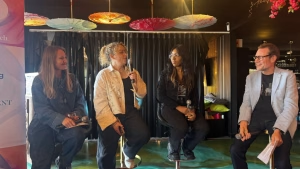
At Miami’s POSSIBLE conference, for which NDA is a media partner, Advance Women held a panel titled Unfiltered: The Career Conversations Women Usually Whisper, which cut through the usual polish of leadership discussion to focus on what is often left unsaid in media and adtech careers: the personal trade-offs, the internal pressures, and the structural changes still needed to support women at senior level.
Moderated by Montana Accavallo, SVP, Programmatic and Client Strategy, Screenverse, the session brought together senior leaders from across the industry to explore what it really takes to progress, and what needs to change in how leadership itself is defined.
A central theme was the idea that leadership is not just about access, but redesign.
Amanda Forrester, SVP Marketing at OpenX, challenged the notion that progression ends at promotion. For her, the real shift is what happens once you are in the role. “It’s not just about getting the seat, it’s about changing how those seats operate inside organisations and how we lead,” she said, pointing to the need for more fundamental change in how leadership functions rather than simply who occupies it.
That idea of redefining roles extended into a broader discussion about identity at work. Stacie Medley, Sr. Director, Integrated Media & Agency Relations, Kimberly-Clark pushed back on the long-held idea that professionals should compartmentalise their lives.
“People at work needed to know I was a mom, that I was a wife, and that mattered,” she said, arguing that bringing more of her whole self into the workplace has strengthened rather than diluted her leadership.
Perfectionism emerged as another quiet but persistent barrier. Katherine Yager, VP Strategic Sales at LG Ad Solutions, described much of her early career as being driven by a need to appear constantly right. Over time, she said, that mindset became limiting.
A shift came when she reframed her approach away from correctness and towards effectiveness. “I stopped trying to be right and started focusing on being effective,” she said, adding that letting go of perfection created space for more confident decision making.
Sarah Martinez, CCO at Tracer, reinforced this, highlighting how uncomfortable growth can be, particularly for women navigating leadership environments where mistakes are less readily forgiven. “You have to give yourself permission to fail,” she said, saying that progression often depends on embracing risk rather than avoiding it.
Risk-taking, in fact, was a defining thread throughout the discussion. Forrester spoke about stepping into a major leadership role at OpenX while balancing new motherhood, despite external pressure to wait.
“I bet on myself that I could do it,” she said. The decision ultimately coincided with a significant period of transformation for the business, including a rebrand and her move into executive leadership.
Yager echoed this idea of stepping forward before feeling fully prepared. “You’re rarely fully ready. Sometimes you have to raise your hand before you feel it,” she said, framing readiness less as a prerequisite and more as something that follows action.
As the conversation turned to leadership culture, the focus shifted to curiosity and communication. Martinez described moving from execution to leadership as being driven by a willingness to ask questions and stay open, regardless of seniority. That openness was paired with a call for greater directness in feedback cultures.
Yager referenced Brené Brown’s widely cited principle that clarity is kindness, arguing that honesty is often the most effective leadership tool. “Once you give people clear, honest feedback, they move faster and make better decisions,” she said, making the case that transparency accelerates performance rather than undermining it.
Closing the session, panellists reflected on what the next generation of women should protect most. The answers varied, from health and boldness to kindness and voice, but converged on a shared idea of agency and self-trust.
“You don’t realise the influence you have until you use it,” Medley said, a reminder that leadership is not only about position, but about the willingness to speak and act within it.
Taken together, the discussion reflected a broader shift in tone across the industry, away from curated narratives of success and towards a more honest account of what leadership actually requires, and what it costs.