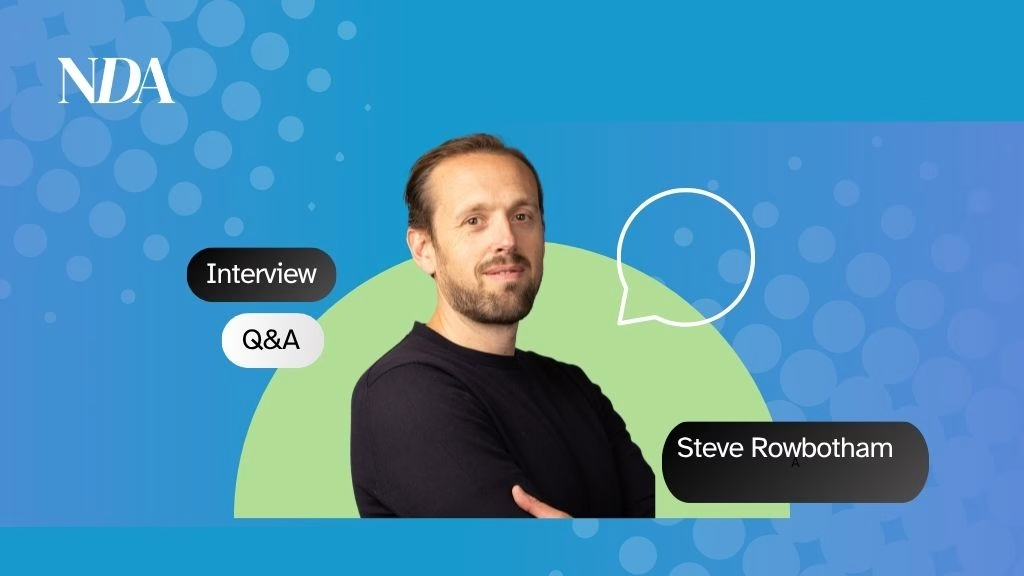
Steve Rowbotham is CEO of Navigator, a travel audience platform that is repositioning itself as a global commerce media network for the travel sector. A former Team GB medallist turned entrepreneur, Rowbotham is leading the company’s expansion across the UK, North America and Singapore.
In conversation with New Digital Age, he discusses Navigator’s evolution, the growing value of travel data, the challenges of proving incrementality and why he believes travel audiences can become a major force in commerce media.
How would you describe Navigator today?
The business was born in one form and is now transitioning into something slightly different. Originally, we contracted with some of the world’s biggest airlines and travel booking platforms, giving us access to very rich first-party data, things like origin, destination, cabin class and booking behaviour.
On the demand side, we were selling those audiences to brands and agencies with a very traditional “right ad, right person, right time” proposition. What we effectively became was a performance agency specialising in travel.
Brands would come to us and say, “If your audiences are so strong, prove it.” They would give us budgets tied directly to return on ad spend and performance outcomes. If we delivered, they stayed with us. If we did not, they moved on.
The challenge with that model is scale. Running performance campaigns with relatively small budgets while maintaining sizeable teams is difficult. About six months ago we started looking much more closely at commerce media and retail media, and that became very exciting for us.
What sparked that shift towards commerce media?
We started looking at businesses like Uber, Expedia and Tesco Media. Uber publicly announced it generated around $2bn in advertising revenue and is now targeting $4bn. They cannot simply double their audience or double prices, so they are asking themselves how to create more value from their signals and data.
That is exactly where we see the opportunity. We fundamentally believe travel audiences are highly valuable. Travellers are aspirational consumers, often with higher spending patterns, and they are operating in a very different emotional state when planning or booking trips.
The challenge in commerce media today is fragmentation. If you are an FMCG brand buying retail media, you may need to buy across ten different supermarket networks. Travel is even more fragmented. Booking.com, for example, still has less than 10% market share globally.
To truly build a commerce media network in travel, you need aggregation and consolidation. That is where Navigator comes in. We are moving from being a tactical travel performance agency into a global commerce media network built around travel audiences.
How important is AI to the business?
AI is a huge enabler for us. Twelve months ago, to process and activate against billions of travel data points would have required enormous investment.
We are very clear that we are not building foundational AI technology ourselves. What we are doing is integrating AI-native tools and applications into our ecosystem. We are building the machine learning, modelling and predictive capabilities around the audiences.
Today we have access to around two billion data points. AI allows us to ingest, analyse and activate against those signals in a way that simply was not commercially viable before.
What does the business look like operationally today?
We are headquartered in the UK, but we also have entities in North America and Singapore. On the supply side, we work with airlines, hotel groups, online travel agencies and metasearch businesses globally.
On the demand side, around 60% of our business now comes through agencies and 40% direct from brands. The agency side is growing quickly as we become more established in market.
L’Oréal is one of our biggest clients, for example, and that business is now flowing through their agency. We are also working with groups like Wavemaker and Dentsu, typically at brand level rather than through central trading agreements.
What are the biggest challenges in getting agencies and brands to buy into the proposition?
The biggest challenge is helping people make the leap from “traveller” to “consumer”.
The easy assumption is that travel audiences are only relevant for luggage brands, travel insurance or holiday products. We are arguing something much broader. These audiences are also highly relevant for automotive, finance, technology and luxury brands because of the behavioural signals attached to them.
Take luxury audiences as an example. We have hundreds of millions of people booking first-class flights and five-star hotels. Those are incredibly rich signals for premium brands.
The second challenge is proving incrementality. No one gets fired for buying Google or Meta. But when you bring a new proposition to market, brands want proof of impact.
We are taking an agnostic approach to measurement. If an agency wants to use a particular clean room or measurement partner, we integrate with it. Over time, we may build more proprietary solutions, but right now interoperability is critical.
You also mentioned duty-free retail as an opportunity. How does that work?
We believe we effectively “own” the traveller earlier in the journey than airports or hotels do.
A traveller might book a summer holiday six months in advance through one of our partner platforms. That means we know they are travelling through Heathrow Terminal 5 at a specific time weeks before they arrive at the airport.
Historically, duty-free brands have mainly activated media inside airports because that is where the shopper physically appears. We can now reach those consumers in the crucial two-to-three-week window before they travel.
The challenge has been attribution because the final purchase happens offline in-store. What we are now doing is working with duty-free retailers on pilots that connect their point-of-sale data with our audience and campaign data.
That creates a true closed-loop measurement model. It allows us to tell brands exactly what impact their campaigns had, which is something the sector has struggled to achieve globally.
What comes next for Navigator?
Right now, awareness is a major focus. Unlike Uber or Trainline, we are not a consumer-facing brand, so we have to work harder to explain what we do.
We are currently rebranding the business and investing heavily in PR, communications and agency relationships. The goal is to become recognised as the commerce media network for travel.
We genuinely believe travel audiences are going to become more valuable over time because high-quality signals are becoming rarer. If we can continue proving performance and scale, we think there is a very significant opportunity ahead.