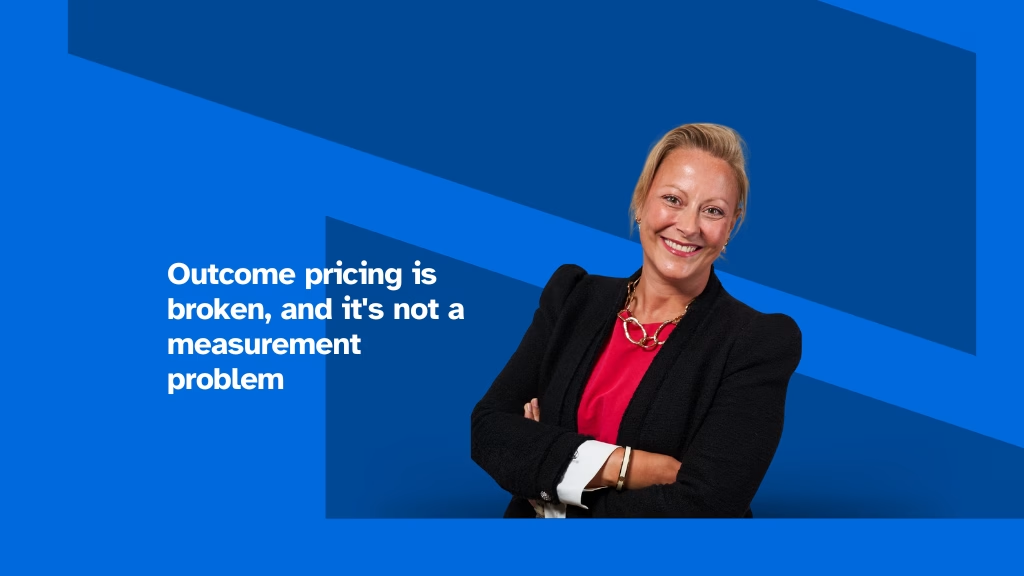
By Virginie Goupilleau, Founder of BerylliumIV, a boutique marketing transformation and AI integration consultancy. She has spent twenty years inside major advertising holding companies, leading large-scale operating model redesigns, business and technology integration programmes, and commercial growth strategies
The whole industry has agreed that outcomes are the future. Every conference panel, every new business pitch, every agency positioning deck now leads with the same promise: pay us for what actually happens, and not for the media we place. It sounds like progress. It sounds like the industry finally growing up and accepting the kind of accountability that other parts of a business have lived with for years.
Then watch what happens in the room.
The outcome quietly becomes a media metric. Cost per acquisition. Return on ad spend. Viewability. Brand favourability or recall. All useful numbers, all things an agency can genuinely influence, and all of them proxies. A proxy is a correlated data point you rely on when the thing itself cannot be measured. Most outcome conversations stall right there, and they stall for reasons that have very little to do with tooling. Nobody in the room is willing, or able, to talk about the real thing the proxy is standing in for.
The arithmetic nobody wants to say out loud
Ten things move a commercial outcome. An agency has meaningful control over three of them, and most of the rest is never shared with them.
On the agency side sit media buying, targeting and bidding; creative and message; channel mix and phasing. That is the lane, and it is a real one. It is also, structurally, a part of the story rather than the whole of it.
Outside that lane sits everything else that determines whether a sale happens. Pricing and promotional depth. Product, range and packaging. Distribution and availability. The sales team and conversion rates. Service, retention and repeat purchase. None of it sits with the agency, and almost none of it reaches the agency either. The conversation was never designed to include it.
Beyond that sits a layer nobody controls at all: competitor moves, category dynamics, the wider economic and geopolitical weather. An agency can be optimising flawlessly and still lose to a rival’s price cut it never saw coming, or to a supply chain problem three departments away from marketing.
So when a brand asks an agency to be accountable for the outcome, what is actually being asked is this. Be accountable for the thing you have partial visibility into and roughly a third of genuine control over. Accountability implies control. What is on offer here is exposure.
The stakeholder problem is the real blocker
Here is the part that gets missed in most of these conversations, because it is less comfortable than talking about measurement frameworks. Agencies are usually talking to someone who cannot open the doors that outcome pricing actually requires.
If your main day-to-day contact manages the media budget, they cannot authorise sharing margin data. They cannot convene the sales director for a joint working session. They almost certainly cannot tell you, in a room with other stakeholders present, that the product itself is the reason conversion is falling. That information was never theirs to give, and raising it was never their call to make.
Outcome pricing is structurally impossible below a certain seniority of relationship. That is the real reason it stalls in most organisations, and it gets blamed on measurement instead, because measurement is the safer and more technical thing to have a debate about. “We need better attribution models” is a much easier sentence to say in a meeting than “the person I am meant to be having this conversation with does not have the authority to have it”.
What has to change, on both sides
Brands have to share more than media data, and they have to accept the harder conversations that follow from doing so. If the number moves because pricing moved, or because a product line went out of stock, that has to be sayable in the room. Smoothing it over keeps the media story clean and implicates nobody. It also guarantees that next quarter will look exactly the same.
Agencies, in turn, have to build the structure that can actually receive and act on that intelligence in real time, rather than asking for it and then defaulting back to the tools they already have. You cannot ask for a seat at the table where pricing, product and sales data get discussed, and then turn up to that table with a monthly deck talking only about media performance and brand uplift metrics. The ask for deeper access has to arrive with a genuinely different way of working behind it. Real-time intelligence and orchestration at scale what that seat now requires.
What good looks like, and why it is rare
I had my fair share of outcome-based campaigns during my time at WPP Media. Optimising against stock levels in individual stores, app download numbers, sales performance in specific postcode areas, new membership sign-ups in regions with low existing penetration. None of it was easy. It took extensive planning, real creativity, and clients brave enough to arrive with robust data and a genuine willingness to be transparent about what that data showed. It also took a team that functioned as one unit rather than a set of departments passing information back and forth through intermediaries.
Every one of those campaigns produced strong results, award-winning ones. I am proud of that work, and of the colleagues who made it possible. Here is the honest caveat. None of them were built on the deeper business metrics that a CEO or CFO would actually act on. Store-level stock and postcode-level sales are real outcomes, and they are a significant step up from viewability or recall. They are a long way short of margin, lifetime value or category share. We got closer to the thing itself. We can all do better.
What you would actually have to build
Diagnosis is the easy half of this. If you want to price against outcomes rather than talk about them at conferences, here is the order I would build it in.
An accountable sponsor on both sides. Somebody on the brand side with the authority to release the data and convene the functions that move the number, and somebody on the agency side who can commit resource and carry commercial risk. If you cannot name both, the deal is an ambition with a contract attached.
A definition both sides sign. What counts as the outcome, over what window, using whose data, something that can be modelled and risk managed in advance. Leave this vague and everything downstream becomes arguable.
A baseline agreed before the work starts. Reconstructing a baseline once the results have arrived turns a measurement into a negotiation, and usually sours relationships very quickly.
A data contract. Who owns the source, who needs to maintain it, how it is safely and compliantly accessed, and what happens when the client switches vendor halfway through the term.
An attribution method chosen in advance, with its limitations stated. Every method has its own biases. Recognising those is paramount ahead of any result call. It is also the basis for improvement.
The payoff structure. How much fee sits at risk, the floor below which nothing is earned, the ceiling above which nothing further accrues, and whether a miss reduces the base fee or only forfeits the bonus. This is the step that turns everything above it into pricing rather than reporting, and it is where the industry needs to be honest about what an agency can actually survive. Downside sized to a business outcome can quickly exceed the whole fee on an account, let alone the profit inside it. Decide the shape before the first measurement period, model it against a bad quarter neither side caused, and hold that number up against the entire fee. If the downside is bigger than the fee, the structure is a loss with a bonus attached. Decide too what happens if the contract ends mid-period. Somebody is either paid or not paid for a measurement window that never closed.
A variance clause. When the number moves for a reason neither side caused, a rule-based exception should carve those effects out of the commercial calculation before anyone is paid or penalised. The brand still lives with the business result, and that is as it should be. Nobody should be paid or docked for weather neither side made. The same test tells you when to avoid the instrument altogether. Below a certain spend or conversion volume the noise swamps the signal, this clause fires every quarter, and you have built an argument generator rather than a contract. Agree a materiality threshold early, and be willing to conclude that an outcome model is the wrong fit for that particular account.
A review cadence with the right to dispute. Quarterly, with named people on both sides, and a route to reopen the definition when the business changes underneath it. Say who can call for a re-basing, on what evidence, and what happens to payments already in flight while the question sits open.
Five of those six are contractual rather than technical, and that is the tell. The measurement industry has spent a decade building better attribution while the commercial conversation has barely moved. The missing pieces were never sitting in the measurement layer. They were sitting in the contract, and in the seniority of the person with the authority to sign it.
The conversation I would like to see more of
I would like more of those conversations to happen, and I would like the thinking and the sharing that make them possible to happen further up the organisational chain than they currently do. The people holding these conversations today are perfectly capable. They have been handed a task that sits outside their authority to complete.
Accountability for an outcome has to run both ways. The brand has to be accountable for sharing the conditions that make the outcome possible or impossible. The agency has to be accountable for building the capability to act on what it is given. Anything else is simply a better-dressed rate card.
So here is the actual question, and it is worth asking plainly rather than rhetorically. Who is genuinely ready to have that conversation? On either side of the table?