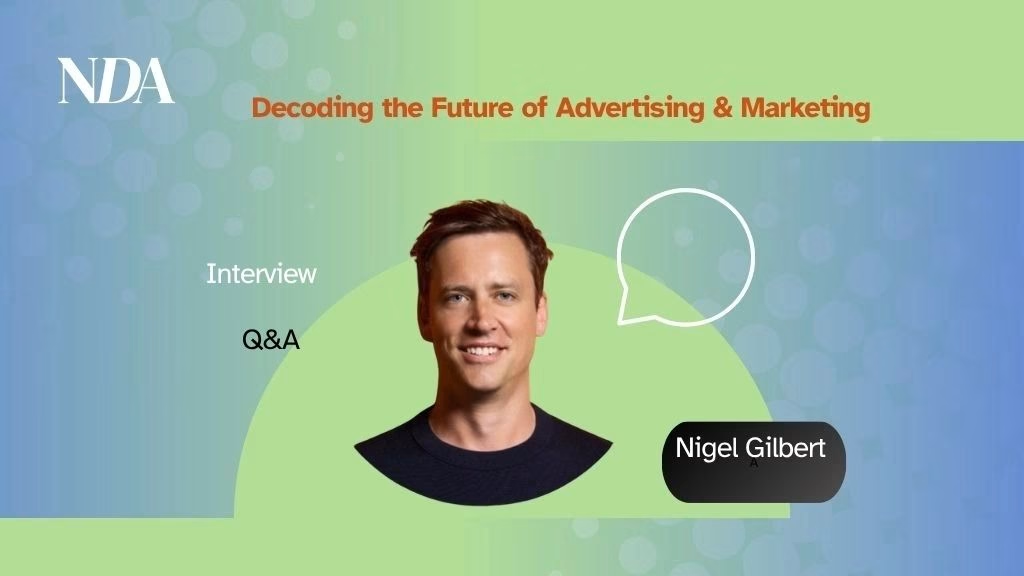
Nigel Gilbert has spent more than two decades at the forefront of digital advertising. In the second of NDA’s interview series, Decoding the Future of Advertising and Marketing, he explains that when content and media work as one system, the upside is not marginal.
Campaigns respond faster, budget stops leaking into channels that were never really aligned to the message, and brands get a clear view on what’s working, rather than three partial reports stitched together afterwards..
Most organisations understand the value of connecting content and media. Very few are structured to do it..
This of course is not a new problem. the proximity of content and media has been a recognised problem for years. The industry has been talking about the gap between content and media, AdTech and Martech, as well as owned and paid for years.
The technology has rarely been the real blocker. The real issue is how, why and where decisions actually get made, and by whom.
At its core, every media strategy is answering five questions:
- Who are we trying to influence
- What do we want to say?
- Where should we say it?
- What format will work best?
- How much are we prepared to spend?
Simple enough on paper. Except those five decisions are almost never made in one place.
They’re spread across multiple partners, functions, tech providers and different sources of truth. Everyone works to a different timeline. Everyone has a different reporting dashboard. Sometimes, everyone has been given a slightly different brief. So every partner can claim success against their own metrics. Or avoid accountability when things do not work.
Now imagine the alternative: one loop, one workflow, one shared source of truth. An AI-powered orchestration layer sitting at the centre, continuously learning from the customer, content, media and contextual signals. It doesn’t just optimize the media buy, it optimizes the full system.
That’s closer than it sounds.
AI is already accelerating this, in three important places.
First, the briefing stage. A single brief can be generated, interpreted and adapted consistently across every partner instead of being rewritten and reinterpreted at every handoff
Second, segmentation. Audiences can be built and refreshed dynamically rather than frozen at the start of a campaign
Third, forecasting. Planning becomes less of a static, pre-flight exercise and more of a live process that adapts with new performance data.
Put those three together and you start to see the shape of the single loop.
There are already real signals of movement. Adobe and The Trade Desk announced a partnership in June 2026 connecting Adobe’s Real-Time CDP with The Trade Desk’s DSP. This allows paid media signals to enrich first-party customer profiles which allowsfirst-party data to activate paid campaigns ([Adobe, 2026](https://business.adobe.com/blog/rtcdp-trade-desk-first-party-intelligence)).
It’s a genuinely useful step as it reduces friction at the activation layer. The tougher friction sits further upstream: where strategy, briefing and budget are decided in the first place. WPP made a similar point publicly earlier this year: connecting the pipes doesn’t fix the plan.
Most clients are still passing a baton through clunky approval chains between partners who were never told they’re running the same race. One partner finishes their leg, hands off, and the next partner picks it up cold. Different brief. Different timeline. Different success definitions.
Brands are gathering an immense amount of signals from customers, content, media and culture, but those signals are rarely acted on fast enough to impact the work. That is where orchestration matters.
It is not an argument for bringing everything in-house or reducing the role of agencies and specialist partners. The expertise those partners bring is valuable and difficult to replicate. The friction usually sits elsewhere: repeated briefing, duplicated reporting, disconnected systems and approvals stalled by someone several steps removed from the decision.
The more a client can own the orchestration layer, the more agility they get back. Not because they need fewer partners, but because everyone is working from the same source of truth rather than creating their own version of it.
Insight should inform the brief. The brief should move directly into activation. Performance should shape the next decision. That is a very different operating model from passing work between teams like a relay baton.
And beneath all of this sits the bigger issue: a brand’s own cloud and data infrastructure. As AI-powered capability matures, the brands that win will be the ones able to capture useful signals, turn them into decisions and coordinate action across their ecosystem quickly.
That infrastructure will become a competitive advantage in its own right.