Fairing, a zero-party data measurement and attribution platform, recently announced the launch of Advanced Attribution, a new product that identifies the specific podcasts, TV placements, creators, and AI platforms driving a brand’s sales.
Advanced Attribution builds on the “How did you hear about us?” (HDYHAU) post-purchase survey that Fairing helped popularize. When a customer selects a channel, the product asks a dynamic follow-up question tailored to that answer, turning a channel-level response into a named source. For example, a customer who selects YouTube can identify the creator who influenced them, while someone selecting a Podcast can identify the show. Those citing ChatGPT or another AI assistant can share what they asked.
In early rollouts, Advanced Attribution uncovered up to 50% more usable attribution signal from the same order volume, with no change to survey placement or response rates.
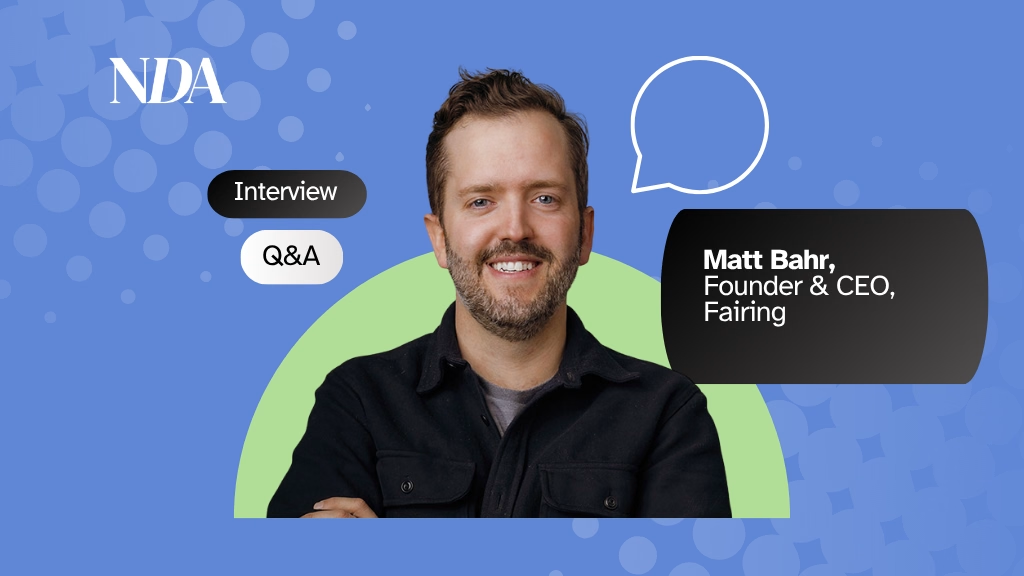
New Digital Age spoke with Matt Bahr, co-founder and CEO of Fairing, to find out more…
Why is attribution still such a problem for brands? Generally speaking, is the problem getting better or worse?
It’s a massive problem because the path to purchase is nowhere near linear anymore.
Ten years ago, brands could look at every time somebody viewed a digital ad and correlate that to their media spend to understand where to allocate budget and improve the ROI of their marketing spend.
Fast-forward to today, and more and more brands are working with creators who are posting across a tonne of channels. We also now have AI search. Even the data that OpenAI has released shows that a lot of users aren’t clicking and purchasing immediately after querying through search.
So, now there are all these massive gaps in our knowledge of the customer journey. Where did the consumer discover my brand? Was it the Facebook ad? Was it AI search? Was it an influencer they saw on Instagram?
The media landscape is now so diverse that, for a marketer, it’s become even more difficult to understand the ROI of their media investments..
Where do existing methods of attribution fall short? Are particular channels harder to measure than others?
If you’re using a multi-touch attribution model, there might not be any clicks at the top of the funnel to allow you to measure that. You’re trying to measure something with no signal.
With last-click attribution, obviously you’re going to favour lower-funnel mediums. Some of our customers on these hard-to-measure channels use promo codes for attribution, but those are now constantly getting leaked and scraped by agents.
Then, with other methodologies, whether it’s incrementality testing or a media mix model, those things don’t produce results overnight. Brands looking for a short-term signal don’t have the information they need.
For things like incrementality testing, you can’t run an incrementality test on an influencer programme. You can’t have a holdout for an influencer and say, “Post on Instagram, but don’t show that to people in New York and California.” It’s just not possible.
I feel like some people were a bit dogmatic about this. Now everyone’s coming back to a more triangulated approach: not every channel has the same set of inputs that allow us to measure the outcome of that investment. We’re now at this multi-pronged approach.
How does Advanced Attribution help brand marketers?
At Fairing, we help brands solve attribution through attribution surveys – those “How did you hear about us?” or “What led you to us?” surveys. We power almost a million of those a day to help brands understand the top of the funnel.
What we want to do is match what’s in the consumer’s brain. For example, when we consider ‘audio,’ most podcasts are now simulcast to YouTube. To the marketer, it’s a podcast; to the consumer, they might consider it to be YouTube because that’s where they consume that piece of content.
With Advanced Attribution, a consumer might select ‘YouTube’ and then enter a particular podcast. Another might select ‘Podcast’ and type the same thing. Another user might select Instagram and so on. We’ve created this flexible model that allows multiple different entry points for the consumer and resolves the actual placement that the marketer spent money on.
The consumer is the only entity that has the entire path to purchase. Clicks don’t have it. A media mix model is a more macro, top-down approach. The end consumer has all the touchpoints, so how do we extract that in the most meaningful way possible? That’s our long-term goal.
How can brands interested in testing your beta version of Advanced Attribution get involved?
We’re actively onboarding our customers right now. We work with about 3,000 brands today, and we’re in beta for another few weeks before doing another push, probably in mid-October. We’re currently onboarding about five customers a day. The majority of the demos we’re doing today are inbound from customers interested in the extended functionality we’ve launched.
It’s mainly customers spending a lot on audio or creators. There’s still a gap there. Fairing is helping solve it, but we needed to go to the next level. We’re doing onboarding calls with everyone, and eventually it will graduate to fully self-serve. You’ll just click a button and it will set itself up.
Are there any other trends in the marketplace worth paying attention to? What sort of support are your customers most commonly looking for?
Obviously, we can’t have any conversation without mentioning AI right now. That’s the one we’re going to be leaning into, especially in Q4. We saw a huge spike last November during the holiday period in brands and consumers mentioning AI, and we expect to see that again.
But if we think about where media is consumed, podcasting is a really interesting example. I think around 5% of media consumed in the US is podcasts, but only 1% of advertising is spent there. It’s a very effective form of advertising. It’s typically host-read or post-read content, with the trust and everything that goes along with that.
But the marketer can’t put money in and get money out right away in the way they can with more self-serve platforms. So, for us, it’s about how we create that most useful data for brands to measure these channels using the proprietary data they have from their consumers.
The things we’re most excited about are creators and AI, given that those are two areas on the highest growth trajectory right now. AI search is a good example. A lot of brands today aren’t monitoring or investing in it. Maybe 10% to 15% of our brands are becoming obsessed with the question of what they should do.
We spoke to a brand recently that’s focused on PR with major publications because its thesis is that this will help advance its AI rankings. Everyone moved towards performance-based marketing over the last decade, and it seems like that’s now coming back as a methodology.
The hard part is measurement. If you’re seeing 0.5% of your traffic come from ChatGPT, and maybe even less of your conversions, how do you get buy-in from leadership to start investing in the hypothesis that you need to rank better in AI?
Fairing is a client of Bluestripe Group, the publisher of New Digital Age.