Digital advertising business Ozone has launched Arc, a new product capability that helps advertisers optimise towards the performance outcomes that matter most to their business. Ozone was founded in 2018 as a result of a joint venture between News UK, Guardian Media Group, Telegraph Media Group and Reach Plc.
Arc marks the latest evolution of Ozone’s Audience Connection Platform, which reaches almost 300 million consumers across trusted, high-attention publisher environments in the UK and US.
Built in-house, Arc builds on Ozone’s success in delivering campaigns focused
on the measures that drive impact for brands. The new capability combines Ozone’s consented and compliant data with an understanding of the content people are consuming, using these signals to predict where audiences are in their purchase journey within a specific category.
Arc’s algorithmic models then predict not only who is most likely to deliver a specified outcome, but the moments when they are most likely to do so. Campaign delivery is optimised towards these opportunities in real time, helping advertisers focus investment where it is most likely to move the needle.
The announcement is supported by new research from Ozone, conducted with OnePoll among 2,000 UK adults. One key finding is that news, magazine and lifestyle websites are the only online advertising environment where trust outweighs distrust, with a net trust score of +12. Ads in social feeds or stories score −18.
In addition, four in ten UK adults (40%) have bought something, or taken a step towards buying, after seeing an ad on an editorial site.
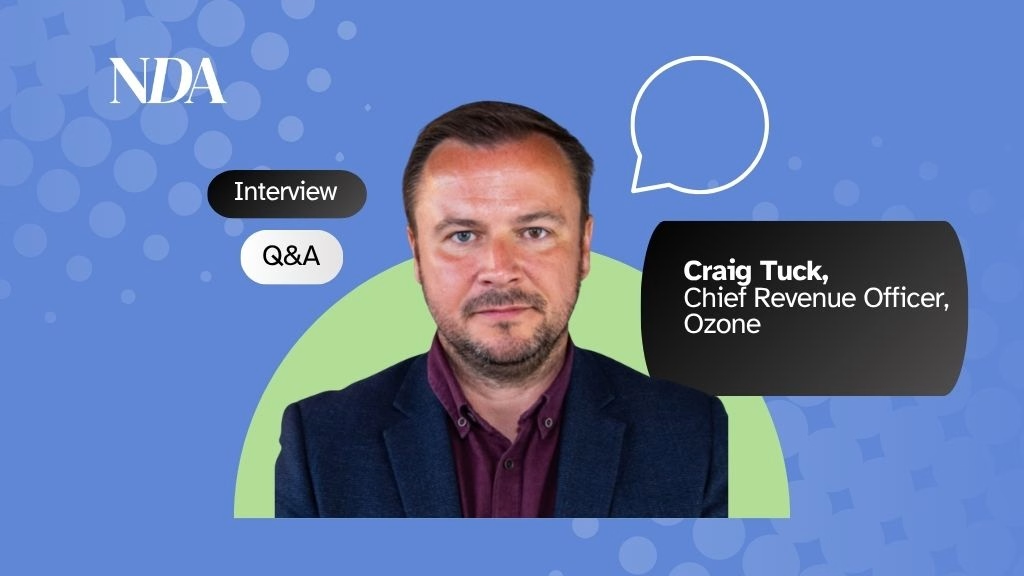
New Digital Age spoke with Craig Tuck, Chief Revenue Officer at Ozone, to learn more…
What is Arc and who is it for?
Arc is really a label that crystallises what we know to be true, which is our performance capability. Ozone is a platform we’ve built, and Arc is naming the capability we have in that platform to drive outcomes for advertisers.
It’s about moving beyond the great media performance we see – view-through rate, engagement rate, scroll rate and all of those good media performance metrics – and officially announcing that we’re very good at business impact too. That means return on investment, sales, footfall and those more meaningful measures for advertisers.
What motivated its development? Why decide to develop the solution in-house?
We always intended to develop it in-house. Over the last few years, we’ve been told anecdotally that we perform really well from a business standpoint, even though the brief itself might have been asking us to drive a strong view-through rate, a high level of attention or better brand awareness.
In the background, clients were seeing that the investment and advertising they put into Ozone’s platform was driving significant amounts of sales – whether that was on-site, in-store, footfall, test-drive requests, leads or quality landings on websites. We were always being told we did that job really well, even though it wasn’t the official brief or purpose of us being on the plan.
We thought that, combined with the well-publicised challenge publishers have in isolation to compete better with platforms that have the scale to drive those great outcomes, it was a perfect combination. We know we’re good at it, and it also allows publishers to enter the outcomes arena because it brings the scale required to drive those meaningful measures for advertisers.
How has the market reacted so far to Arc?
It’s been really good. It’s opening up new revenue for us and our publishers already.
Whether that’s from the same teams who don’t just plan and buy brand campaigns but are also planning and buying performance or outcomes campaigns, I think when you look at the industry, increasingly, whether you’re a holding company agency, an in-house client team or an independent agency, any budget being invested in digital advertising has to drive an outcome of some sort.
People are increasingly being remunerated based on those outcomes, so it was perfect timing for us, and the feedback has been great.
We’re helping brands understand what conversions happen in privacy browser environments, given our first-party data. The fact we’re not reliant on third-party IDs allows us to do that. We’ve got a lot of brands from different verticals testing the proposition, and we’ve already seen some good case studies around driving incremental conversions that probably wouldn’t have been possible to drive or attribute without working with Ozone.
What sort of support are Ozone customers and clients most commonly asking for right now?
Everybody we speak to is under an increasing amount of pressure to prove that digital investment on a communications plan – alongside TV, out of home and all of these other channels – has to prove itself beyond media performance and towards business impact.
The question is: is my investment driving a return on investment for my business? And can I go into the boardroom and prove to my CFO and CEO that it’s doing just that?
We’re being asked increasingly to prove that, and I think everybody in digital is probably answering the same question.
Arc gives our customers what they need. It proves that digital investment, when it’s in the right environments where human beings are congregating and spending lots of time, and where attention and awareness are high because the content is professionally produced and meaningful, can drive a return on investment.
That’s the support we’re increasingly being asked for. People are saying, “I’d love to still work with you on branding, but I’ve got to do a performance job. Can you help me? Can you be more of a full-funnel partner for me?” And the answer, of course, now with Arc is yes, we definitely can.
What were the headline findings of the new research by Ozone?
The real key takeaway for me is that when somebody trusts the content they’re consuming, they’re at a level of awareness where they’re more likely to take an action towards the advertiser or have an affiliation with the advertising they’re seeing in that same environment.
The big headline for me, which confirms a lot of the research and the Newsworks research we’ve seen recently, is that people trust advertising they see in and around news, magazine and lifestyle content. It gives the brand a much better association.
But when you go down a couple of layers, you see from the research that the intention or inclination to do something after seeing the advertising is high. As a result of seeing advertising in these environments, I think four in 10 people are more likely to take an action towards a conversion versus seeing it in some spurious part of the internet or on a really fast-scroll environment like Facebook or a big social media platform.
The level of trust people have is highest in these environments, and the level of distrust is lowest.
That’s completely counter to what we got in terms of feedback on social media platforms. The level of trust was the lowest of any category, and the level of distrust was the highest.
So we don’t just have an argument that this is a good place for your brand to associate with. Now, with Arc, we can prove it’s not just about association and branding; it’s about true performance.
The research also dug into the differences between categories. Whether it’s travel, hospitality, automotive or finance, those figures held up irrespective of channel. When people are engaging with content they can trust, it has an unparalleled positive impact on the return on investment of advertising in that same environment.
Did any of the findings surprise you?
You would be forgiven for thinking that news, magazine and lifestyle are yesterday’s news, and that social media, influencer marketing and CTV are where it’s at.
It wasn’t surprising to me because at Ozone we know this and we live it day in, day out. But it was really satisfying to see that this content, and these people engaging with this content, are ripe for advertising messages.
It’s not just about saying that my ad got more clicks than the next ad. It’s: did my business improve its bottom line as a result of advertising here?
It was satisfying to see that still holds true. If you read a lot of the headlines and speak to planning communities, you’d be forgiven for thinking the attention has gone elsewhere. But it absolutely hasn’t.
I think it was an important piece of research, just to reaffirm what we’ve known for a long time.
Are there any other trends or shifts in the digital media marketplace worth paying attention to?
The big one is AI and agentic technology. When buyers are venturing into these new ways of activating media and relying on LLMs or AI assistance to get the information they want from the internet, we’ve got to be very careful that the LLM itself has the right sources of information.
There’s a whole layer of the internet now which is causing a decline in traffic to some publisher sites, which is a concern. It’s important as an industry that we dig into that and understand why those LLMs make the decisions they make and surface the answers they surface.
What are their sources of information? What datasets are they pulling from to inform the consumer with that particular answer?
With Ozone, we founded something called Ozone Labs to help our publishers collectively answer exactly that question and dig into it, and represent the community on that front too.
AI and that whole layer of non-transparency that’s been introduced to the internet is something we all need to understand better.