Beyond the hype: How Stelia is helping brands move from AI fragmentation to enterprise governance
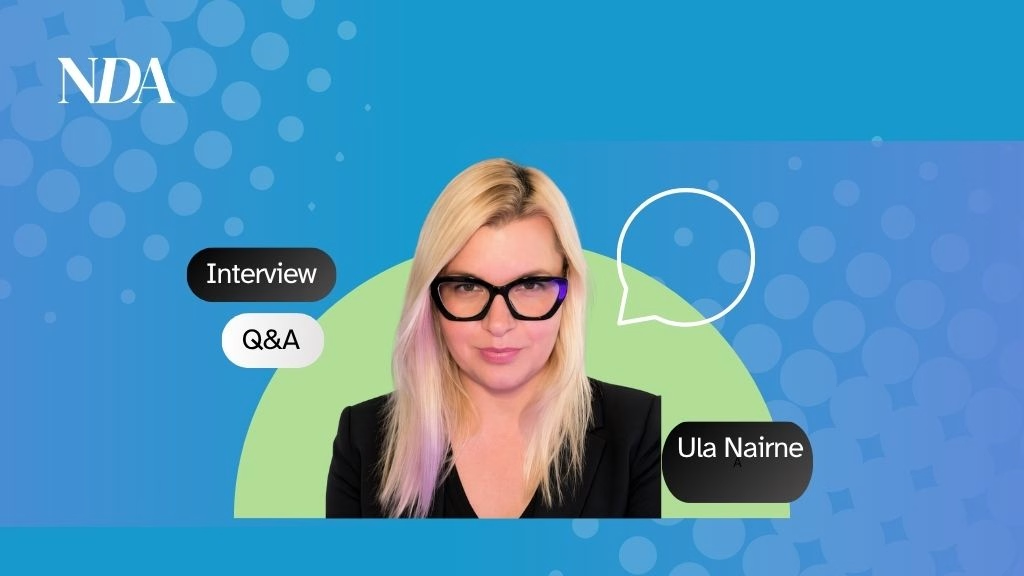
Stelia is on a mission to drive the maturation of AI adoption. New Digital Age sat down with Ula Nairne , VP of Strategic Markets, to find out more.
Stelia is a full-stack enterprise AI company, designed to help organisations move from fragmented AI experimentation to secure, governed and scalable AI infrastructure and applications. Through model-agnostic architecture, organisations can work across different models and cloud environments while maintaining control over security, data, governance and cost.
Agencies and brands have embraced AI heavily, but you argue the way it’s currently being deployed across marketing and media is flawed. Where are companies going wrong?
At the moment, agencies and brands treat AI as a collection of disjointed tools rather than an integrated operating capability. Marketing buys one tool, creative uses another, the agency runs its own tech stack, and employees use personal subscriptions on the side.
This fragmented approach creates serious blind spots, nobody knows where the data is going, how IP is being used, or what the company is actually spending.
Moving from isolated experimentation to enterprise-grade AI requires moving away from single-model lock-in toward a technology-agnostic architecture focused on security, governance, and real-time flexibility.
Is there a misconception about the types of AI models businesses actually need?
Absolutely. There is a widespread belief across the industry that the biggest, most advanced model is automatically the best choice. In reality, massive models are often unnecessarily expensive and over-engineered for specific tasks.
Smaller, highly specialised models are often much better suited for targeted jobs.
They can be faster, more cost-efficient and more accurate within the domain they have been trained for. Rather than relying on one massive general-purpose model to handle everything, we see the market moving toward intelligently orchestrating specialised models and agents depending on the task.
Moving from ad-hoc experimentation to enterprise-scale AI sounds like an organisational challenge. Who inside the company needs to take ownership of this shift?
Historically, these choices sat exclusively within IT, CIO, or CTO departments. Today, every executive with budget responsibility, especially CMOs, must understand how their technology choices impact infrastructure costs and data security.
When department leads operate in silos to solve immediate team KPIs, AI spend can quietly balloon into millions without central oversight.
Aligning the C-suite is essential so organisations can orchestrate AI safely without leaking proprietary data or losing critical intellectual property to third-party models.
How does Stelia fit into this space, and how do you differentiate yourselves from other players?
Stelia is a full-stack agentic AI company. What sets us apart is that we cover both the application layer and the underlying infrastructure. We don’t force organisations to bet on a single model, cloud provider, or vendor.
Instead, we provide an ecosystem that allows companies to deploy and orchestrate different models dynamically, while maintaining strict governance, security and cost controls. More importantly, we enable organisations to build specialised models on their own proprietary data and give those models access to shared organisational context, so the AI understands what is unique to that business.
We provide real-time visibility into token usage and cloud infrastructure costs so leaders can accurately predict expenses before committing budget, giving CFOs the transparency they need to approve AI implementations at scale.
How are you applying this in the media and advertising sector specifically?
Media and marketing was our first vertical because it’s digital, global, data-heavy, and fast-moving. A strong example is our strategic engineering alliance with Monks. Together, we have built a predictive advertising solution that uses fine-tuned models trained on brand-specific performance and historic campaign data to pre-validate an ad creative’s projected algorithmic delivery.
Instead of just using AI to generate ad creatives faster, the system can analyse thousands of ad variations beforehand to predict performance. The system analyses the structural, semantic and visual characteristics of creative assets and scores their projected algorithmic delivery before media budget is committed, allowing marketers to optimise earlier rather than relying solely on costly in-market testing.
We’re also launching an AI Centre of Excellence with Reading Football Club alongside technology partners like Lenovo and Nvidia, bringing this structured AI framework not only into sports and entertainment, but across the wider Thames Valley enterprise ecosystem.
What is next on the horizon for Stelia, and where do you see the market heading?
We have just launched Stelia Workspace, our enterprise AI workspace and private model foundry. It allows organisations to connect their proprietary data inside their own boundary, train and distil specialised private models through Crucible, and then make those models and shared organisational context available across teams through Continuum.
The objective is to move enterprise AI beyond generic models and fragmented tools toward AI that understands what is unique to the organisation, its data, knowledge and workflows, while keeping ownership, governance and control with the enterprise.
We are also expanding into highly complex, data-intensive sectors including space, robotics and other environments where sovereignty, performance and reliability are critical.
The market is evolving extremely quickly, but we believe the organisations that create a secure, governed foundation for AI will be in a much stronger position to move from experimentation into meaningful enterprise-scale deployment.