AB Tasty and VWO, the platforms behind experimentation and personalisation for brands like L’Oréal, LVMH, Decathlon, Puma and De Beers have officially merged as one company, Wingify.
The new business reports $105m+ in revenue, 4,000 customers and 700 staff across 11 offices – with the UK a core part of that.
The new Wingify platform combines experimentation, personalisation, customer insights, commerce optimisation, feature management and customer engagement through a shared data foundation and embedded AI engine. Wingify describes this approach as “Agentic Experience Optimisation.”
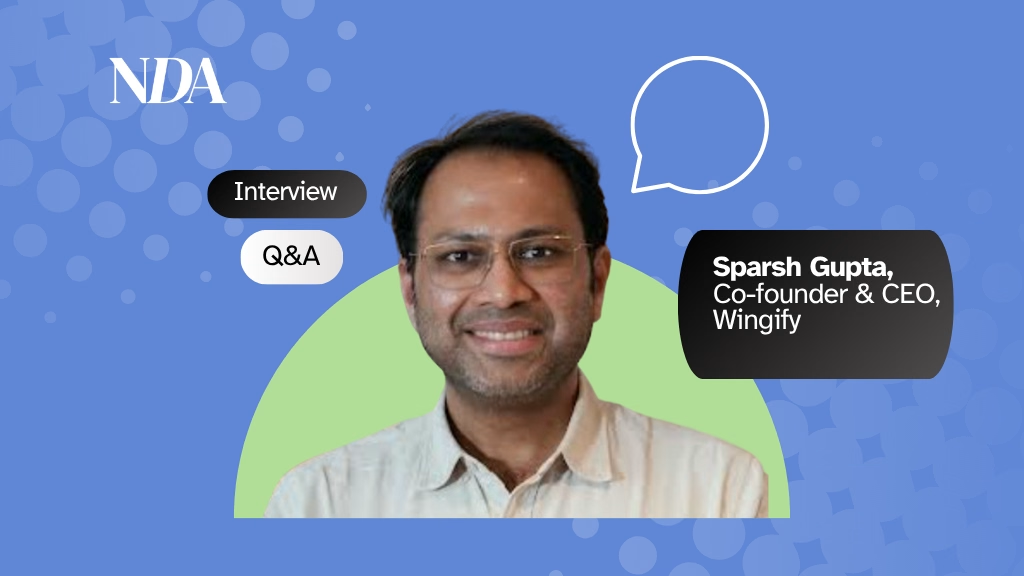
NDA spoke with Sparsh Gupta, Co-founder and CEO of Wingify, to find out more…
What were the motivations behind the merger? How long has it taken to organise, start to finish?
VWO and AB Tasty had known each other for almost 15 years. We were in the same industry, often competing with each other and sitting on opposite sides of the table, so we were very aware of each other’s businesses.
The idea actually started very casually. In March last year, I was in New York and Alex and Rémi from AB Tasty were also there. We exchanged messages and realised we were in the same city, so we decided to meet for dinner. It started off as a very casual conversation.
What we discovered was that while we were building two businesses of a similar size – both upwards of $50 million – we had built organisations that were powerful but very distinctive and complementary.
Around 60% of AB Tasty’s business was in North America, whereas AB Tasty was largely 70% business in Europe, and VWO was doing a lot of business in industries such as software, travel and finance. So while we competed, our approaches to business were very different and complementary.
During that meeting, we started talking about what we had built and what we wanted to build over the next two or three years. We realised that if we could work together, we could effectively short-circuit that journey because we would get, from day zero, everything from either side – across our product lines, go-to-market and market penetration.
From the first discussion to getting conviction and the finances in place took four or five months. Then we spent another three or four months going through the entire process, getting everything done and signing off. There were also statutory compliances and transactions to take care of.
In total, it took around nine months. It was a longer process, but I wouldn’t say it was very complicated because there was strong conviction at the top that it made sense for us to do this together.
What does the new combined platform deliver for marketers?
The combined business is an agentic experience optimisation platform, designed to ensure that every digital experience is relevant. I use the word “relevance” a little differently from personalisation, because something that is personalised doesn’t always mean it is relevant.
VWO has spent a long time building capabilities to understand context better – understanding the user, what they are doing and their patterns of behaviour on a website or mobile app.
For example, are you frustrated? Your mouse patterns can tell us that. What is your affinity right now? Are you looking for a luxury shirt, a premium market shirt or an everyday shirt? Before you explicitly tell us, your browser and behaviour patterns can give us clues.
The first aspect is understanding every customer better, individually, using state-of-the-art AI to take near-real-time decisions about the right experience for that user.
It is almost like walking into a store. The store manager or salesperson understands what you might be looking at and then pitches to you in a bespoke manner. Can we do that in a digital world, where decisions happen in real time?
But you don’t stop at taking the decision. You have to implement it. That is where the activation layer comes in. We can control the entire environment across websites and mobile apps, as well as SMS and email, so that the entire digital journey can be personalised, bespoke and relevant.
All of it is built on a pillar of experimentation, so we can always challenge and evaluate the impact it is creating. By bringing together these capabilities from VWO and AB Tasty, we’ve been able to build a platform that aims to make every digital experience relevant for people.
How does the platform’s approach to AI differ from others?
For a lot of people, AI still largely means a chat interface, particularly with ChatGPT and Claude. You have a lot of information and smart models, and you access AI through a chat interface.
What we’ve been able to do is push it beyond that. Imagine somebody interacting with a website and looking for a travel deal. The AI can understand their needs and give them exactly what they are looking for in real time, without the shop owner having to interact with them.
You’re not asking somebody to tell you what they need, as you would with a typical chat interface. Instead, you infer their movements and their entire context, and change their experience in a way that feels highly relevant.
We have an automated system that we’re calling Wings, which can act on your behalf. Of course, it depends on what guardrails you set up and what you want it to do, but the system can operate on its own. Rather than having a smart teacher that teaches you all the time, it is an autopilot that can drive your entire engine by itself.
We’ve been able to do that because this new platform gave us a unique opportunity. We have 15 years of legacy, but we also had the opportunity to build something again from zero in today’s world, with AI.
AI is not a layer that sits on top, which is how a lot of vendors approach it because they have a legacy platform and are effectively putting AI on top. We built this in 2025, with the merger and AI at the core.
So the functionality is as good as a new system you would get from a startup, but you also have a system that has been out there for 15 years with that legacy of trust. That makes it particularly powerful.
What has been the market reaction to date?
While the public launch has only just happened, we had been running a private beta with customers for some time.
The biggest reaction we’ve had from clients on both sides is that, when they were looking at the market, they were often deciding whether to go with VWO or AB Tasty. Some chose AB Tasty and some chose VWO.
When we announced that we were merging the two, bringing that power together, people were really excited because the decision became much easier. The two biggest options they had been considering were now coming together.
The new platform has been in beta for a few months and some customers have already used it. The feedback has been fantastic. It brings together what VWO and AB Tasty had to offer, while also introducing a novel approach to AI.
So clients are very excited at the moment and the feedback has been positive.
Looking ahead 12 months, what would a successful year look like for Wingify?
Success for us as a business really lies in making our customers more successful.
It’s a very challenging time in the industry to do business as an ecommerce, travel, software or media company. Things are changing fast, and a lot of businesses are still trying to understand what this means for them and how they cope in an AI world.
How do we use our 360-degree approach and the entire relevance loop we’ve built to empower them to continue delivering relevant experiences and have a positive impact?
For us, success is about our customers. Customers were probably using half of the capabilities available to them because they were either VWO customers or AB Tasty customers. Now that we have Wingify and they are moving onto the combined platform, how can that entire loop deliver far more value for them and help them become more successful?
We have around 4,000 customers jointly between VWO and AB Tasty. So how do we onboard more and more of them onto Wingify over the coming year and make them hugely successful?
There is obviously a financial number attached to it. We expect the combined business to deliver strong numbers, and our average ticket size should increase. If customers are more successful with AI through the platform, that should drive more revenue for us.
But ultimately, our customers’ success is our success.