As AI takes on more of the manual work involved in media planning, buying and optimisation, the role of the media agency is changing fast. But rather than simply replacing people, Michelle Sarpong, Head of Activation at the7stars, believes AI could ultimately create a more strategic, valuable workforce.
Ahead of her appearance at New Digital Age’s Foresight conference on 30 September, Sarpong talks about where responsibility sits when campaigns underperform, why junior roles could evolve rather than disappear, and why the agency’s future value may lie in being a strategic partner rather than an executional supplier.
AI is taking over more of the planning, buying and optimisation process. What does that actually leave the media agency accountable for?
I don’t actually think AI is taking over. Everyone forgets that we’ve been working with AI for a long time. If you look at the programmatic world and machine learning, we were already working in that space.
It’s just massively accelerated and is now seeping into other elements of the campaign lifecycle, from brief to buying.
You still need the human layer to set the boundaries. AI can’t just buy willy-nilly. You have to set those boundaries by industry, KPI and objectives, so you need that strategic layer on top.
You could tell AI to buy something at a certain cost and not go above it, but what happens when sales are down and you need to pivot towards more lower-funnel activity across a number of channels? You still need human decision-making within that process.
What AI is doing is making roles more strategic. It gives us the opportunity not to waste time on setup and administration, and instead spend more time thinking, looking at new opportunities and understanding the client’s business.
When a campaign underperforms, whose fault is it, the agency, platform, technology or client?
There can be a number of factors. Objectives or KPIs can change during a campaign, or the data underpinning the original targets may turn out to be incorrect.
But ultimately, as the agency, we have to take ownership of making sure the campaign delivers. That means setting the right goals and closely monitoring pacing and results.
There can also be issues on the supplier side. If a capability or particular outcome has been mis-sold, that’s their responsibility. Ultimately, the technology is only as good as what the supplier has built and is selling, so those two things go hand in hand.
Does the increasing use of AI change the conversation with clients and procurement about agency fees?
There are certainly more questions from procurement around how AI should translate into efficiencies and agency fees, but those conversations also need to consider the value and quality of the output.
But clients are also aware that they’re moving much quicker. Outside of sectors like retail, we tended to operate on much longer planning cycles, with annual plans usually being the default.
Now, we’re activating campaigns in a matter of days, and on social, often within hours, with huge numbers of creative executions. Everything is faster, more responsive, and increasingly driven by performance. Clients aren’t going to pay for more people just to activate campaigns that quickly, so it has to be a balance.
What does that mean for junior roles, when so much of their work has traditionally involved manual tasks?
When I started out, there were roles dedicated to tasks such as physically checking and verifying ads in magazines and manually tagging them. Those kinds of jobs simply don’t exist today. Instead, junior people could potentially take on more responsibility much earlier, because they’re starting to get under the skin of the client, understand their strategic goals and think about how to solve their problems at lot earlier into their career.
This also means that people could move up the ranks much quicker. It shortens the timescale of what roles and responsibilities are open to you at certain points in your career.
So AI could actually increase the value of the workforce rather than simply getting rid of people?
Absolutely. I think that’s the basis of AI. It could enrich the entire workforce.
I don’t think it’s ever designed purely to reduce headcount. It will change certain roles, but I think it can also enrich the workforce.
Instead of spending hours on a report for example a sales targets can change overnight, requiring everyone to quickly adapt and pivot. AI gives us the time to move faster.
It means we can stay on the front foot, working alongside our clients to tackle challenges as they arise without losing sight of the campaign objectives or strategy. It also gives us more time to really understand their business and build stronger partnerships
How do you know when automation is genuinely improving performance rather than simply making media more efficient?
You can see the impact clearly because clients and campaigns are measured against well-defined objectives. Ultimately, what matters most to clients is whether activity is driving performance. That’s the conversation we have with every client, and it remains our primary focus.
We wouldn’t activate anything unless it delivers a measurable performance outcome. If it also improves media efficiency, that’s a welcome benefit, but we see that as a hygiene factor rather than the end goal.
Who has the final say when the algorithm says one thing but an experienced media buyer thinks something else?
Human judgement should always have the final say in algorithmic decision-making because it is grounded in experience. An algorithm can optimise within the parameters we set and learn over time, but it is ultimately focused on a single campaign or dataset. What it cannot replicate is the breadth of perspective that comes from working across multiple clients, categories and agencies, or from years of conversations with media owners, partners and consumers.
There is also a distinctly human dimension to advertising. At its core, our industry is about understanding people and behaviours. We all bring different experiences, instincts and perspectives that help us interpret context and identify opportunities in ways that technology alone cannot.
That said, human judgement and algorithms are not in competition. If an algorithm is delivering stronger performance, that is a positive outcome because performance is ultimately what matters. The two should be working towards the same objective. When KPIs and business goals are clearly defined, technology and human expertise should complement one another rather than compete.
Where agencies add the greatest value is in deciding what comes next. Have we reached the point of diminishing returns? Which activities should we continue to invest in? Where is the next growth opportunity? Those are strategic decisions that require experience, judgement and commercial understanding.
Are agencies measuring the things AI is good at optimising rather than the things that actually matter to a business?
I think it’s both, but ultimately, we’re measuring what matters to the business. That’s the bottom line and that’s what we’re valued on as an agency.
We monitor how campaigns respond to changes in budget, audience and platform performance, but those are tactical measures. Ultimately, success is defined by business outcomes. More clients are aligning their marketing activity to sales targets, CPA goals and other commercial metrics, and that’s exactly where our focus should be.
Optimisation is valuable, but it is not the objective. The real measure of success is the impact on the business, and that’s what agencies are ultimately accountable for delivering.
Does automation make agencies more accountable because there are fewer excuses for poor performance?
I don’t think it makes agencies any less accountable because we still have responsibility for monitoring and delivering performance. Our value increasingly comes from the strategic thinking that sits beyond the immediate metrics.
Clients’ businesses are becoming more complex, with PR, creative and media continuing to converge. As a result, our role is evolving. While we’re focused on driving performance through campaigns, we also need to understand how those campaigns influence the wider business.
Performance metrics can often be short-term in nature, but our responsibility is to balance those immediate results with longer-term business objectives. That means looking beyond optimisation and considering broader outcomes such as brand growth, customer relationships and sustainable commercial success.
Ultimately, our role is not just to improve campaign performance, but to help clients achieve their wider business ambitions.
Are clients becoming more educated about what AI can actually do, and does that put more power in their hands?
I think we’re all on the same AI journey. Agencies and clients are working together because nobody has completely figured it out yet.
Some agencies are beginning to talk about AI-powered solutions that can take a campaign from planning through to activation with little or no human intervention. But that raises an important question: if everyone is working from similar datasets and prompts, how do you ensure differentiation? If multiple clients are receiving near-identical recommendations, it’s worth asking whether that’s genuinely creating value.
The more interesting conversation with clients is increasingly centred on creativity and strategy. How are we using AI to enhance ideation? How does it support brainstorming and problem-solving? And where does the line sit between machine-generated output and genuinely original thinking? Those questions are prompting clients to look more closely at what they expect from their agency partners. They’re not just buying execution, they’re investing in expertise, perspective and fresh thinking.
We’re very transparent about where AI adds value. It can dramatically reduce the time spent on repetitive or administrative tasks, helping teams work more efficiently and freeing up time for higher-value activities. However, human oversight remains essential. Campaigns still need to be quality assured, budgets still need to be challenged and validated, and strategic decisions still require context and judgement.
Ultimately, the future is unlikely to be defined by AI or human expertise alone. The agencies that succeed will be those that combine the efficiency and analytical power of AI with the originality, judgement and commercial understanding that only people can provide.
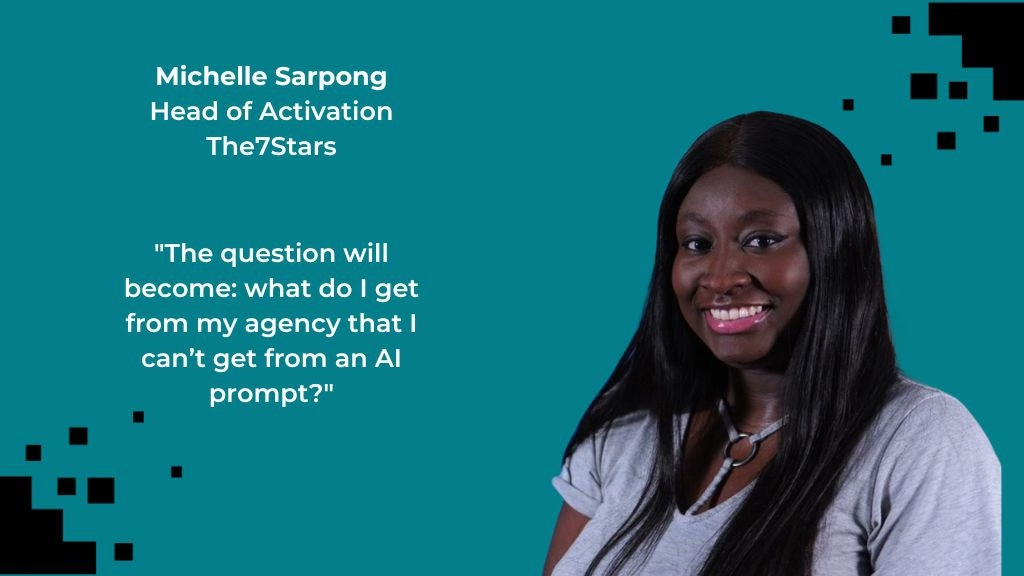
The question will become: what do I get from my agency that I can’t get from an AI prompt?
I think that’s where the relationship between agencies and clients will change.
It will come down to the human lens. Who do you have a relationship with that you can pick up the phone to when you have a problem that needs solving in the next couple of hours?
You still need those relationships within the industry. You need someone who can flex, call in a favour, negotiate added value or find a way to move something quickly.
Those things will be really important going forward, compared with some of the thought-starter roles that could potentially be covered by AI.
Looking five years ahead, what is the role of the media agency if AI handles most of the execution?
I think media agencies will become strategic partners to clients.
It’s about coming alongside the client and asking: how can we really transform your business?
At the moment, an agency might be servicing one part of a client’s business. They have a new brand they want to launch, and we help them launch it.
Going forward, I think we’ll come alongside them much more closely. We’ll be asking: what’s the next thing? How do we grow that brand? What’s your five-year plan? How do we launch in other markets? How do we bring in PR? How do we bring paid, owned and earned closer together?
That’s where the media agency relationship will grow.
We’ll become much more integrated with our clients, really getting under the skin of their business rather than simply delivering campaigns and then moving on to the next isolated one.
It’s about joining all the dots and becoming a longer-term strategic partner.