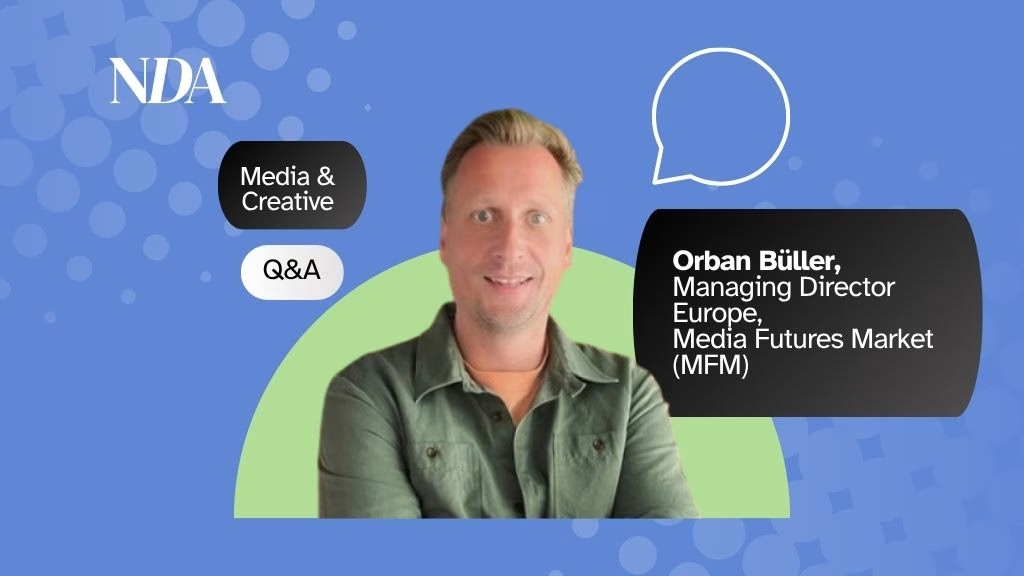
New Digital Age recently spoke with Orban Büller, Managing Director Europe at Media Futures Market (MFM), a London- and Amsterdam-based independent media agency and marketplace that integrates media planning and buying services directly into independent creative agencies.
Topics discussed included shifts in client demands, the impact of Ai on agency structures and the need to reduce complexity for marketers…
For readers who aren’t familiar with MFM, how would you describe the business?
MFM is an integrated media agency. While we work directly with some brands, our core proposition is integrating media with creative agencies. Rather than bringing media in once the creative idea has already been developed, we make sure media and creative work together from the very beginning.
We believe that unleashes the full effect of great ideas in media and ultimately leads to better work. Creative and media should work hand in hand from day one, rather than operating in separate silos.
What are clients asking you for most at the moment?
Clients are looking for clarity and integration. The media landscape has become incredibly fragmented, with more platforms, more data, more technology and more specialist partners than ever before. That doesn’t necessarily make decision-making any easier.
Many of the brands we work with have already built strong performance marketing programmes, but they’ve reached a performance plateau. They’re now asking more fundamental questions: how much should we invest? Where should we invest? What’s the right balance between long-term brand building and short-term activation?
Our role is to connect media and creative, and to measure commercial impact without reducing everything to the last click. Clients aren’t looking for another layer of complexity; they’re looking for a genuine partner who can help them move the conversation beyond traditional media metrics and towards meaningful business outcomes.
Are you seeing any wider changes in the way brands are approaching agencies?
Absolutely. One of the biggest trends we’re seeing is advertisers pitching creative and media together. Rather than running separate pitches for creative and media agencies, they’re asking for one integrated response.
That’s a significant shift because it reflects the growing recognition that media shouldn’t simply distribute creative ideas. It should help shape them from the outset.
Why is that integrated approach becoming so important?
When media is involved from the start, alongside the creative agency and the brand, you develop a much deeper understanding of the audience, the context, the channels and the investment level. The media strategy is then built around the strength of the creative idea rather than simply becoming the distribution layer.
Take digital out-of-home as an example. Working together means asking much better questions: when do we want to show up, what mindset do we want to reach people in, which locations matter, what times are most relevant, and how might factors such as the weather influence the campaign?
There are also far fewer handovers. There’s much greater consistency between strategy, creative, media and, ultimately, performance.
One thing I particularly like about working as one integrated team is that there’s nowhere to hide. Media can’t blame the creative work, and the creative work can’t blame the media, because we’re both responsible for the outcome.
AI is dominating conversations across the industry. How is MFM approaching it?
We see ourselves not only as an integrated media agency but also as a technology company. Being a scale-up gives us the freedom to design our operating model without legacy systems, fragmented processes or decades of fixed ways of working.
One of our biggest developments is building our own media assistant. It uses existing language models, but the environment, knowledge base and data are all managed locally. That gives us much greater control over governance, confidentiality and how the technology is trained and used.
We’re building it around MFM’s own media intelligence—our planning solutions, publisher knowledge, market studies, industry research and other expertise. That enables a relatively small, senior team to support clients across multiple markets while maintaining consistency and quality.
Do you see AI replacing traditional agency structures?
I don’t think the future is simply about adding AI tools to the existing agency model. There’s an opportunity to redesign the model itself from the ground up, and that’s where a scale-up like MFM has an advantage.
AI helps us deliver on our promise that clients work with a small, flexible, agile and highly experienced team. But technology doesn’t remove the need for talent development.
As our media assistant matures, we’ll still need to train the next generation of media strategists – not just in what to do, but in how to think, and how to add the personal perspective that AI will always require.
What are your priorities over the next year?
MFM has successfully evolved from being primarily a media marketplace into an integrated media agency, and my focus is continuing that transformation across the Netherlands and the wider European market.
Building the team starts with building the client base. A large part of my role is developing partnerships with creative agencies and demonstrating why media and creativity should work hand in glove from the very beginning.
Success over the next 12 months means building a team comparable to the one we have in the UK while continuing to win new business across the Netherlands and expanding further into markets such as Germany and Belgium. Ultimately, it’s about proving that integrating media and creative from day one delivers better outcomes for clients.