Are you a fan of microdramas?
Maybe you’ve never watched one, but you’ve been seeing the term appear more and more. These ultra-short, vertical video episodes are the latest trend in entertainment, having first taken off in China before migrating to the rest of the world, capturing millions of viewers.
Microdrama series are typically punchy, dramatic, and highly bingeable. Unsurprisingly, as audiences have flocked to microdramas, brands have also started to look into how they can get involved with this rapidly-growing trend and engage consumers via the new format.
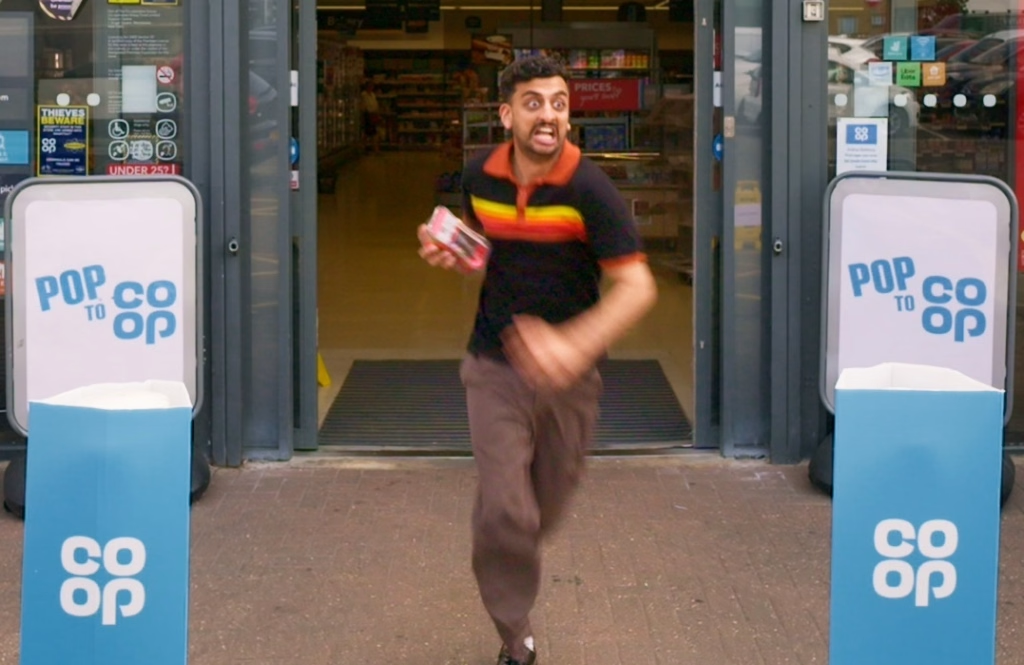
One such brand is Co-op, which launched a four-part microdrama series starring comedian, podcast host, and TV producer Jake Bhardwaj that served as a key pillar of its ‘Pop to Co-op’ campaign platform.
New Digital Age spoke to Roxanne Vure, Strategy Director at Carat UK, and Kameshia Lewis, Head of Media Excellence and Comms Planning at Co-op, about what drew Co-op to this emerging format and how the series served as the conversational engine behind the convenience chain’s new marketing platform.
“Something unique and different”
“The challenge for Co-op, luckily, has never been awareness – rather, it’s that we’ve got a very crowded convenience market, and so the goal behind the campaign was to build mental availability,” explains Roxanne Vure.
“We needed to make ‘Pop to Co-op’ a kind of instinctive response to everyday needs.”
Co-op and Carat UK became aware of microdramas because the format is one of the fastest-growing globally, but Vure notes that the real appeal lay in the audience behaviour behind the format. “People aren’t just watching these – they’re commenting on them, they’re sharing them, and importantly, they’re coming back to watch more,” she says.
“From a media strategy point of view, that’s exactly what we were looking for – that authentic engagement and earned attention.”
Co-op’s Kameshia Lewis adds, “As part of launching the ‘Pop to Co-op’ platform, we wanted to do something unique and different.
“We’re often seeing the convergence of our paid and owned ecosystem overlapping now – everything is becoming digitalised. How the consumers interact with our brand is becoming digitalised.
“So, we were excited to deliver something against our consumer need states in an environment where they were most happy and most native. We love to test these things – we love to innovate, and this is us dipping our toes into the water and seeing what it brings.”
Everyday situations approached with humour
The ‘Pop to Co-op’ campaign spans numerous channels from radio to out of home, display, influencer marketing and social media, and Vure describes the microdrama series as “the conversational cultural engine behind it”.
“Every episode allowed us to showcase a different convenience mission for a different need – but it’s reinforcing the same behavioural cue: When life throws up a challenge, what do you do? You pop to Co-op,” she says.
While microdramas are notoriously melodramatic – akin to miniature soap operas – the team set out to create something a little more grounded with the Co-op series. “We wanted to take that core message [of popping to Co-op] and put it into real-life scenarios, and put those scenarios into real-life social feeds,” says Vure.
“It was really nice for us to take that very functional proposition and turn it into something more emotive that people would choose to watch. They want to talk about it; they want to share it with their friends, because it’s funny and because Jake Bhardwaj is funny.”
Lewis agrees that bringing lightness to the campaign was important. “From a consumer point of view, the world is heavy,” she says.
“Everyone is looking for a bit of humour – so, if we can put our brand into those scenarios and help people feel a bit lighter, bring a bit of joy into their world, that’s a win for us. Because it’s bringing us more top of mind.”
Measuring the impact
With such a wide-ranging campaign, tracking the impact of so many different channels becomes an interesting challenge – particularly when one channel is a microdrama series whose impact may be more difficult to quantify.
“We are looking at a wider metric ecosystem that encompasses everything underneath the ‘Pop to Co-op’ platform,” Lewis says.
She describes the microdrama measurement as a layer on top of this wider measurement, consisting of “softer metrics such as engagement rate, likes, comments – and looking at that from a paid point of view, but also looking at how that’s translating into our owned ecosystem.”
This includes tracking follower growth across social channels like Facebook and Instagram; the team is also using social listening tools such as Sprinklr to track sentiment and mentions related to the microdrama.
Co-op is also employing econometrics for measurement of the overall ‘Pop to Co-op’ brand campaign, with Lewis saying that, “Trying to associate an ROI with this type of content is important – the more we can prove this type of space works, the easier it will become to plan and prove to the business that it is driving something different for our customers and members.”
Are there more microdrama ventures in Co-op’s future? Lewis notes that Co-op is still testing and learning, but emphasises, “We like to try new things all the time – especially when you’ve got an opportunity around a new brand platform that just lends itself naturally to that.
“Our media strategy is all around contagion – and that opens us up quite a lot to be able to trial new ways of thinking and of doing activations.”
Vure adds that Co-op is very receptive to new ideas: “As a brand, Co-op really understand that attention has changed – and the way that we communicate with those audiences has to change alongside it.
“If there is a way for us to communicate a commercial message in a way that people actively choose to watch and engage with – we will jump on it.”