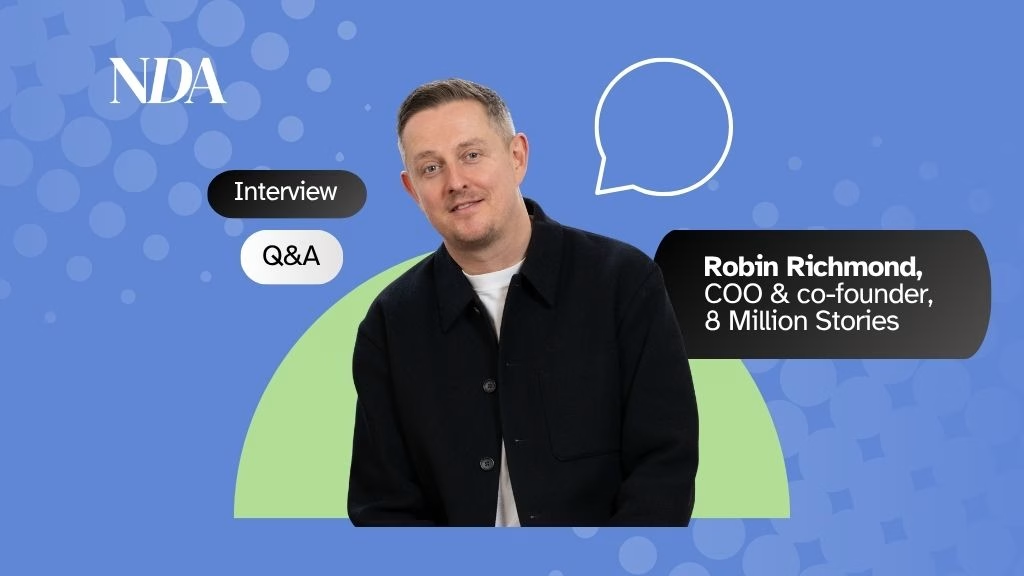
Independent digital agency 8 Million Stories recently announced a strategic roadmap to double the business’s global billings in the performance marketing sector over the next five years. Central to this expansion is continued investment in its proprietary AI-powered performance platform, Codex.
New Digital Age spoke with the Edinburgh-based agency’s COO and co-founder Robin Richmond to find out more…
You co-founded 8 Million Stories back in 2013. Looking back, what have been the biggest changes in digital marketing over that time?
It’s definitely been lively. When my co-founder Lyndsay Menzies and I started up, we saw an opportunity to blend what we’d traditionally done – performance marketing, things like SEO and PPC – with creative. We were creating content, telling stories, and helping clients position themselves online.
More recently, there’s been a huge movement away from thinking just about last-click sales and more towards the entire user journey. That’s been a big shift.
Google has changed massively as well. Back in 2013, it was pretty straightforward: three paid search ads and organic listings. Now it’s a much more diverse landscape, with maps, images, and over the last year and a half, AI elements have come in, which has been a huge shake-up.
Internally, one of the biggest challenges has actually been talent. The pool of people interested in traditional performance marketing has shrunk. Graduates are much more drawn to social, YouTube, and influencer marketing, which are seen as more exciting. So attracting the right people has definitely become tougher.
What was the original thinking behind developing the Codex platform?
Codex actually started as an internal piece of technology to solve specific client problems. There was nothing out there already that quite did what we needed.
One of the first areas we focused on was forecasting. Clients are always asking for annual forecasts on how paid media, social, and organic are going to perform over the next 12 months. We’ve got data analysts who can work through that, but AI allows us to process that data much faster and also consider factors we might not have thought about. Seasonality, competitor activity, things like that.
Another big driver was the rise of large language models. Clients started noticing a growing percentage of traffic coming from platforms like ChatGPT, but they didn’t have visibility on what was actually happening there.
So we built a module called AI Mentions, which tracks how often brands and their competitors show up in queries across these platforms. For example, someone asking, ‘Is this a good pension provider?’ We can track that, understand the sentiment, and help clients adapt their content accordingly.
Because unlike Google, where results are often pulled directly from your site, LLMs are pulling information from multiple sources. You want to be able to control that conversation as much as possible.
So really, Codex came from solving real client problems, and we’ve continued to build it out from there to add a new layer of valuable insights for clients.
What does Codex add to your overall agency proposition?
Codex underpins the excellent account management our teams deliver by giving them the armoury to analyse data and interpret trends quickly and effectively. This translates into actionable insights for our clients that positively impact performance.
It also allows us to do a lot of traditional digital marketing tasks much faster than we could before. Forecasting, for example, used to involve a lot of spreadsheets and could take weeks. Now we can turn things around much more quickly and with better accuracy, time that can be reinvested into campaigns.
Are we past the hype phase with AI in marketing, or are clients still finding their feet?
I don’t think we’re beyond the hype yet. What’s interesting is how quickly clients have shifted large portions of budget into something so new. In some ways that’s smart, but there’s also a risk.
At the moment, AI-related activity might still represent a relatively small percentage of overall traffic, but some clients are putting a disproportionate amount of focus on it. There’s a danger of chasing the ‘new shiny thing’ and neglecting the fundamentals.
The hype period is definitely lasting longer than normal. And while AI is going to change things, it’s not necessarily changing them at the same pace as some of the investment suggests.
Do clients fully understand how to use AI effectively yet?
A lot of clients see AI as a way to get better marketing results quickly. But what we’re seeing is that it’s changing how fast you can produce campaigns, but it’s not necessarily improving quality at the same rate.
So there’s definitely a need to use AI responsibly. Right now, it’s a tool for speeding things up, not a guarantee of better outcomes.
What are clients most concerned about right now?
The biggest area we’re getting asked about is how Google is changing. AI and things like AI-generated answers have had a big impact on organic traffic. We’ve seen drops of 15–20% in some cases.
That’s caused a bit of panic, especially when budgets are based on historic performance. If SEO numbers start going down, people naturally get worried.
But actually, we see it as one of the biggest opportunities in SEO in the last 10 years. You can now achieve visibility for competitive terms much faster by creating targeted, structured content that appears in AI-driven results.
Clients might not always get the click, but they’re getting the impression—and often users come back later. So the role of SEO in the funnel has changed. It’s really an education piece. Moving away from just focusing on last-click sales and thinking more about visibility, impressions, and the broader journey.
How important is understanding the full customer journey in this new environment?
It’s becoming critical, especially as we move towards a more cookieless world. Understanding how different channels interact, how they amplify each other, how campaigns perform when they’re on versus off – that’s going to be key.
As tracking becomes more limited, you’re relying more on understanding the overall impact rather than individual touchpoints. So getting a handle on that now is really important before things get even harder.
Finally, what does success look like for 8 Million Stories over the next 12 months?
A big part of it is leading that re-education piece, helping clients understand where things like SEO now sit in the funnel.
We’ve had consistent double-digit growth over the past 10 years, but this has definitely been the most challenging period of change. So it’s about capturing the opportunity that comes with that and leading the conversation around how AI is impacting search.
If we can continue that growth and help clients navigate this shift successfully, then that’s a good year for us.