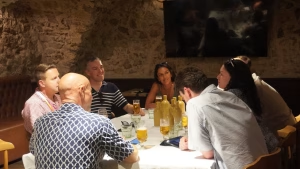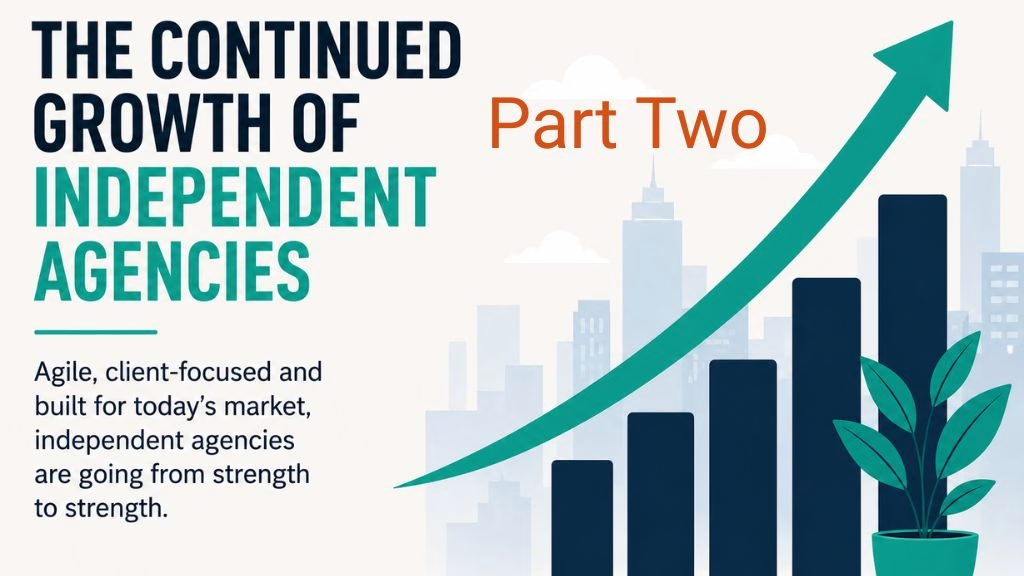
At Cannes Lions, NDA ran a roundtable discussion on the state of the indie agency sector. This second article based on the discussion looks at the challenge and opportunities of talent, IP development and AI.
The roundtable was chaired by NDA Editor-in-Chief Justin Pearse; Alex Kirk, Managing Director and co-founder at Medialab Group; Anthony Abou-Zeid, Managing Partner at The Kite Factory; Art Zeidman, MD, Agency & Programmatic Sales, Permutive; Clive Mishon, Founder/Director of Alliance of Independent Agencies; Jen Smith, co-founder of Craft Media; Jonny Ray, Co-Founder + Partner at Beyond; Kate Fulford-Brown, MD, 2LK; Nick Tong, Mediaplus Managing Partner; Rhys Williams, managing partner, the7stars; Sarah Dawson, EVP, Managing Director, The Team; and Sebastian Schichtel, Crossmedia, Executive Director International.
The rise of generative artificial intelligence and large language models has accelerated the conversation around what constitutes an agency’s core value. In a world where execution is increasingly automated, strategic thinking and proprietary methodologies are becoming an agency’s primary assets.
Rhys Williams highlighted that safeguarding intellectual property is set to be a critical battlefield for independent agencies. “I think that concept of IP is probably something that we are all going to have to deal with, particularly as we see more of the LLMs more available,” Williams predicted. He suggested that agencies must learn to codify their strategic frameworks so they can be protected and monetised. “We can put that into frameworks, we can build it into a framework, that is our IP, we can protect it, and we can put it into the models.”
This focus on proprietary methodology must coexist with a deep respect for the human talent that generates it. For Jen Smith, the ultimate product of an independent agency remains the collective intelligence of its people, rather than a piece of software.
“My product is my people, and my people’s brains, and so therefore I treat Craft like a school, not an agency,” Smith explained, adding that constant training and intellectual curiosity are what keep an independent offering distinct from commoditised network tools.
Sarah Dawson agreed that while productising workflows adds operational stability, it must never come at the expense of client-centricity. “Every client needs a different thing, so that is where the big agency mentality of just believing tech can do it all is so wrong,” Dawson said, describing how clients require bespoke applications of technology rather than off-the-shelf products.
Nurturing talent and overcoming procurement barriers
As the structural divide between indies and networks widens, a talent crisis looms on the horizon. Many holding companies have drastically reduced or entirely eliminated their entry-level training schemes, leaving a developmental void that independent agencies are now forced to fill.
Anthony Abou-Zeid expressed serious concern over the long-term implications of this industry-wide neglect of grassroots talent.
“As a whole sector, not just independents, we need to be committed to bringing people in so that we have got a strong talent pipeline for the future,” Abou-Zeid argued.
He said that while independent agencies invest heavily in training, it’s important to consider how entry level roles will adapt over time considering the impact of technological advancements and AI becoming endemic in some of those entry level workflows. “It’s about shifting the focus to arm and accelerate new entrants to deliver greater value for both agency and advertiser businesses earlier in their tenure rather than discounting them entirely in the new world of AI”.
Furthermore, when independent agencies attempt to bring their superior talent and agile models to large global pitches, they inevitably clash with legacy procurement practices. Nick Tong pointed out that procurement departments often act as gatekeepers, enforcing rigid, cost-focused criteria that favour the scaled structures of the holding companies.
“I struggle a little bit with the outcomes model in lots of ways, because we obviously pay our staff on an hourly rate,” Tong explained, highlighting the disconnect between internal agency costs and external client procurement demands. He added that the industry remains clouded by “a lot of smoke and mirrors” regarding how network agencies claim to deliver global services.
This procurement barrier requires a coordinated effort to educate clients on the hidden costs of network models. Clive Mishon explained that independent networks are making progress, but it is hard to transition from legacy structures.
As the roundtable drew to a close, the participants looked toward the future, addressing whether there is a natural ceiling to how much an independent agency can grow before it loses the very qualities that made it successful.
Jonny Ray rejected the notion of a fixed ceiling, suggesting that limitations are often self-imposed or cultural rather than structural.
“The ceiling and being relatively smaller and nimble allows us to work with clients in a way that holding companies simply cannot,” Ray stated, emphasizing that true scale is measured by the quality of impact rather than head count.
Nick Tong concluded that the future belongs to those who can maintain their cultural identity while building sophisticated, collaborative ecosystems.
“Value is obviously the conversation you have to have with clients,” Tong said, summarising the collective ambition of the room. “The independent agency sector will continue to grow and prosper because we are focused on the long game, on building trust, and on delivering real, human-driven brilliance.”
The first part of this writeup can be read here.