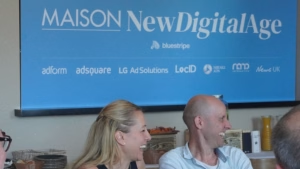
At the recent New Digital Age, chaired by NDA publisher Andy Oakes, a panel of industry leaders gathered to discuss the evolution of media ownership. The first part of the report on this event focussed on the dual challenges of technological disruption and the enduring necessity of trusted editorial content.
The roundtable brought together a diverse group of experts: Alex Kirby, Revenue Operations Director, Hello; George Odysseos, Chief Commercial Officer, Planet Sport; Glenn Iceton, Commercial Director, Future; James Florence, Head of Advertising Technology, Immediate Media Co; Keith Gillen, Senior Account Director, CNN International Commercial; Meena Miles, Director of Global Ad Ops, The Independent; and Owen Griffiths, Commercial Revenue Director, The Sun.
Unsurprisingly, artificial intelligence dominated a significant portion of the debate, though the panel intentionally avoided well-worn tech-utopian talking points in favour of practical applications and commercial realities. For publishers, AI is simultaneously an infrastructural threat to search referral traffic, a copyright battleground, and an internal efficiency tool.
Meena Miles, Director of Global Ad Ops at The Independent, said there were real anxieties surrounding AI’s impact on web traffic. She described AI search as a genuine threat to publishers, changing how audiences discover information and already reducing referral traffic from traditional search.
Miles said that the decline in traditional search page views requires active mitigation through reader loyalty and engagement, alongside licensing and syndication strategies.
“On the one hand, we want to come up in search and become a source of referral traffic, but at the same time want people to be coming to our site directly.”
The structural dynamics of how AI interacts with publisher content are already driving new strategies. While some publishers are choosing to block LLM scrapers entirely to protect their intellectual property, others are exploring ways to ensure their brands are heavily referenced within AI search results.
For a platform like The Sun, the perspective on artificial intelligence is entirely distinct. Griffiths said that looking at AI purely as an audience threat misses the immense value unlocked at the corporate level. When broader scale is secured through major corporate partnerships, technology shifts from an adversary into an operational asset.
“You have to be in that space,” Griffiths said, emphasising the importance of active participation over isolation. “Otherwise, how can you truly understand it? If you simply pull your content out, you completely miss out on the internal insights of what works and what doesn’t.”
Instead of viewing AI engines solely as traffic threats, Griffiths looks to tech integration as a mechanism to scale creative initiatives, empowering editors and opening massive opportunities for dynamic modern storytelling.
Two years ago, Future began working with OpenAI. Now, the global specialist media company is observing how its trust within LLM environments has evolved into distinct commercial opportunities, particularly around branded content and citation ranking.
Iceton said that the historic data exchange models are shifting toward something more commercial.
“Four years ago, we started working with OpenAI, we opted in, we gave them access, not fee-based, not licensing, but a value exchange of learning.”
Now, Future is observing how those early models have evolved into distinct commercial opportunities, particularly around branded content and citation ranking.
“We are starting to see actually that there’s a way that we’re becoming really relevant because our content is the number-one ranked citation that’s coming up. So actually, how do we work with brands to make sure you show up in those spaces?”
This emerging focus on visibility within AI-generated results represents another commercial opportunity for publishers. Rather than viewing large language models solely as a competitive threat, publishers are increasingly exploring how authoritative journalism and trusted brands can become more visible within AI-generated answers, creating new opportunities for commercial partnerships and audience growth.
Beyond the hype cycle
Ultimately, the consensus among the participants was that the existential dread often associated with algorithmic changes, such as Google’s volatility or Meta’s deprioritisation of news, can overshadow the real progress publishers are making internally.
Griffiths emphasised that when it comes to platforms, the external news feed disruptions we witness are a separate problem from the technological advancements.
The news publisher traffic decline we’ve seen hasn’t purely been because of AI overviews,” Griffiths said, steering the focus back to traditional platform dynamics.
“What has driven growth for publishers prior to last July was Google Discover. Then there was a double whammy with Google Discover changing the way it presents sources, and Meta changing its algorithm to retain users rather than exiting them to publishers.”
He suggested that within modern business operations, AI is paving the way for publishers to deliver superior user experiences.
“It allows us to do so much more,” Griffiths said, pointing to the immense potential of utilising deep content archives to power voice and podcast translations.
Similarly, by automating routine tasks, such as standard listicle creation, publishers can successfully optimise their resources. This tactical pivot frees senior editorial teams to redirect their energy toward deep, original, and analytical human journalism, the kind of storytelling that software simply cannot replicate.
As the roundtable drew to a close, the participants agreed that the definition of success for a media owner over the next five years will rest on cultivating direct, unshakeable relationships with a core audience. While the scale games of the past decade may be winding down, the publishers who survive will be those who treat their audiences not as raw traffic metrics to be monetised by third parties, but as real communities built on deep, institutional trust.