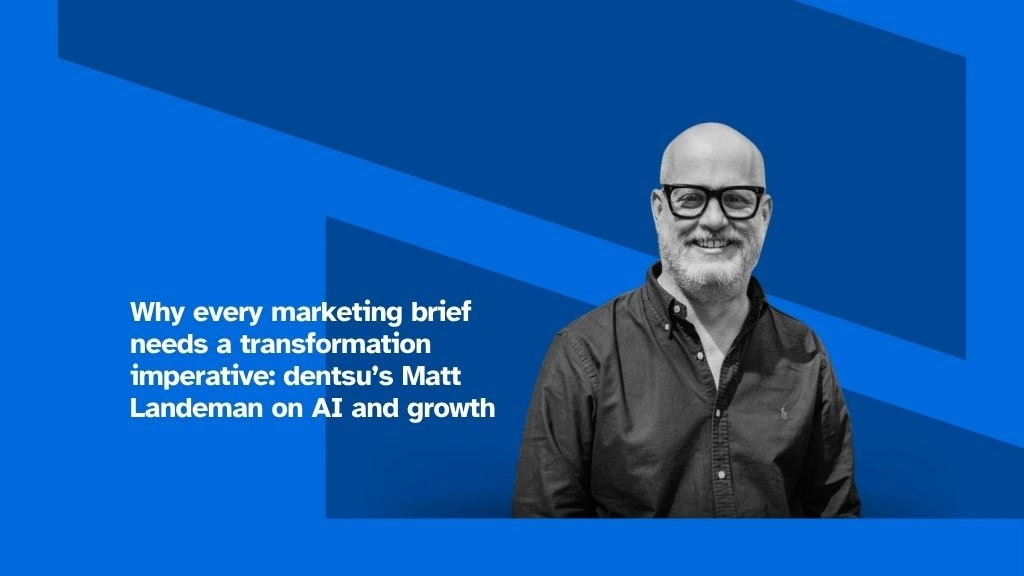
Matt Landeman, UK&I Chief Client Officer, dentsu UK&I
In Brief
- The Core Problem: 56% of CMOs expect future revenue to come from non-existent products, yet traditional briefs address symptoms rather than underlying growth challenges.
- AI’s Real Role: Technology must earn its place by altering outcomes; only 43% of consumers value tech-powered shopping experiences unless it delivers tangible value.
- The Solution: True marketing transformation isn’t always a 3-year overhaul, it’s identifying the single meaningful change that unlocks new business value.
Growth rarely comes from doing exactly what you did last year, just slightly better. Most businesses know that, yet the way marketing challenges arrive can make it easy to forget. A brand may need launching, a media plan may need rethinking, a site experience may need improving, CRM may need optimising, or an AI use case may need exploring.
Each is a valid problem to solve, but each may also be a symptom of something bigger.
Underneath the immediate ask sits a more consequential question: what needs to change for this business to grow? That’s what I think of as the transformation imperative, and it’s becoming harder to imagine a serious growth conversation without one.
There’s good reason for that. According to our research, half of CMOs are now accountable for redesigning marketing processes, workstreams and skills with AI in mind. More strikingly, 56% believe that five years from now most of their company’s revenues will come from products, services or businesses that don’t yet exist.
Against that backdrop, a familiar-looking brief can be sitting on top of a very unfamiliar business problem.
Find the change behind the challenge
The natural response when a brief lands is to leap straight to ‘how do we solve this?’ However, there’s another question worth asking alongside that: what challenge if solved would unlock the greatest growth opportunity for this business?
It might be a customer experience that no longer matches expectations, a commercial model that lacks focus, an operating system that makes agility impossible, or a brand struggling to stay discoverable as consumer journeys change.
Regardless of where the answer sits, it gives us a more useful place to start because it anchors the conversation in the business outcome. Transformation starts with the consequence we want to create: what will become possible, more valuable or more effective if we get this right?
That also gives us permission to use the word transformation a little more broadly than we sometimes do. It doesn’t have to mean a three-year programme, a new technology stack and wholesale organisational redesign. Transformation can be huge, but it can also be one important change made in exactly the right place.
For me, the most useful definition is simple: transformation is meaningful change that unlocks new value.
Technology must earn its place
That distinction matters particularly now, because AI has made it remarkably easy to attach the word “transformation” to almost anything.
There are extraordinary opportunities emerging from AI, and they’re already changing what businesses and marketers can do. But the existence of a new capability doesn’t tell us whether deploying it will make a meaningful difference.
The customer perspective is a useful reality check. Merkle’s latest research found that only 43% of consumers say it’s important that their shopping experiences are powered by new technology. After years of investment in personalisation, just 51% say the personalisation they receive is very or extremely useful.
So, AI earns its place when it changes an outcome. Does it make the experience genuinely better? Does it allow the business to operate differently? Does it create a new source of revenue, remove a meaningful barrier or give the customer something they couldn’t have before?
The transformation imperative keeps innovation anchored in value. It gives us something more important to pursue than novelty.
Transformation gives integration a purpose
It also changes the way we think about integration.
At dentsu, we have capabilities spanning media, creative, customer experience, commerce, data, production and technology. The interesting question isn’t how many of those capabilities can be brought into a client relationship, it’s which combination will make real change possible.
That’s also where our BX (business transformation) team can play an important role: helping clients define the business problem behind the brief, identify the transformation imperative and shape the route forward. A challenge that arrives as a media brief, for example, might ultimately depend on changes to the customer journey, proposition, operating model or technology as much as the media strategy itself.
The answer may sit largely within one discipline, but many growth challenges cut across several. Once the transformation imperative is clear, the right combination of expertise becomes much easier to see.
Transformation gives integration a purpose. Integration is most powerful when it’s organised around an outcome rather than around itself. The growth problem should determine the team around it.
Growth partnership starts with a better question
Clients know their businesses more deeply than any external partner ever will. The value we add comes from combining that knowledge with another perspective: what we see across consumers, culture, technology, categories and markets.
That perspective may reinforce the brief in front of us, or it may reveal a bigger opportunity underneath it. The most valuable conversations often happen when both sides are willing to explore that possibility together.We need to always be asking what needs to change for the next phase of growth to happen, and how we build the kind of high-value partnership that can make that change real.
Get that right, and the relationship moves beyond delivering against a brief. It becomes a partnership built around the growth the client needs next, and the orchestration of the priorities required to get there.