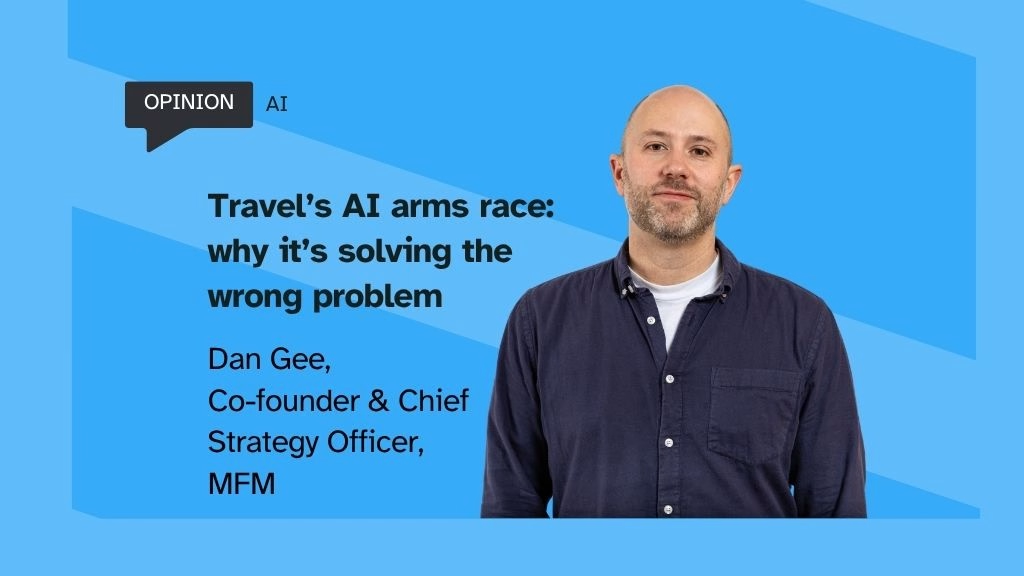
By Dan Gee, Co-founder and Chief Strategy Officer, MFM
Google has been quite open about their move towards agentic hotel booking. It shouldn’t come as a surprise, but the recent announcements should focus minds across the travel industry. They are testing AI capabilities that could help users move from a travel search to an actual booking.
The response from the industry is understandable. If AI is going to reshape how people research and book travel, the major OTAs need to respond. Better recommendations, more user friendly apps and websites, and fewer steps between search and transaction all make sense. The AI arms race is on.
But there is a risk that hurried wave of investment solves the wrong problem.
The focus of AI investment remains overwhelmingly on what happens once someone has expressed intent: helping them find the right destination, hotel or flight more quickly, and then making it easier to transact. But that is only one part of how people make travel decisions.
Travel rarely begins with a perfectly formed idea of what you’re looking for. Sometimes you know you need a hotel in Barcelona on 14 October and start comparing prices. But often the journey begins much earlier. You wonder what flights cost to a couple of airports close to your destination. You browse hostels in Tulum without having committed to going. Someone sends a villa on Airbnb into a WhatsApp group. You spend half an hour looking at Japan because Race Across the World got you yearning.
None of these moments may generate an immediate booking. But they can all shape what happens later. That is where travel brands need to focus their attention: not just on making the booking journey better, but on finding ways to reach prospective customers before plans are locked and intent is clear.
For OTAs, that means thinking beyond their role as a bottom-funnel utility. The ambition should be to become a platform people choose as their default. Or at least as default in certain situations. A brand associated with the enjoyment of imagining a trip, not simply the work of booking one.
If consumers only start using an OTA once their plans are set, that business is competing for existing demand. Price, search position and convenience become the primary battlegrounds. The stronger position is to influence the decision before that point. To have been part of the journey from the outset, rather than simply competing for the transaction at the end of it.
Understanding the emotion
Whether for business or pleasure, travel is an inherently emotive category. It represents connection, opportunity and escapism. The opportunity for travel brands is to harness those emotions and become the first app or platform someone opens when they start thinking about going somewhere.
Ideally, that relationship begins even earlier.
Some of the strongest consumer platforms have created behaviour that sits somewhere between shopping and entertainment. People who are not moving house still open Rightmove. They browse fashion without an immediate need to buy. They look at restaurants, cars and holidays because considering the possibilities is enjoyable in itself.
Travel is inherently browseable. But capturing that behaviour requires more than functional features. It requires a brand and experience that people actively want to spend time with.
That challenge becomes even more important as Google and emerging AI platforms become more capable.
If Google can answer travel queries and facilitate bookings, intermediaries face an obvious threat. Their response cannot simply be to operate more effectively within Google’s ecosystem or mimic its technology.
The more important strategic question is how much of the customer relationship they own before Google enters the picture at all.
Capturing intent is not the same as creating growth
Google, and increasingly LLMs, are becoming exceptionally good at identifying intent. They give businesses the opportunity to compete for the attention of people who are already in market.
But being brilliant at capturing existing demand is not the same as creating new demand.
That does not make search advertising ineffective. Far from it. If someone needs accommodation in Rome next weekend, the ability to identify that demand and compete for it is enormously valuable.
But travel brands should be careful about mistaking demand capture for growth.
Concentrating investment on existing intent means competing for a finite pool of customers who are already looking to buy. The competition intensifies, acquisition costs rise and optimisation becomes increasingly marginal.
Meanwhile, the platforms facilitating that demand capture become more powerful.
True growth requires reaching further upstream.
This is where brand investment has a clear commercial role. Video and outdoor media can make destinations desirable before a search begins. Audio, partnerships and content can build relevance around the motivations that drive people to travel in the first place.
The job is not simply to generate awareness. It is to increase the likelihood that when someone eventually decides they want to go somewhere, one particular brand already comes to mind.
It’s about what comes before the search
None of this is an argument against performance marketing or AI. In fact, the opposite is true. A liked and preferred brand makes those investments work harder.
If consumers arrive at Google already intending to use your brand, you are in a far stronger position than if every transaction begins with an auction.
AI will make the experience of booking travel easier. Recommendations will become better, booking journeys easier and planning more personalised. Over time, much of that functionality will become expected.
That is why the travel brands that emerge strongest from the AI arms race may not be those that simply build the best booking technology. They will be the ones that understand the value of everything that happens before the search.
They will optimise relentlessly for the buy, while investing just as seriously in the reasons people choose to buy from them in the first place.