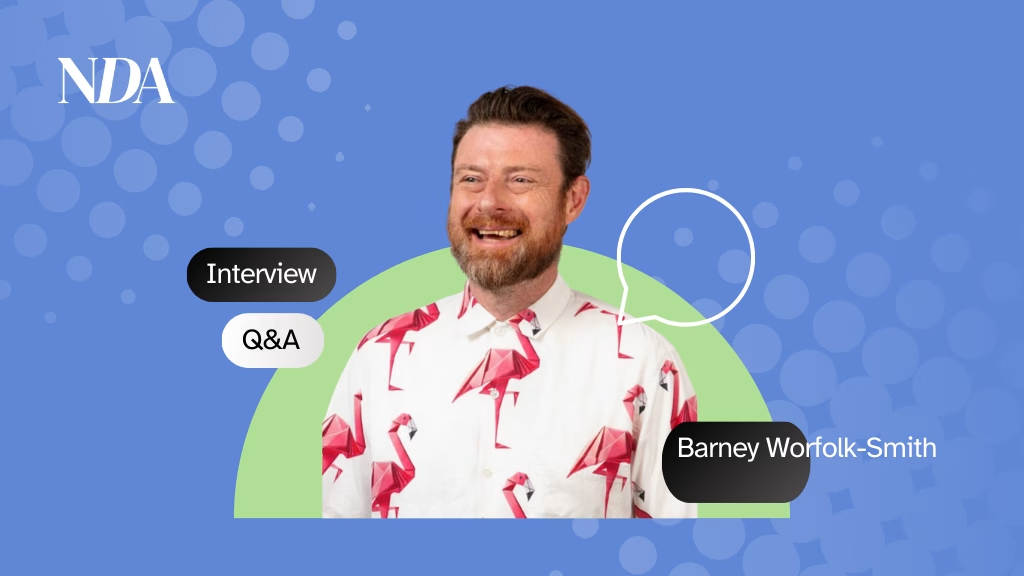
As AI reshapes the marketing landscape, new players are emerging that promise more than incremental improvement. NDA’s series AI Marketing Pioneers explores these companies. Next up we sit down with Barney Worfolk-Smith, Chief Growth Officer at Daivid, to discuss how AI is transforming creative effectiveness and the wider advertising ecosystem.
How do you see the state of AI in advertising at the moment?
I don’t see it as dissipating. I’ve worked in media, then creative, and now I sit in technology and measurement. I get to see what’s happening across adtech, agencies, and brands, which is a pretty lucky vantage point.
Last year was very much about experimentation and incremental testing. Over the break, it felt like companies were moving into acceptance mode.
There’s a realisation now that you can’t stand still. People are being pragmatic. Some steps will be wrong, but the alternative is inaction, and no one is paid to do nothing.
What about AI in creativity? It seemed like the industry went from excitement to scepticism quite quickly.
Exactly. Everyone saw the hype initially, then there was a realisation that a lot of the early output was underwhelming.
But AI-generated creative, done well, will soon be indistinguishable from human-made work. That’s inevitable, much like when CGI entered films. It was once sniffed at, now it’s unquestioned.
Practically speaking, there’s a wave of generative AI tools coming through from major players and startups alike. We’ll see more creative on the market, but a lot of it will be poor quality.
That could influence consumer behaviour, for instance, if platforms like TikTok become dominated by low-quality AI content. Ultimately, I don’t think the big holding companies will lead this space, it will come from the edges, from agile adtech firms and innovative startups.
How does this translate into your work at Daivid?
For us, it’s about assessing creative at scale. Our system is built on human input, so whether an ad is AI-generated or made by someone in East London doesn’t matter. What matters is how people respond to it.
Brands have been experimenting for a while, assessing creative and correlating it with media or sales data. Our AI takes that further.
We decode creative into data and then benchmark it. For example, if a certain type of ad performs well, we can generate hundreds of ads, filter out the ones that don’t meet criteria, and optimise spend. This is how we create what I call a Rosetta Stone for advertising: unified signals from disparate data to drive performance.
Who do you work with to deploy this signal?
We don’t go directly to brands like Mars or PepsiCo, they wouldn’t take kindly to another system. Instead, we work with nodes, primarily in adtech, who already have client networks. For example, we’ve partnered with Creative X, embedded in 40 of the largest FMCGs, and Boots, correlating all their creative and media data to build a clear playbook.
We’re also involved with Accenture via Droga, helping them build a culture engine for clients that spans early brand strategy to iterative content at scale. We’ve done work with Sky assessing creative and even evaluating ad environments to create emotional PMPs.
Essentially, we’re a signal provider. Our role is to pull together disparate insights, so media teams can make better decisions, optimising spend and effectiveness.
How do you find talent to work with these new AI-driven systems?
Agency talent is a challenge because legacy structures can be slow to adapt.
Some product teams in WPP and Omni have brought in entrepreneurial tech people, which helps. Senior brand leaders can struggle with the shift because the skill set now demands both systems thinking and storytelling. Data and analytics teams, though, have been AI-savvy for years.
They get the plumbing, the insights, and can make it actionable.
It’s a generational shift, but the most interesting thing right now is seeing people rolling up their sleeves, using AI to unify disparate data sources into meaningful signals, and improving advertising outcomes in a measurable way. That’s what excites me most.
What’s the most important message for marketers right now?
It’s the power of AI to provide clear signals at scale.
Creative abundance is here, but it’s meaningless without insight. By decoding creative into data, brands can invest confidently, optimise media, and measure impact reliably.
In a world full of noise and hype, that clarity is invaluable. We’re just the dial, showing where to turn and by how much.