By Virginie Goupilleau, Founder of BerylliumIV, a boutique marketing transformation and AI
integration consultancy.
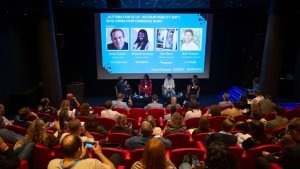
This article follows up on NDA’s Foresight 2026 event, held at the Soho Hotel in London on 30 September 2026, where AI, brand and measurement dominated the conversation.
When I started in media twenty-odd years ago, I was taught the 60/40 ratio of brand to performance very quickly. As a marketing graduate, the theory made sense to me. Feed the top of the funnel with brand, then collect the effect of that hard work with the wide net that performance gives you. Since then, with the growth of digital, real-time reporting and attribution, I have watched that ratio swing in every direction, in cycles that mostly follow the macroeconomy and market pressures.
The growth of econometrics and a measurement obsession fed the same pattern. Budgets followed whatever showed the best attributed return. Some channels were rightly boosted and some lost their credibility over time. Display advertising became the scapegoat of measurement, and the walled-garden platforms rose up the plans with their neat one-to-one attribution frameworks.
AI is now gathering pace accompanied by its backlash: job losses, redundancies, margin pressure, agencies feeling the squeeze, creativity loss. I understand the anxiety and feel it too. I have also started to think AI may turn out to be the best thing to happen for branding in decades. That sounds odd after years of budget drifting towards whatever could be measured by Friday. My reasoning is simple. A system that recommends has to decide which brand deserves to be named. To do that it relies on a plethora of sources and on the consistency of the message across them, which happens to also be how people decide whom to trust.
How performance squeezed brand out
Don’t get me wrong, performance marketing earned its budget fairly. It could show a click, a conversion and a cost per acquisition, and finance teams could read all three. Brand struggled to prove itself in those terms, so it kept losing the argument, one quarter at a time.
The damage shows up in a quiet way. A business that optimises only for the person already searching spends its money on demand someone else created. Brand is the part of the system that creates that demand. It is an asset that needs investment and it pays back slowly. Cut it, and the dashboards stay green for a while, because the stock of recognition built in earlier years keeps feeding the funnel. Then the funnel narrows and nobody can say why. The brand has simply dried out.
In financial terms, marketing is still perceived as an operating cost, and internally generated brands are not recognised as intangible assets (IFRS Foundation, IAS 38). However, economically the two behave very differently. Brand building acts like a capital asset: it creates brand equity that compounds over years, supports pricing power and loyalty, depreciates slowly without maintenance, and can lower long-term customer acquisition costs. Performance marketing acts like working capital: cash goes in today, revenue comes out within days or weeks, and when the funding stops the sales stop with little left behind. A business needs both, and a CFO who funds only the working capital will eventually find the asset has run down.
Unfortunately, attribution still distorts where money goes (New Digital Age, 31 July 2026). On the day, Esme Robinson of Epsilon showed that 79% of marketers are pushing more spend into performance and direct response and only 8% are leaning into brand, while 63% of consumers are deferring purchases. Pascal Schuster, CEO of Not on the High Street, described the other side of that bet: after years with more than 65% of spend on paid search following Covid, the business is moving back to brand building, with an addressable TV test that converted far better and a new TV campaign for Christmas.
Research and academia support the instinct. Les Binet and Peter Field’s 2013 IPA study found the best-performing budgets split about 60:40 between brand building and activation, and the IPA reports that ratio held when retested, moving to 62:38 by 2018 (IPA, 13 September 2023). More recently, WARC’s study The Multiplier Effect, built on Analytic Partners data, found that moving from a performance-only to a mixed brand and performance approach lifted revenue ROI by 90% on average, and that moving back to performance-only cut it by 40% (WARC, January 2025). Byron Sharp’s work on mental and physical availability and Kevin Lane Keller’s customer-based brand equity make the same case from different angles: be easy to recall, and for distinctive reasons (Ehrenberg-Bass via LinkedIn B2B Institute, 2025; Keller, Journal of Marketing, 1993).
The economic pressure to prove returns now, and to defend marketing budgets, makes it increasingly difficult for CMOs to apply the basic principles of marketing.
Why recommendation changes the game
We are still early in the AI discovery journey. eMarketer data shown at Foresight put UK generative AI use among internet users at around 45%, with only 16.6% citing shopping as a use case, so AI mostly shapes consideration rather than the final purchase. Adoption is moving fast though, and everything suggests LLMs will become a mainstream route to search and discovery very soon.
When someone asks an assistant for a good accountancy platform, a pair of running shoes or an agency for AI integration, they do not get ten blue links to click through. They get a short answer with a few names in it. Decisions are increasingly mediated by systems brands cannot control. Or can they?
A short list rewards the brands the system already “knows” and trusts. That knowledge comes from what has been written about a brand, by whom, how consistently, and whether the descriptions agree with each other. Brand strength, in other words, becomes a data problem as well as a feeling in a customer’s head.
A retail search engine might show 40 organic results, where an AI recommendation engine shows five. Amazon’s Rufus is unwilling to recommend products below roughly 4.6 stars and 15,000 reviews, which is a brand-strength threshold in everything but name.
So brands have two audiences to plan for: the agents that recommend, and the people who still want to choose.
What matters for AI recommendation
There is no secret lever (sorry), and I fully expect the models to keep that decision engine recipe secret just like Google did for SEM and SEO and profited massively from it. Google says so directly for its own AI features: “There are no additional requirements to appear in AI Overviews or AI Mode, nor other special optimisations necessary,” and points site owners to helpful, reliable, people-first content and the usual search basics (Google Search Central, updated 10 December 2025). Other assistants publish less, so treat the rest as informed judgement rather than fact.
Four things appear to matter most, and each is a brand decision even when other teams execute it.
- A clear, consistent description. If your website, your press coverage and your reviews describe you three different ways, a model has no stable answer to give. Say what you are, for whom, and why you are different, in plain words, everywhere and consistently.
- Independent corroboration. Other people vouching for you, which the next section covers.
- Specific, checkable claims. “Trusted partner” tells a system nothing. A named category, a named customer type, a named outcome gives it something to match against a question.
- Content people actually find useful. Pages that answer real questions in text, with the important facts easy to read, give assistants material to quote. Google lists this under making important content available as text and keeping structured data consistent with what is visible.
Notice what is missing from that list: bidding, targeting and creative testing. The things performance teams optimise hardest barely register. But a retailer optimising product content for conversational queries, such as “nut-free snack for school lunchbox”, drove a 20% uplift in unit sales (Foresight, September 2026).
GEO as a network of corroboration
Search engines learned long ago that a page cited by many credible pages was probably worth showing. Links formed a network of corroboration, and the engine inferred a quality score from it. I would argue that generative engine optimisation (GEO) runs on the same principle, across a much wider range of sources. A model reads what a brand says about itself, what journalists say, what customers argue about on Reddit, what creators demonstrate on YouTube or other social platforms, what experts say on LinkedIn, and what reviewers rate. Where those accounts agree, the brand looks safe to recommend. Where they conflict, or one is missing, it looks risky. No platform has yet published such a score, but the research below is pointing in that direction.
The main sources feeding AI answers today are a brand’s own website and structured data, national and trade press, Reddit and forums, YouTube, Wikipedia, LinkedIn, and reviews and creator recommendations, with paid placements playing a different role. The evidence points to earned media carrying the most weight (Chen et al., arXiv, 10 Sept 2025), while platforms differ. Profound’s analysis of 680 million citations found that Reddit made up 46.7% of Perplexity’s top ten sources and Wikipedia 47.9% of ChatGPT’s (Profound, Aug 2024 to Jun 2025).
All of this directionally points to a consistent brand story. Each source type usually belongs to a different team: the website to digital, press to PR, reviews to customer service, creators to social, paid to media. A network can only corroborate itself if every team tells the same story. It takes strategic orchestration of one message and one identity across all of them. I would argue promoted activity should amplify what owned and earned sources already support, because a paid placement can buy attention but cannot buy independent agreement.
An early academic work on GEO, a 2023 preprint by Aggarwal and colleagues, reported that content tactics can raise visibility in generated answers by up to 40% (arXiv, v3 June 2024). My caveat though, is that anything that works that cleanly gets copied by every rival. What rivals cannot copy quickly is a reputation. Reviews, press coverage, expert voices and a consistent story take months or years to accumulate, and assistants draw on what already exists.
That is the case for branding to come back stronger than ever now.
Short term against long term, and why distinctive creativity should return
The pull towards the short term will not disappear, because the pressure on attributed growth will not disappear. The way through is to give each time horizon its own owner and budget rather than asking one team to serve both. At Foresight, Allwyn’s Ben Brown described a model with a transformation hub for the long term, a planning hub covering one week to one year, and a delivery hub for day-to-day performance. I think this is the right way to go about it.
Here is the silver lining I find most interesting. If assistants favour brands that are distinctive and widely corroborated, then sameness and generic AI-written content that tends to converge on the same phrases and the same claims for brands stop being safe. This is why Not on the High Street removed dropshipped and AI-generated lookalike products, cut its range by more than half, and saw conversion go up. It is also why they are now returning to TV with a “Meet the Makers” campaign about craft and provenance. This is a commitment to the brand, what it stands for and more importantly, why consumers should choose them over the competition.
AI is taking over much of the execution work that once swallowed creative teams’ time. What it cannot supply is a point of view, a story worth repeating, or an idea nobody else would have had. Those are the raw material for being recommended. If that proves right, AI could pull advertising back towards ideas, differentiation and trust, and give brand building a stronger commercial case than it has had for years.
Which brings me back to the bread. Bread has to win on the day, because it has to be fresh. Yet very few people choose a loaf from scratch each morning. They reach for the brand their parents bought, or the one whose values sound like their own. That familiarity and attachment are what brand building creates, and it is what an assistant will look for before it names anyone. If AI makes brands earn that place again, it may turn out to be the best thing to happen to branding since sliced bread.