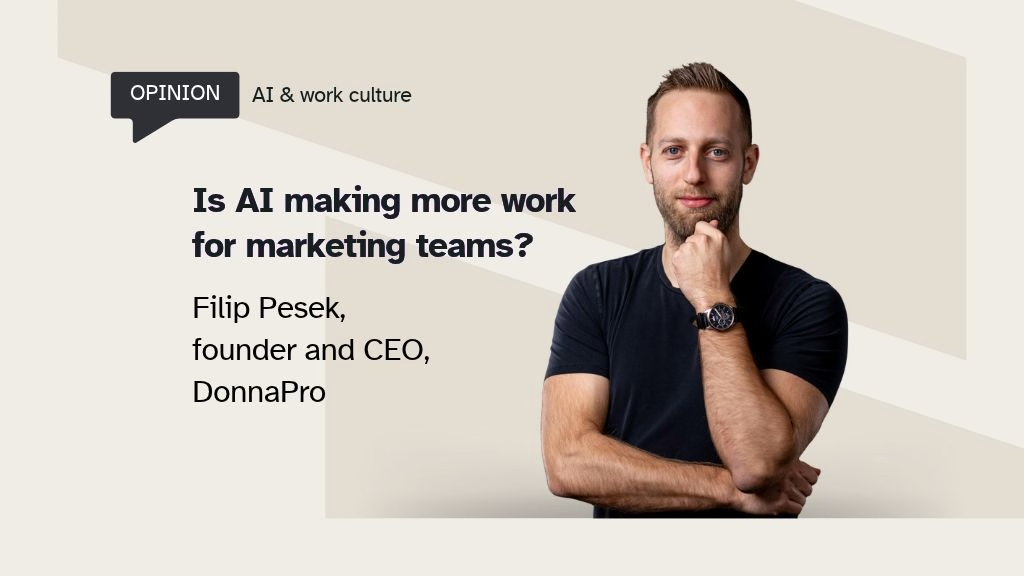
By Filip Pesek, former marketing agency owner and founder and CEO of DonnaPro, a European executive assistant agency for CEOs and founders.
Marketing is one of the sectors where AI is used most. It’s there to take care of repetitive tasks, speed up content production, and free up people to do the work that actually makes a difference. At least, that’s the theory. So, why are so many marketing teams and agency leaders finding themselves working harder? They’ve got the tools, and productivity has improved. But that’s partly because most team members are running themselves ragged. Leaders, especially. So, what’s gone wrong?
The problem is that businesses have misunderstood what AI can really change. And how much it relies on people to make it effective.
When the easy work disappears
Everything we’re told about AI positions it as a productivity tool. It can parse information in a fraction of a second, and produce a detailed campaign brief with a month’s worth of social posts in the time it used to take a person to open a document. It’s so fast, and so impressive. And that’s where the problem lies. Because all of that surface-level speed hides the fact that you still need a person to make that content usable. Does the brief address the right problem? Do the posts sound like the brand? Does the report tell a story worth reading? And even when those questions are answered, someone needs to get the client’s approval, respond to their concerns, and decide what happens when the campaign doesn’t deliver quite what they’d hoped for.
The easy work may have vanished, but that doesn’t mean that there’s nothing left to do. The work is still there; the need for skill and experience is still high. It’s just that the job has changed along with expectations, and experienced team members are working twice as hard to manage that.
What AI can’t do
Creativity is only part of marketing, and that’s the part that AI can help with. The rest comes down to understanding what it is to be human. Understanding why a client has stopped responding, working out why your audience isn’t engaging as you’d thought they might, or reconnecting with journalists who’ve stopped running your stories. That’s where human insight and interpretation are needed. Because sometimes, the most important part of a client relationship isn’t in the completion of the task, but in the contact you make. While AI can help you prepare for that follow-up call or problem resolution, it can’t understand the subtleties of the relationship or recognise the significance of a change in someone’s behaviour. For that, you still need people. And the more attention people devote to managing AI-generated work, the less time they may have to notice what’s happening around it.
The hidden risks
The other problem with automating routine work is that it can make missed tasks harder to spot. When AI is being used to manage an inbox, if a client message gets categorised incorrectly and consequently ignored, it can lead to a whole host of problems. So, while automation can make a process appear to be working, it can actually be hiding outright failures. It helps to separate two kinds of AI that usually get lumped together. Some tools sort and decide: filtering an inbox, routing requests, flagging what looks urgent. Others make things: briefs, posts, reports. They go wrong in different ways. Generated work fails in plain sight, even if it’s fluent enough to get past a tired reviewer, so someone has to check it piece by piece. Sorting tools fail silently. If a filter misreads one type of client email, it will misread it every time, and nobody notices what never arrived. That needs a different kind of oversight, a regular check on what the system is doing rather than a review of what it produces. Most marketing teams have built in the first and skipped the second, and in a job that runs on timing and responsiveness, that’s where the damage happens.
Of course, the risk here isn’t that AI will always get things wrong. It’s that teams may become less likely to notice when it does. And it’s this that is adding greater pressure to managers and leaders.
Someone still needs to own the result
AI isn’t the fix-all it’s often positioned as being. That’s not to say that it doesn’t carry enormous value. But it does mean that more thought needs to be put into where and how it is deployed. Including how responsibility will work once automation is in place. For every significant process, there needs to be a clear owner; not necessarily the person who creates the content or liaises with the client, but someone who is responsible for making sure the intended result happens. And a lot of the time, that’s already happening organically, but rather than being acknowledged and scheduled, it’s become invisible extra time. And that’s why the office is so constantly busy.
Rethinking what productivity means
AI can undoubtedly help marketing teams do more. But doing more isn’t necessarily the same as achieving more. AI can help with production. It can’t tell you what’s worth producing. If a team publishes twice as much content but has less time to understand its audience, the benefit is questionable.
AI can do a lot. It can parse data, improve decision-making, identify trends, draft rough copy, and make a whole raft of processes quicker and easier. But it can’t do everything. And it needs human oversight throughout. Particularly in marketing, the ability to understand people and respond to what they need underpins everything. So, if businesses want to maximise the potential of AI, without running their teams into the ground, they need to understand that while technology can now do a lot, it still needs people to make genuine progress.