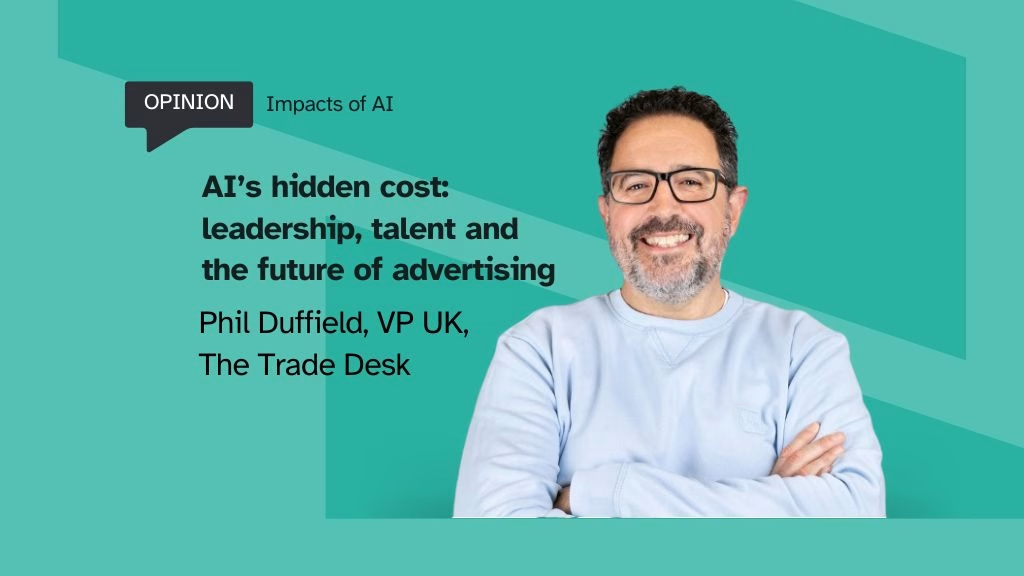
By Phil Duffield, VP UK at The Trade Desk
Artificial intelligence is transforming industries at breakneck speed. From reshaping workplace structures to redefining advertising itself, AI is becoming the centrepiece of strategy in many organisations. But amid the rush to adopt new technologies, businesses risk overlooking the two ingredients AI can never replace: leadership and creativity.
Manchester United is a cautionary tale here. Rather than building a culture of success on and off the field, they’ve instead focused on short-term cost-cutting and have seen their fortunes nosedive as a result. The same pattern is emerging in our industry: as businesses chase the AI race, they risk sacrificing long-term success for short-term savings.
Every week brings fresh headlines of organisations making deep cuts in their workforce under the banner of AI efficiency. And it’s not only existing careers that are being impacted, but prospective ones too – in September, the CEO of recruitment company REED highlighted that UK graduate jobs have dropped from 180,000 down to 55,000 in under four years thanks to AI.
While these cuts may please short-term balance sheets, the human impact is corrosive. Employees are left anxious, constantly looking over their shoulders and wondering, “will I be next?”. Fear like this doesn’t inspire innovation – it suffocates it.
Automation over imagination is a recipe for hollow storytelling
Picture this: it’s the end of 2026 and you’ve just signed off your marketing budget for the year ahead. The CFO review went smoothly – you’ve managed to cut spending while increasing household reach and projecting sales growth of 15%. Minutes later, you inform your agency that their contract won’t be renewed. Instead, you’ve handed over planning, creation and execution of all marketing activity to Meta.
Sound far-fetched? Not really. Earlier this year, Mark Zuckerberg predicted that AI would soon replace agencies entirely: marketers will simply set a budget and an objective, and algorithms will do the rest.
On paper, Zuckerberg’s idea might sound efficient. But efficiency is not the same as effectiveness. A dark picture is being painted for the future of the creative industries, where brand images are generic and easily replicable, and ‘journalism’ is fabricated. If brand-building is reduced to clicks and conversions, what happens to creativity? What happens to the iconic campaigns that define culture and build emotional trust over decades – like Coca-Cola’s Christmas truck, instantly recognisable in a single frame?
The likes of quality journalism and well-loved brands are not built on the sum of their sales or on performance metrics alone. They are built on creativity, storytelling and emotional connection. If AI becomes the sole driver we risk stripping these things of their distinctiveness, leaving them forgettable.
Combining human creativity with AI capability
Let me be clear: the danger is not AI itself, but the way businesses are choosing to deploy it. In the race to adopt this technology, too many businesses are sidelining their most valuable asset: their people. They see AI as a replacement rather than a partner – a shortcut rather than a tool for empowerment.
But eliminating people and creative talent in favour of algorithms is a false economy which leads to weaker leadership, fragile cultures and declining performance. This approach may deliver short-term savings, but it risks long-term brand erosion and talent loss. Without putting people and creativity back at the heart of decision-making, businesses risk losing talent, losing business, and ultimately finding themselves in the same pickle as Manchester United.
Instead, leadership must foster a culture of innovation where employees feel valued and empowered to push boundaries with the support of AI. It can play a powerful role, but it is not a substitute for vision, culture or imagination. The organisations that thrive in the AI era therefore won’t be those that blindly chase automation – they’ll be the ones that recognise AI for what it is: a tool that’s only as strong as the people and creativity guiding it, and the quality of the data it uses.
Marketers must champion a future that balances creativity with automation, taking decisive steps to ensure long-term brand building remains a human-led endeavour, not ceded to algorithms. Because the truth is that without strong leadership and inspired talent, AI ultimately risks becoming less of a revolution, and more of a reckoning.