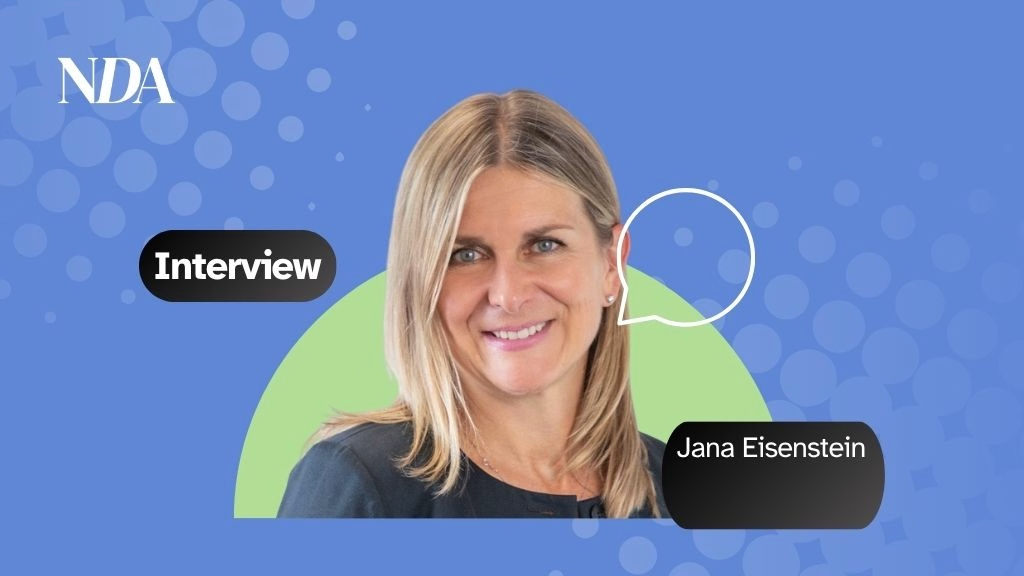
Jana Eisenstein is Chief Commercial Officer at Syllepsis, bringing over two decades of digital media and commercial strategy leadership, including executive roles at, Microsoft, Videology, ProSiebenSat.1, Vidsy.
How do you describe what Syllepsis does, and what core problem are you solving for businesses adopting AI?
We describe ourselves as a knowledge architecture company. While AI is incredible, its outputs depend entirely on the data fed into it. The main challenge for most organisations is that data is messy and unstructured.
It sits in scattered documents, individual processes, or simply inside people’s heads. If you do not get that foundation right, you cannot properly harness the AI agents or skills you build on top.
Over the past two years, our founder Jon has developed a product and service methodology to gather, structure, and codify institutional knowledge across commercial, legal, product, and organizational domains. Businesses are finding this to be the hardest part of AI adoption. They encounter issues with inconsistency, missing information, or incorrect outputs because of the classic ‘garbage in, garbage out’ problem.
We help them structure that knowledge so it integrates cleanly into AI tools, skills, and Model Context Protocols (MCPs), while providing the framework to maintain it over time.
Which sectors and client groups are you working with so far?
Syllepsis works with large media owners and advertising sales organisations across Europe, spanning television, radio and out-of-home. Our wider client roster includes companies in healthcare, education, professional services and the charity sector. Excitingly, we are about to kick off work in North America.
Three we are happy to mention publicly are Global Media & Entertainment Ltd., France Télévisions Publicité and Radio Marketing Service GmbH Germany.
In terms of functional areas, sales and marketing is usually the first port of call. It is a lower-risk starting point than finance or operations, yet it delivers immediate impact. By codifying institutional sales knowledge, companies standardise pitch materials, ensure quality, and give sales teams immediate access to consistent information.
What made you join the business, and what level of client leadership are you engaging with?
I joined Jon in September as client demand was ramping up significantly. Jon is a visionary product technologist, while my role focuses on building and commercialising the business, client engagements, and business development.
The offering resonates strongly with C-suite leaders and CEOs. Leadership teams recognise AI’s potential, but worry about how employees use it and how their business is represented externally.
Because institutional knowledge is sensitive and core to the business, managing it effectively has become a top strategic priority.
How does your work differ from traditional consultancies or systems integrators?
Systems integrators and traditional consultancies focus on architecture, process design, and large platform rollouts. They are ideal for massive, data-intensive transformations, but rarely go deep into an organisation to extract and codify human knowledge.
We see them as natural partners rather than competitors.
Many companies build internal AI teams and seek specialist partners for specific steps. Our role is to build the clean knowledge foundation that those tools and platforms plug into.
How do you actually capture knowledge that sits purely inside employees’ heads?
We follow a structured methodology developed by Jon. First, we align with leadership to define priorities and collect existing documented knowledge using our AI tools.
To capture the undocumented operational reality, we conduct structured audio sessions with key personnel.
Our tools process and assimilate all forms of input, highlighting inconsistencies and gaps across departments. We then present this refined structure back to the business as a centralized, maintainable knowledge map.
What is the biggest operational risk with AI companies face without a central knowledge structure?
The lack of a shared, persistent memory. When employees use unintegrated AI tools independently, they must search for and re-feed context every time. It is time-consuming, prone to error, and risks using outdated documents.
By establishing a central knowledge architecture with built-in access governance, every AI tool draws from the exact same verified source of truth.
Additionally, our approach is completely AI-agnostic. Whether a client connects ChatGPT, Claude, Gemini, or custom internal agents, every system receives identical, high-quality data.