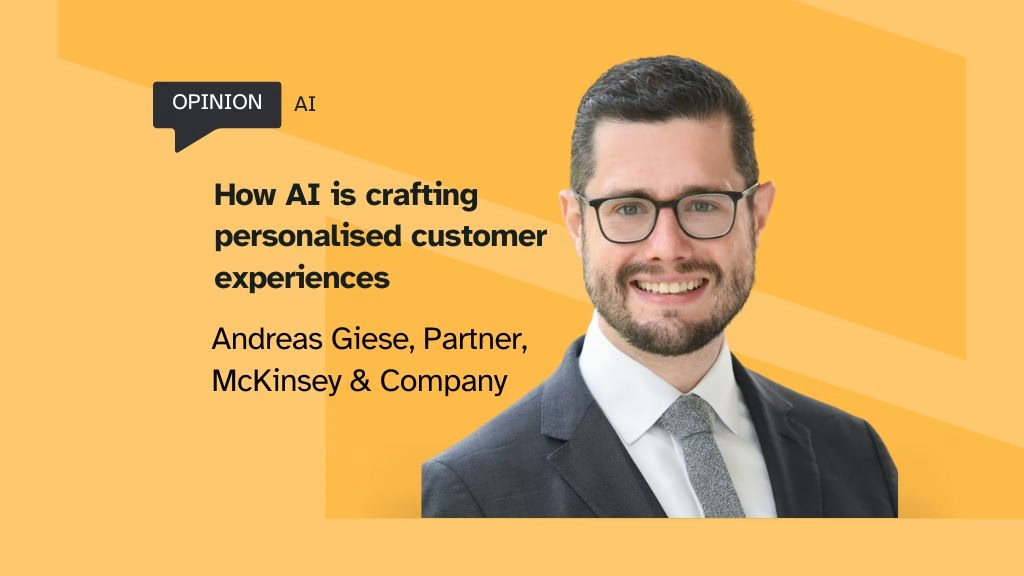
By Andreas Giese, Partner, McKinsey & Company
For decades, marketers and sales teams have pursued the idea of the ‘segment of one’. A customer experience tailored with such specificity that each prospect or customer feels seen and known as an individual, not just a face in the crowd. Evolutions in sales and marketing technology have brought this goal closer over the years, but the practical feasibility of the ‘segment of one’ has remained out of reach.
Now, AI is helping marketing and sales professionals take the biggest leap yet towards super-finely targeted customer experiences. Think of an AI-powered engine that quietly analyses behaviour patterns, spots friction before it appears and triggers the next action. A personalised message, a service prompt, a channel shift – exactly when the customer is most receptive. It’s now possible to deliver this kind of proactive experience design, both at scale and at a high level of granularity.
From ‘next best action’ to ‘next best experience’
This is the emerging discipline of the ‘next best experience’, and it’s becoming the strategic north star for customer experience leaders. The next best experience model allows companies to proactively deliver each customer the right interaction at the right time in the right place. This approach differs from the more-common ‘push’ approach, where a company essentially spams customers with offers or promotions.
Next best experience is more than just a highly detailed automated flow. It feeds integrated data sets that span the entire customer life cycle into machine learning- and AI-powered predictive models, to decide what a customer needs in a particular moment. It then delivers a personalised experience using GenAI content generation capabilities, so each person’s interactions with the brand are unique.
It can also be a powerful way to address damaging silos in customer experience management. For example, a company’s customer insight, customer loyalty, and marketing teams might all send separate comms to a single customer within a single day, causing them to disengage or unsubscribe. Next best experience can address these challenges by unifying comms, focusing on customer experience as a way to drive value, sequencing touchpoints, and then using AI to drive personalisation.
The measurable upside
There’s evidence that this approach can drive significant value. Companies applying this approach see customer satisfaction rise 15–20% and can expect revenue to lift by 5–8% through higher conversion, retention, and upsell. They also see the cost to serve per customer reducing by 20–30%. Taken together, that’s a potentially major lift in value for organisations deploying a next best experience strategy.
For example, take a major US airline that’s harnessed AI for predictive customer insights. Its approach has enabled more personalised offers for high-value or at-risk customers. By introducing machine learning models to inform recommendations, agents could prioritise specific customer segments and tailor their compensation accordingly. They differentiated between, say, a frequent flyer who’s faced three recent delays and a leisure traveller with no recent delays.
This AI-driven move led to a massive 800% increase in customer satisfaction, a 210% improvement in targeting at-risk customers, and a 59%reduction in churn intention among high-value, at-risk customers.
Steps to success
To make next best experience real without overwhelming existing teams, businesses can consider the following six steps.
1. Build a unified data foundation
Start by connecting core data sources like CRM, billing, and operations into an initial feature store or sandbox data lake. Use a proof-of-concept ingestion pipeline to validate data access and quality.
2. Deploy advanced analytics
Choose a high-value use case such as churn prediction or upsell likelihood and deploy a basic predictive model within a pilot workflow. Track weekly performance and use feedback loops to continually tune accuracy.
3. Strengthen the tech stack
Invest in tools like MLOps, DevOps, and MarTech to streamline model development and deployment. These systems also help tighten alignment between analytics and marketing, improving engagement.
4. Redesign operating mechanics
Revisit operating models to align incentives across teams. A unified contact policy, for example, enables coordinated customer interactions across billing, CX, marketing, and sales. A cross-functional team with shared goals can reinforce collaboration.
5. Measure impact rigorously
Set universal control and target groups to understand customer behaviour and track patterns in transactions. Use these controls for campaign A/B tests and maintain dashboards to monitor model performance.
6. Use a two-track delivery model
Run a small lighthouse pilot to generate quick wins while simultaneously building long-term capabilities – such as scalable data architecture and governance – to support a later, broader rollout.
The next best experience approach brings into reach a significant step up for sales and marketing teams. When businesses build AI-enabled targeting, prediction, and personalisation into their CX workflows, it can unlock previously untapped value.