Yext, a brand visibility platform that enables engagement across AI search, traditional search, social media, websites, and direct communications, recently launched a new Research division. Powered by over 2 billion trusted data points and a suite of integrated products, Yext aims to provide brands with real-time insights, AI-driven recommendations and execution at scale.
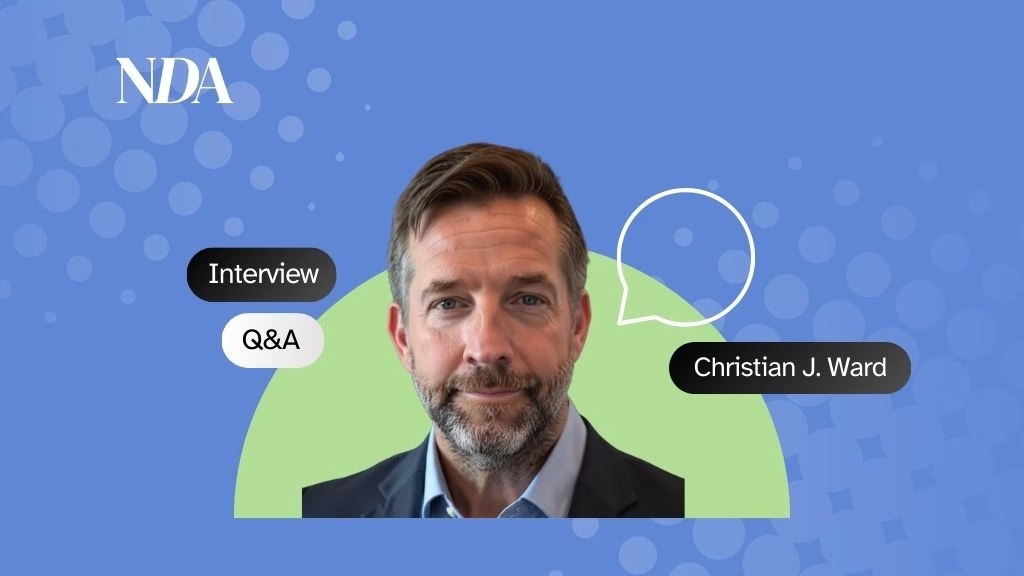
Christian J. Ward, Chief Data Officer at Yext, believes that improved reasoning and memory will make AI assistants the new gatekeepers of brand visibility, opening the door to a new era of Search Experience Optimisation (SXO).
New Digital Age recently spoke with Ward to learn more…
Tell me about your role at Yext.
My role is really about the data assets – the data our clients provide, the data Yext manages, and the data platforms need. We sit in between major brands, millions of small businesses, and a couple of hundred different platforms. My job is to make sure all parties are getting not just the right data, but also to help decide which data assets we should be investing in, improving, or expanding. I sit between product and client, so I can see both what we’re building and what the demand really is.
At its core, Yext is about brand visibility, whether you’re a global brand with thousands of locations or a single pub in a small town. Today nobody drives around looking for businesses. We look at our phones. Visibility has gone from being about street signs to being entirely digital. For us, the most authoritative source of information is the business itself. Our mission is to make sure their data (opening hours, availability, prices, specials and so on) is accurate and visible instantly across Google, ChatGPT, Perplexity, Bing, and beyond.
If a marketer is considering the potential impacts of AI Agents for the first time, what are the key things they need to be aware of?
Marketers used to think they knew the game: Google controlled the top of the funnel, and you optimized for that. What’s happening now is fragmentation. AI is stretching the funnel from top to bottom and walking consumers all the way through to purchase. That’s a huge change. Another big difference is that Google used to share data with marketers because they wanted ad spend. AI companies aren’t under that obligation. So the rules of engagement are shifting fast.
Is link-based SEO now redundant? Is it still worth doing?
Link-based SEO isn’t dead, but it’s evolving. Google’s original algorithm was based on citations, just like academic papers. Large language models work the same way, except they don’t just look for links — they look for any consistent, fresh data that increases confidence. It’s less deterministic, more probabilistic. That means every mention, every structured citation of your brand matters. It’s an evolution, not a revolution.
Structured data will always beat unstructured data when you’re dealing with machines. A business webpage might be 300 megabytes, full of images and stories. But the actual knowledge an AI needs from that page is about 25 kilobytes. If you give it that structured, machine-readable version, you’ve made its job easier and you’ll be rewarded with better visibility. The more you structure your knowledge, the more AI can trust it, and the more often it will surface your business.
What is Search Experience Optimisation (SXO) and how do you get started with it?
People aren’t typing three keywords anymore. They’re asking full, natural questions, in the way they’d talk to a person. That’s why we talk about ‘search experience optimization,’ not just search engine optimization. AI is adopting us, not the other way around. It’s meeting us more than halfway by letting us speak naturally and still get accurate results.
AI is the ultimate personalization engine. It remembers your context, your location, even your past conversations, and optimizes around that. For marketers, that means competition isn’t just brand versus brand anymore — it’s contextual. A burger chain might compete with sushi or falafel restaurants in one market and with another burger brand in a different market. Understanding that nuance is key to winning in AI-driven search.
What does success look like for Yext over the next 2-3 years?
The switching cost of AI is zero. If one AI gives me a wrong answer, maybe tells me a pub is open when it’s been shut for months, I’ll switch instantly. That’s why citations are the receipts of trust. The more a piece of data is confirmed across platforms, the more consumers and AIs can rely on it. For us, success means growing the Knowledge Graph so brands’ data is accurate, structured, and consistently cited everywhere. If consumers trust the AI, they’ll keep using it, and that’s what drives value for our clients.