Since its creation in 2018, Audion has focused on delivering digital audio ad solutions for brands and agencies, along with monetisation technology tailored to publishers and creators. Today, the company operates offices in Paris, London, Milan and Brussels, with a team of around 50.
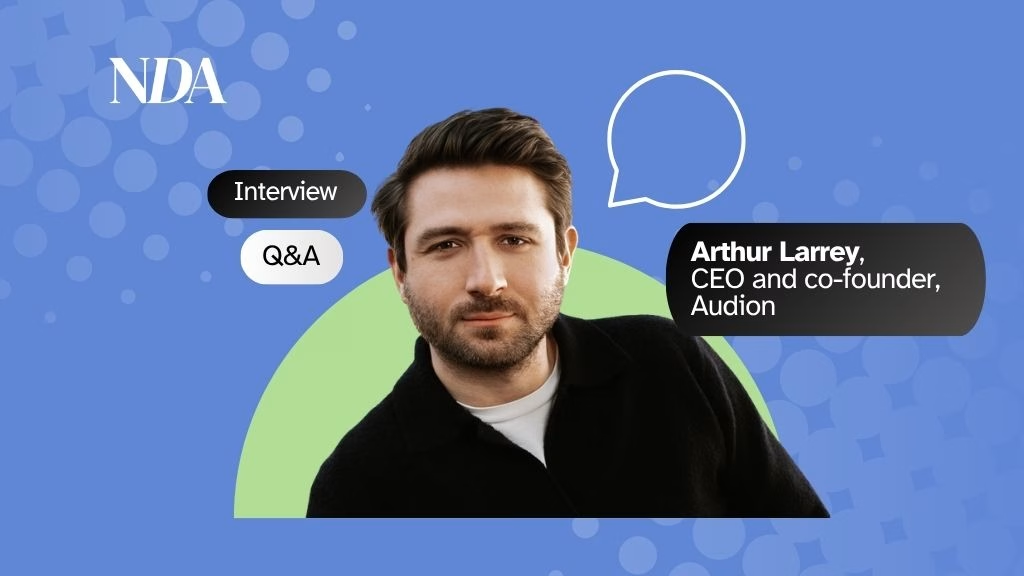
New Digital Age recently spoke with Arthur Larrey, CEO and co-founder at Audion, to discuss the evolution of digital audio, the growing role of AI, and why brands should rethink audio as a performance channel…
As CEO, what takes up most of your time? Where do you focus your energy?
The company was co-founded with my associate, Kamel El Hadef, who is responsible for the demand side, i.e. brands and media agencies, while I work with the supply side, in the form of platforms, publishers, talent, creators, and ad tech solutions.
My time is split between hands-on operational and technical work, both internally and with clients and partners, and more strategic thinking around the business and innovation. It’s a good balance, because if you really want to push innovation, you need to understand the operational pains that need to be solved.
Looking ahead 12 months, what are the company’s key priorities? What would success look like?
We just released Audion AI, our new audio and AI solution, which is a suite of AI agents allowing audio performance for brands and agencies. So the year will be very focused on launching and scaling that solution across all our markets. We also have three main priorities.
First, educating the market around performance audio. It’s still largely seen as a branding channel, whereas we believe it can drive much more performance.
Second, expanding adoption of the tool. We’re targeting more than half of our operations being transacted through our AI solution by the end of the year. It’s ambitious, but we believe we can get there.
And third, continuing to develop capabilities. AI is evolving daily, almost hourly, so you need to stay fully up to date to maximise what it can bring to your vertical.
What sort of support are clients asking for most when it comes to digital audio?
Most clients have already tested digital audio, and for many it’s been successful. Now they want to level-up to really make the most of it.
They’re asking for support around targeting and orchestration. How do you better target podcasts? How do you orchestrate campaigns across the full spectrum, including music, radio, podcasts, and video platforms? You need expertise to make that happen.
We still see too many bad creatives, often in the form of radio ads reused for digital, which aren’t suited to the listening experience. We help brands improve this, from standard production to more advanced approaches like dynamic creative optimisation or generative AI to create audio on the fly.
A final area of focus is measurement. The big challenge right now is proving that audio can be a performance channel. That means working on methodologies, KPIs, third-party measurement, and doing it in a highly automated way with feedback loops for optimisation.
Audio has traditionally been seen as a branding channel. Is that perception changing?
It’s still largely seen as a branding channel today, even though we’ve proven across hundreds of campaigns that it can drive performance. But it’s a journey. Measurement has been a key missing piece, and that’s improving. We can now track, measure and optimise across most KPIs that brands care about.
Beyond that, two major changes are helping. One is centralisation. It used to be very fragmented (different formats, different sales houses) and very hard to operate at scale. That complexity hurts performance.
The other is AI. For us, AI takes the form of dedicated agents across the value chain. You have agents for targeting, indexing content in real time, analysing emotion, ensuring brand safety, activating campaigns, optimising creatives, measuring outcomes, just about everything. These agents act as additional experts, each focused on a specific task, and together they drive better outcomes. That’s how we see the emergence of an “audio performance” category.
There’s increasing discussion around audio’s role in omnichannel campaigns. What are you seeing?
We’ve been working on some large studies around this, particularly on incrementality.
One area is the complementarity between digital audio and traditional radio. Adding digital audio brings clear gains, especially with audiences like younger or high-income groups.
The second area is broader omnichannel impact. One key insight is that audio can reach audiences that are hard to target elsewhere, especially high-income individuals who pay for ad-free environments. Podcasts, for example, remain highly addressable.
Another insight is that audio works very well alongside high-level branding channels like TV and CTV. We’re still analysing why, but my feeling is that audio offers strong attention, allowing you to reinforce branding messages delivered elsewhere. When you combine TV or CTV with digital audio, you see a significant uplift in performance and KPIs.
We’re continuing to develop these insights, but the early results are very encouraging.
What’s the single most important piece of advice you’d give brands investing in audio over the next year?
Approach audio with a performance mindset, just like you do with other digital media. The reach is there. The technology is there. You can measure everything. So treat it as a performance channel, ideally with dedicated experts to help you unlock its full potential.