The digital broadcasting landscape is undergoing a profound transformation, moving beyond traditional linear models to embrace a complex, multi-platform ecosystem.
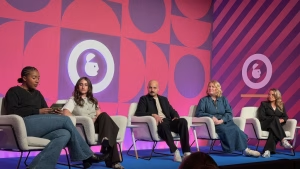
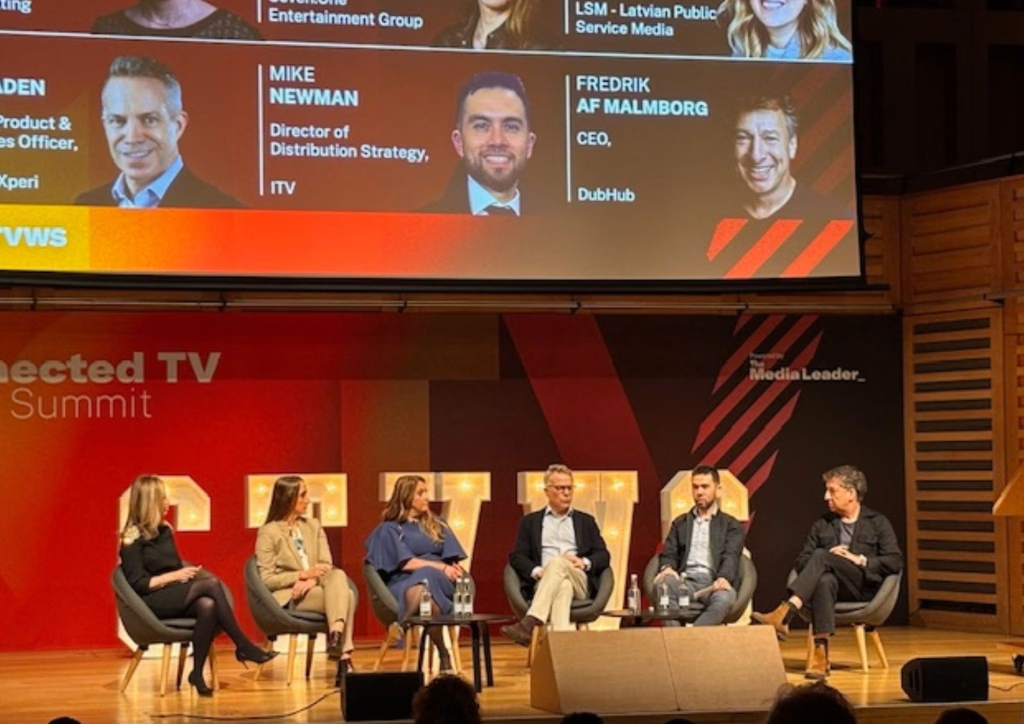
At the Connected TV (CTV) World Summit, a panel including Nicole Agudo Berbel (Seven.One Entertainment Group); Inga Alika (LSM – Latvian Public Service Media); Victoria Davies (Accelerate Consulting); Geir Skaaden (TiVo / Xperi); Mike Newman (ITV); and Fredrik af Malmborg (Dubhub), discussed the strategic shifts required for broadcasters to thrive in this new era. The conversation spanned the evolution of streaming services, the importance of local content, and the role of innovative partnerships and technology.
Evolving streaming strategies
Broadcasters are increasingly focusing on supercharging their streaming offerings to meet changing viewer habits. Mike Newman, Director of Distribution Strategy at ITV, highlighted the success of ITVX, which launched as a significantly expanded service compared to its predecessor, ITV Hub.
Newman said that ITV’s strategy is built on three pillars: “optimize broadcast, supercharge streaming and expand studios”. The launch of ITVX brought over 10,000 hours of content and introduced fast channels, making ITV the first public service broadcaster (PSB) in the UK to launch such channels within its player.
This shift is reflected in viewing data, with Newman pointing out that “40% of hours watching video on TVs was to services outside of linear broadcast and BVOD” in the previous year.
In Germany, Seven.One Entertainment Group’s Joyn platform has also evolved its business model. Nicole Agudo Berbel, Managing Director and MD, explained that Joyn started as an aggregator with a “two-folded approach”.
It offers an extensive advertising-based portfolio with over 100 live TV channels and a large FAST portfolio, alongside a growing subscription-based model. Berbel emphasised the importance of the “ad exchange” and “focused targeting opportunities” in their business model to achieve higher CPMs.
The digital advance in public media
Public service broadcasters are also making significant digital strides. Inga Alika, digital strategy consultant at Latvian Public Service Media (LSM), described Latvia as “super digitally advanced,” with high broadband penetration and a strong preference for subscription streaming.
LSM is currently working on a “unified ecosystem” that combines linear channels, radio, and video-on-demand under one proper streaming solution. Alika said that their strategy is “audience first,” with a focus on all connected TV devices, which are already heavily used by their audience.
Prominence and discovery in a global market
A central challenge for local broadcasters is maintaining prominence and discoverability on global platforms. Geir Skaaden, Chief of Product and Services Officer at TiVo/Xperi, observed that while users in all markets “want local content,” competing with global giants like Netflix and Disney+ for visibility on the home screen is “becoming increasingly competitive”.
He said that the home screen is an opportunity for platforms to work with local broadcasters to make their content more prominent.
This sentiment was echoed by Mike Newman, who discussed the “Freely” collaboration in the UK between PSBs (BBC, ITV, Channel 4, and Channel 5). He described Freely as an opportunity for PSBs to “in a way become owners of this TV platforms where we are distributed”.
This collaboration aims to ensure that PSB content remains easily discoverable as viewers move away from traditional broadcast to smart TVs not connected to an aerial.
Global reach and innovative technology
The future of digital broadcasting also involves looking beyond national boundaries. Fredrik af Malmborg, CEO of Dubhub, advocated for a more “global publishing world”. He highlighted the potential for local content, such as Turkish dramas, to achieve massive global reach through platforms like YouTube.
Malmborg also pointed to the role of AI in revolutionising content distribution. His company, Dubhub, uses an “AI dubbing” solution that significantly reduces the cost of dubbing content into multiple languages. He said that instead of focusing solely on national territories, broadcasters should “develop shows, launch them globally,” as the “entry barriers are nothing” today.
Future outlook
Looking ahead, the panel agreed that partnerships and a continued focus on local relevance would be key. Nicole Agudo Berbel stressed that “partnerships are essential” and must be measured with a “clear view on the own markets”.
Inga Alika highlighted the goal of becoming a “local digital content hub”. Geir Skaaden emphasised the growing importance of the home screen as a gateway for viewers to find content.
For Mike Newman, the focus remains on being “wherever the viewers are” and exploring new distribution opportunities. Fredrik af Malmborg concluded by encouraging broadcasters to “start to think more programming from a publishing model” and to “experiment things outside of your territory”.