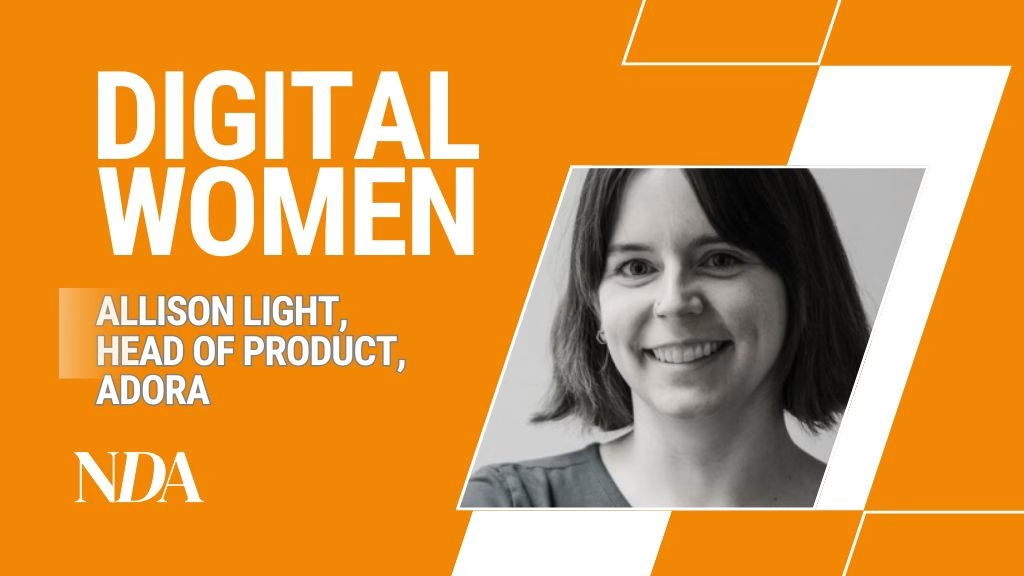
Allison Light is Head of Product at Adora, where she leads the company’s AI-powered platform for performance marketing. She has spent over a decade working at the intersection of content, performance, and applied AI. Most recently, she created Pinterest Trends at Pinterest and worked on the platform’s content ecosystem, helping businesses understand what resonates and scale it.
What are the biggest opportunities for women in your sector of the digital industry right now?
The way brands create and run marketing campaigns is being completely reimagined right now, and I think that creates a massive opening for women to lead.
AI is changing the game in digital advertising. Brands can now test creative ideas faster, understand what’s resonating with consumers in real time, and move from insight to live campaign in a fraction of the time it used to take. What that means is that the competitive advantage is shifting. It’s less about who has the biggest budget or the biggest team, and more about who can make sense of all the signals, from consumer trends to creative performance to cultural moments, and turn that into a clear direction that everyone can rally around.
That’s an orchestration skill. It’s about bringing structure and clarity to an overwhelming amount of information, and getting all the right people moving together toward the right outcome. Many women have been building exactly that muscle across campaigns, across teams, and across the many roles we play in our lives for a long time. Now the industry is finally catching up to valuing it.
At Adora, we work with enterprise brands to help them understand what creative actually drives results and produce more of it, faster. The marketing leaders I see thriving in this environment are the ones who can connect the dots between what consumers care about, what the brand stands for, and what the data is telling them all at once. That’s the opportunity.
What are some of the challenges that you still see for women in the industry? Any advice as to how to overcome those challenges?
The biggest challenge is still about who’s in the room when the important decisions get made. We’ve made real progress in marketing and creative leadership—but when it comes to the decisions that shape how businesses are built, women are still underrepresented.
My advice is two things. First, get curious about how the technology works. You don’t need to be an engineer, but understanding the tools that power modern marketing, like AI, automation, performance analytics, means you’re not waiting for someone else to explain the opportunity to you. You can shape it yourself. I created Pinterest Trends because I understood both the customer need and the technology well enough to connect them. That only happened because I refused to accept the status quo.
Second, and I feel strongly about this, don’t wait for permission. The moments that mattered most in my career were when I saw something that should exist and went after it. If you see a gap in how your brand reaches consumers, or a better way to connect creative with performance, or an unmet need in your market, go build the case for it. The industry moves too fast to wait for an invitation.
What support structures and organizations are most important and effective to you as a woman in the digital industry?
I’m going to give a maybe unexpected answer here: the most effective support structures in my life have been the ones I’ve built myself.
I’m an advisor to PEPS, a nonprofit in Seattle that connects parents through peer-support groups. They’ve been doing this since 1983 and have supported thousands of families. That organization taught me something I now apply everywhere: the most powerful networks are the ones built on genuine, reciprocal support among people going through similar things at similar times.
I actively cultivate mentor relationships across every aspect of my life, not just work, and across different ages and stages. Some of my most important sounding boards are childhood friends, former colleagues, fellow parents, and people who work in completely different industries. I’ve formed small groups with these people specifically to support each other, to hold space for vulnerability, and to learn from one another.
My advice to other women: don’t just join organizations, create your own circles. Find three to five people you trust, who are navigating similar challenges, and commit to showing up for each other consistently. That’s the infrastructure that actually sustains you.
What is the biggest misconception (a) about women in the digital industry, and (b) by women in the digital industry?
(a) About women: That being a woman is the primary lens through which to understand a woman’s experience in the digital industry. It’s one lens. But it’s not the only one—and it’s often not the most important one. You have women at different career stages with completely different challenges. Women in individual contributor roles vs. leadership. Women who came up through different disciplines and areas of expertise. The misconception is treating this as a coherent category with a set of known problems, when really it’s just: people navigating complex careers in a complex industry.
(b) By women: That you need to have it all figured out before you put yourself forward. I’ve watched brilliant women hold themselves back waiting for one more credential, one more year of experience, one more proof of competence. We internalize the belief that we need to earn authority before we claim it.
Here’s what I’d challenge: you’ll only learn the skill by practicing. You don’t develop judgment in a vacuum. You develop it by making decisions, getting feedback, refining, and doing it again. The people shaping the next era of digital marketing are the ones willing to lead before they feel ready—because that’s the only way you actually grow.
The landscape is moving too fast for perfect readiness anyway. Lead from where you are. That’s where the learning happens.
What one piece of advice would you offer a woman starting in the digital industry today?
Learn to be the person who brings clarity to chaos, because that is the skill that will compound more than any other in an AI-driven world. The people who win won’t be the ones who can produce the most. AI can do that. They’ll be the ones who can look at all of it and say: here’s what matters, here’s why, and here’s what we do next.
Start by asking “why” five times. Not to be clever, but to understand what you’re actually optimizing for. Then set your objectives, and connect your ambitions at work to your ambitions outside of work. Then co-build the how. Find peers and mentors solving similar problems, and iterate. Your career isn’t something you plan once. It’s something you refine forever.
And the exciting part: those same skills, synthesizing information, setting priorities, getting people aligned, apply to every part of your life. The boundary between “work you” and “life you” is blurring more than ever, and the tools we’re building can serve you in both. The women I admire most aren’t keeping those worlds separate — they’re drawing on everything they’ve learned across all of them to lead with more context, more empathy, and more conviction than ever before.