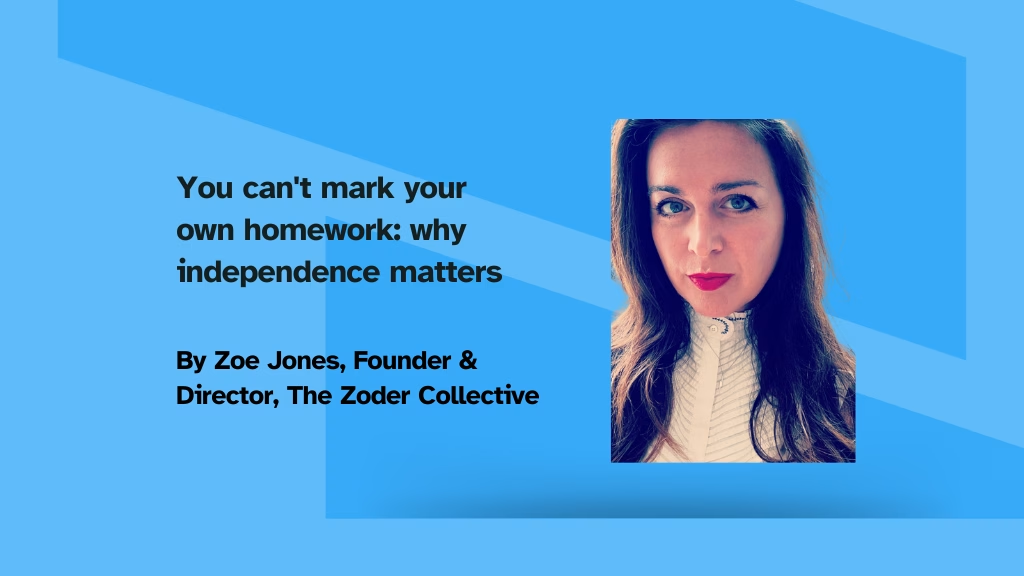
By Zoe Jones, Founder & Director, The Zoder Collective
Earlier this year, I joined Andy Oakes, CEO and Founder of Bluestripe Group and Justin Pearse, Editor-in-Chief, New Digital Age, on a panel at their #MarketingTheMarketers event, alongside Lydia Oakes, COO and Founder of Bluestripe Group, Seb Joseph, Executive Editor of News at Digiday, Kelaine Blades, Global Managing Director, Converged GTM & Operations, Havas Media Network and Maria Shcheglakova, Director, Global Marketing CTV and Data Advertising at TiVo.
We covered a lot of ground on marketing budgets and where spend is being scrutinised, cut, or defended, but one of the clearest points of consensus was: in-person events and peer recognition schemes are not just holding their own, they’re growing in importance. If anything, the noise and fragmentation of digital channels has made the things that can’t be faked – a room full of peers, a jury of independent experts, shortlists you didn’t write yourself – matter more than ever.
Awards represent a meaningful and often underestimated line in a marketing budget. Entry fees alone can run into thousands across multiple categories and schemes. If you’re shortlisted for something like a Sales Team of the Year, you’re potentially looking at creating a live presentation, coaching your team, travelling to a ceremony, and marking the occasion in a way that genuinely celebrates the people behind the work. Done properly, an awards programme isn’t a nice-to-have footnote; it’s a strategic commitment.
Twenty years of awards – from every angle
I’ve written awards entries, judged awards, launched awards schemes, been on stage to accept awards, spoken about their importance and advised teams on how to win. Each of these roles has taught me something different about what awards actually are. They’re not primarily celebrations, though they feel like one when you win. They’re not primarily marketing, though they function as that too. At their core, they are signposts – fixed, externally validated markers of where you were, what you built, and what the industry agreed was worth recognising. In a career and an industry where so much moves so fast and so much gets forgotten, signposts matter.
The awards economy
The global award management market is a multi-billion-pound powerhouse. Cannes Lions alone reportedly generated over $40m in entry fees in 2025. Businesses don’t pour that kind of money into being judged out of vanity, they do it because in a market saturated with self-proclaimed ‘bests’, ‘largest’ or ‘leading’. Third-party, independent verification is one of the signals people trust.
As befits a big global industry, the scrutiny on awards themselves is also sharpening. An industry study, The Business of Awards: 2025 Industry Insight, reveals that the global awards sector faces mounting challenges around credibility, return on investment (ROI), and the disruptive role of artificial intelligence (AI).
The report – based on a cross-stakeholder survey of awards organisers, sponsors, entrants, and judges, alongside interviews with leaders from Epica, Arc Europe, the PPA, Arena International, and more – highlights that fewer than half of stakeholders believe judging processes are transparent. Nearly a fifth go further, describing them as opaque.
As reported in Event Industry News, Mark Tungate, Editorial Director of the Epica Awards, said: “Trust is the currency of awards. Without transparent judging and clear separation of sponsorship from results, the commercial model risks collapse.”
Awards schemes that maintain rigorous, independent processes are becoming more valuable, not less.
Why independence matters
This month, Veridooh, where I work with the team as Fractional Marketing Director, has been shortlisted for two awards programmes: three times in the Campaign Media Company of the Year Awards in the OOH, Start-Up and AdTech categories and the Mumbrella Awards 2026, where the team is recognised in the Sales Team of the Year category.
For a company whose business is built on independent verification, being independently verified by industry juries isn’t just good to champion the work of the team, it’s proof of concept.
These nominations are significant beyond the recognition itself: for most of OOH advertising’s history, media owners have self-reported their own playlogs. Veridooh was built to change that and give brands the same standard of rigorous, independent verification in OOH that they can expect online.
Being shortlisted in such prestigious global awards schemes like Campaign and Mumbrella is a clear signal from the industry that this isn’t a niche concern anymore. Transparency and accountability through independent verification is becoming a competitive advantage for media owners and the OOH industry, not just an ethical preference.
What recognition does to a team – and to a market
For a scale-up like Veridooh, a young company asking an established industry to change how it verifies itself, every signal of earned credibility counts. A win, like Veridooh’s Gold in Digital Experience Platform at The Drum Awards 2025, when it comes from a genuinely rigorous process, is exactly that.
Awards function as a signal in the trust landscape – not proof of perfection, but a recognisable label that says: someone independent and respected evaluated this and decided it was noteworthy and worth showcasing.
The best work doesn’t just survive independent scrutiny, it needs it. Independence drives credibility, and confidence – the opposite comes from marking your own homework.
To the Veridooh team: these shortlists are recognition of our mission to power growth globally in out-of-home advertising. Whether or not a trophy follows, the standard we’re setting is being championed by independent judges. That’s exactly where we want to be.