Ocean Outdoor UK recently expanded the parameters of Digital Out of Home with the launch of Ocean® Portal, a new format which transforms high-footfall indoor environments into immersive, walk-in experiences, placing audiences at the centre of the story.
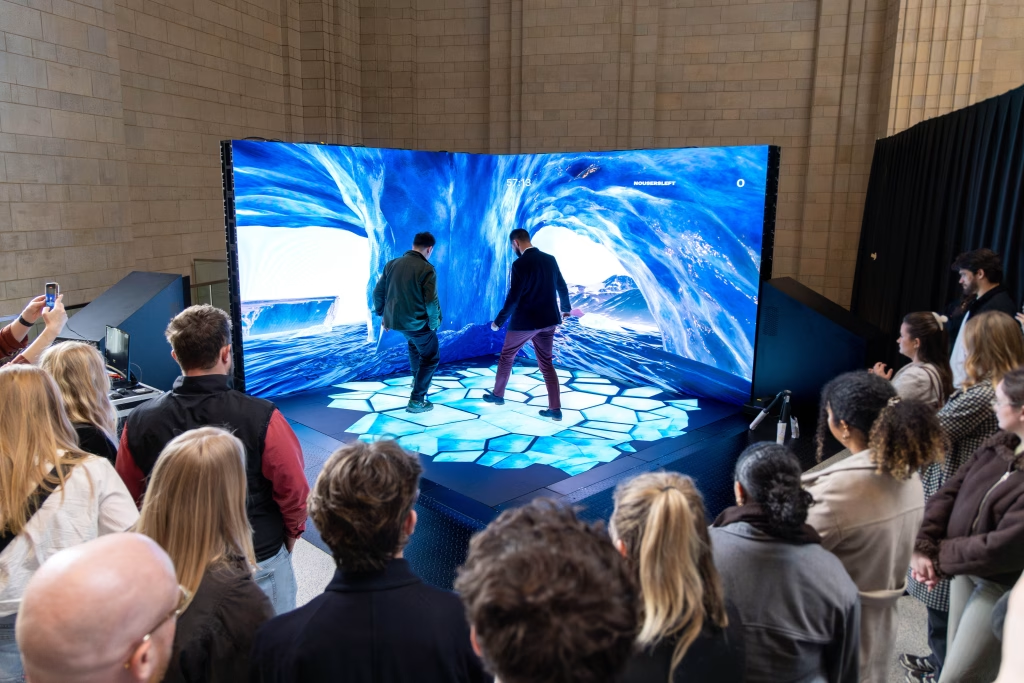
Developed by Ocean Studio and Ocean Labs, the Portal launched in the UK at London’s Battersea Power Station earlier this month with a bespoke entertainment showcase and content produced by Ocean Studio. It includes an interactive game with audio which challenges players to jump from floating ice blocks before they melt.
Measuring 4.5 metres wide x 3 metres high, the freestanding half cube stage is composed of five high definition LEDscreens – three interior including the floor and two on the exterior. The Portal is equipped with Ocean Labs technology, including real-time motion tracking and mixed reality, and features Ocean Studio’s 3D DeepScreen® capability. It is powered by high performance gaming and film industry hardware including Unreal Engine and Unity.
Engineered for durability, the Portal supports heavy loads, including vehicles and full-scale models. This enables brands to combine live product demonstrations with digital and cinematic effects, all within a single immersive space which is fully accessible.
Brands and agencies can book the Portal either as an exclusive, custom-built installation for a single activation, or as part of a curated tour concept, allowing multiple advertisers to share scheduled time slots at a single high footfall location. These can include retail destinations, shows and festivals, transport hubs and stadiums. The Portal is also available to brands and agencies in the German market.
New Digital Age spoke with David Tait, Group Creative Director at Ocean Outdoor to find out more…
Where did the original idea for the new format come from?
Over the last few years, we’ve been pioneering when it comes to creative digital screens. More and more, we’re not thinking of digital out of home (DOOH) as being just a screen. It’s something a bit extra. It’s an experience. It allows clients and their agencies to think outside the box when it comes to the content they can show.
We wanted to build a platform that was much more intimate and one-to-one. Portal is still a huge screen — four and a half metres square — but it’s something you can actually walk inside. You can have that personal interaction with the advertising, which you can’t necessarily do on a giant billboard. As a business, we’ve been doing experiential stuff for years, but we rarely did a digital activation and experiential together.
Given the format is so open creatively, how do brands approach creating content for Portal?
That’s exactly why we’ve decided to have creative people internally. We’ve been involved in creative consultation for years, because we’ve always had weird and wonderful formats — ceiling screens, circular spaces, places where you wouldn’t normally expect to have screens.
That allows us to help steer clients towards the best possible use of the format, and make sure the artwork that appears on our screens uses them properly. With Portal, that’s even more important, because every cell on that screen has possibilities, but those possibilities need to lead somewhere useful for the brand.
When a client approaches us, or when we approach a client, we go in with a concept that’s unique to them. At the site tours here at Battersea, we’ll even make something custom for them to show how it could look. Or we’ll talk through how they want to interact with the public. For example, do they want to put a product in the middle of it and have the screens react to it? Are we transporting somebody to a holiday destination? On every campaign, we have to help hold their hands a bit. That creative collaboration is massively important.
Is there a particular type of brand that this format suits best?
Yes and no. The clients we’ve been talking to have ranged from car brands, which was probably one of our first thoughts, to entertainment, film, and video games.
With cars, the idea of having the car in the shopping centre has been around for years, but now we can have the car driving on the road, changing the scene, being in the desert, responding to the car, or showing the interior when someone presses a button. That kind of thing has been getting a really positive reaction.
Entertainment brands, meanwhile, often want to transport their audience to another world. With a film, for example, all those assets already exist somewhere. If the right people talk to the right people at the right time, we can take that content and transport people into those different worlds. The video game model has been really interesting too, because we can make the whole Portal into a giant touchscreen.
Have there been any surprising use cases?
Anything where a brand wants to surprise the public, where they’re doing something they’re not used to doing — that’s exciting. We’ve had some really interesting conversations and we’re frantically writing things down after each meeting, thinking, “Oh, that’s a good way we could use Portal.”
What are the plans geographically for the new format?
At the moment we have two full units, one in Europe and one in the UK. The European one is in Germany at the moment, but that can move around our European markets. The UK one can go anywhere, really.
Part of the process is to create a known quantity, so when we approach different spaces — shopping centres, expo centres, ballrooms — we know exactly how big it is, how much it weighs, and how long it takes to build.
In the past, every experiential campaign was slightly different, so you’d have a whole new set of challenges each time. Now we can get things pre-approved, and landlords or venues can say, “We’ve already got it all signed off. Off we go.”
Has client demand changed much in recent months?
One of the key things we’ve found is that brands are embracing a lot of the new stuff. For us, anamorphic and 3D campaigns started in 2021, but actually we’ve done more of those this year, and even in the last few months, than we had in previous years.
What’s changed is that these innovations in DOOH aren’t just a first-to-market novelty any more. DOOH is becoming its own unique platform — almost a new area of out of home, what I’d call “experiential out of home.” That’s a real shift.