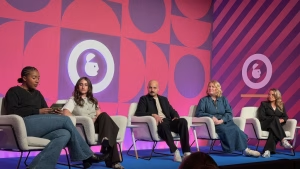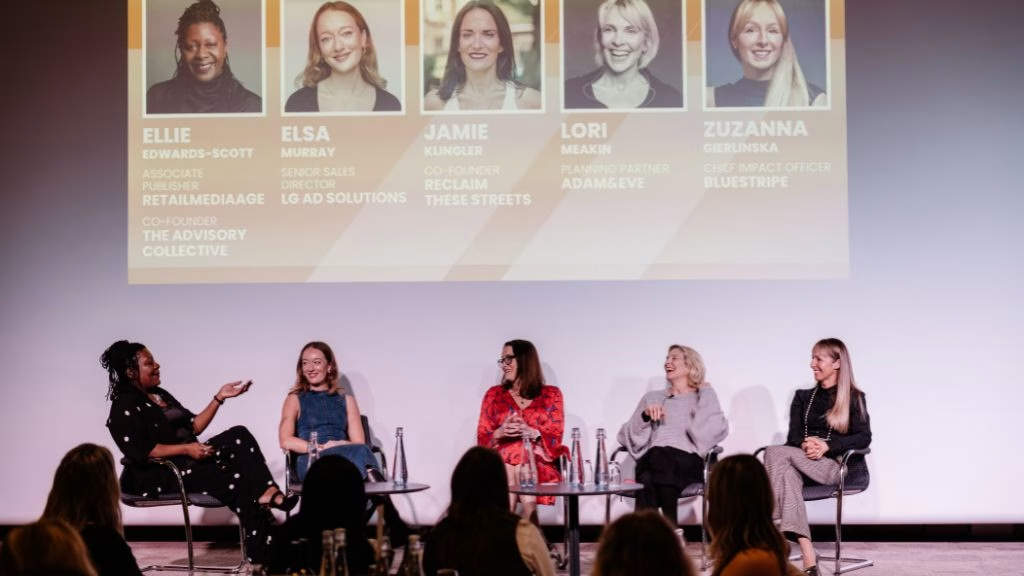
Marking International Women’s Day, New Digital Age brought together leaders from across the media and marketing industry to discuss what real progress on inclusion looks like in practice. The panel, held at NDA’s annual IWD event, explored uncomfortable truths about the sector, from structural bias in emerging technologies to workplace cultures that still marginalise women’s voices, and focused on the actions leaders and individuals can take to drive change.
The discussion featured Elsa Murray, Senior Sales Director, LG Ad Solutions; Zuzanna Gierlinska, Partner, Bluestripe Group; Jamie Klingler, Co-Founder, Reclaim These Streets and Founder, Creative Influence Alliance; and Lori Meakin, Planning Partner, adam&eveTBWA. The session was moderated by Ellie Edwards Scott, Co-Founder, The Advisory Collective.
While the conversation ranged widely, several themes emerged repeatedly, the importance of listening to lived experience, the need to redesign systems rather than simply adding diversity, and the role of everyday actions in shifting industry culture.
Activism through everyday skills
Kicking off the discussion, Jamie Klingler challenged the audience to rethink what activism can look like in a professional context. Rather than assuming meaningful change requires grand gestures, she argued that the most powerful contributions often come from applying everyday skills in new ways.
Klingler said: “You might go and do a phone bank for a charity and raise some money that day, but teaching them how to use SEO to fundraise changes the trajectory of their future.”
For Klingler, the principle is simple, industry professionals should consider how their existing expertise can empower communities. Training women to use AI tools to apply for jobs, or helping grassroots organisations improve their digital capabilities, can have lasting impact.
She emphasised that solutions should be shaped by the communities themselves, rather than imposed from outside. “It’s talking to women in those communities about what they need, not me going up and saying, how do I make this better,” she said.
Crucially, she encouraged people not to fear mistakes when engaging in this work. “We don’t know all the answers, we will misstep, but being willing to misstep if your heart is in the right place is a lot better than doing nothing because you’re worried about offending somebody.”
The double edge of AI
The rapid rise of artificial intelligence also emerged as a major concern, particularly its potential to reinforce existing inequalities if left unchecked.
Gierlinska highlighted the contradiction at the heart of the technology.
“It’s a real double edged sword,” she said. “This technology is phenomenal and has the opportunity to elevate the jobs that we do. But on the other side, it’s enabling more harm and more harassment of women, and AI is systematically embedding the biases that already exist.”
She cited examples ranging from concerns about wearable tech being used to secretly film women to research showing bias in AI-generated salary advice. In one case study, an AI system repeatedly recommended significantly lower salary negotiations for identical CVs when the candidate’s gender was changed from male to female.
“In some instances the recommendation was £200,000 lower,” Murray said. “For all of us working in this industry, we have a responsibility to question how AI is being used and what data it is trained on.”
Her message to industry professionals was clear, engagement is essential. “Ask the questions. If your company is using AI to scan job applications, ask how it’s been trained. Check the bias.”
Zuzanna Gierlinska argued that part of the problem stems from a lack of diversity among the people designing these systems.
“AI has been designed to favour men,” she said. “Women aren’t in the design elements, so it’s generating outputs that reflect that imbalance.”
Representation versus real change
A recurring theme throughout the session was the difference between surface-level representation and genuine structural change.
Lori Meakin described a persistent misconception that simply placing women in senior roles solves the problem.
“Having women in a masculine-coded environment that upholds patriarchal systems is not the job done,” she said. “If those women have to behave like token straight white blokes to survive, that’s not progress.”
Drawing on her experience in the creative industries, she pointed to the narrow definitions of taste and value that often shape marketing work.
“In creative industries we decide what’s ‘cool’, but who decides what cool is?” she asked. “Why don’t we talk about ‘cute’ as often as we talk about ‘cool’? The way we define good work is incredibly narrow.”
Meakin argued that expanding those definitions is not just about fairness but effectiveness. Women, she noted, influence the vast majority of consumer purchase decisions, yet their perspectives are often marginalised in the very industries trying to reach them.
The culture problem
Elsa Murray offered a personal example of how representation without cultural change can quickly become tokenism.
Joining a leadership team as the only woman, she initially encountered enthusiasm about the symbolic value of her appointment. But the day-to-day reality soon revealed deeper problems.
“They were very happy to have me out on stage and in front of clients,” she said. “But when it came to changing how the business actually operated, the culture didn’t shift.”
Networking activities remained male-dominated, while decision-making processes continued unchanged. For Murray, the lesson is that leadership teams must actively rethink how organisations operate if they want inclusion to succeed.
“You can’t just say, we’ve brought in a woman, job done,” she said. “You have to think about how you evolve the culture.”
Structural barriers still persist
The panel also highlighted the structural barriers that still shape women’s careers.
Gierlinska pointed out that even when pay parity exists within specific roles, wider life factors continue to create inequality. Caring responsibilities, parental leave and pension gaps all disproportionately affect women.
“It’s still never equal,” she said. “Even if the pay is the same in the same role, the structure of careers means women often lose out.”
Meakin reinforced this with research showing that each child a woman has tends to reduce her salary and promotion prospects, while the opposite effect is often seen for men.
“We talk about working mums all the time,” she said. “We rarely talk about working dads.”
Encouraging more equal parenting, she argued, could transform workplace equality.
The importance of sponsorship
Despite the scale of the challenges, the panel repeatedly returned to practical solutions, many of them relatively simple.
One of the most powerful is sponsorship, actively advocating for colleagues when they are not in the room.
“Put people up for promotions,” Klingler said. “Be them when they’re not in the room.”
Gierlinska highlighted initiatives aimed at building confidence among emerging voices in the industry, including programmes that train early-career professionals to speak publicly and represent their organisations.
“How many of your junior staff are you investing in?” she asked. “How diverse are they? Those are the people who will shape the future of your business.”
Changing the system, not the individual
Perhaps the most powerful message from the discussion was that the burden of change cannot fall solely on individuals adapting to existing systems.
“We are swimming in water that was not created for us,” Meakin said. “And we keep being told to change ourselves to fit the system. What we actually need to do is change the water.”
That shift requires action at every level, from leaders setting measurable diversity goals to individuals supporting colleagues and questioning ingrained assumptions.
As Klingler concluded, sometimes the smallest behavioural changes can signal the start of bigger cultural ones.
“Stop apologising for taking up space,” she said. “Stop saying sorry. Just stop saying sorry.”