The creator economy is undergoing a structural shift. Beyond individual influencers posting sponsored content, a growing tier of top creators are structuring themselves like modern media companies, cross-platform IP hubs, and broadcast studios.
To understand how this professionalisation affects advertisers, media agencies, and traditional TV, New Digital Age sat down with Ben Woods, Head of Creator Economy at Enders Analysis.
You are currently writing a report looking at how the creator economy is restructuring and professionalising. What is driving this shift?
It is important to clarify that this does not apply to all creators; only a certain tier has the scale and capability to operate like media companies. For those who do, the shift is happening across three main areas.
First, on the commercial side, creators are evolving their advertising models to capture premium spend.
Second, on the talent side, they are acquiring and managing talent to secure long-term business longevity.
Finally, they are operating in a multi-platform way, building media businesses that do not rely solely on video-sharing platforms for revenue. People talk about creators as IP or studios, but ultimately, they are thinking and behaving much more like traditional media businesses.
Media agencies have historically struggled to interface with creators due to a lack of traditional buying structures. Is that friction still there?
The creator economy accelerated so rapidly in recent years that legacy agency structures could not keep pace.
Traditional influencer marketing, such as engaging creators for sponsored posts or short-term brand campaigns to tap into audience trust, remains relevant. However, a disconnect arose because top-tier creators now look and operate like TV services.
They sell shows to major platforms like Netflix, develop transferable IP, and reach audiences across multiple channels. Consequently, they want the advertising industry to view them differently and provide better buying frameworks.
Put simply, they want to capture premium TV advertising budgets, either to sit around their programming or to fund it directly.
How are creators and platforms attempting to unlock those TV budgets?
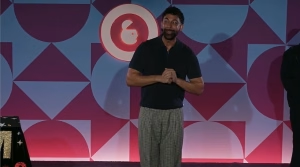
We saw a great example at the recent Arcade event, Europe’s inaugural invite-only creator media Upfront event. Creators are essentially offering media agencies contextual insights and the ability to buy across an entire ecosystem rather than just negotiating with single creators. Instead of buying one channel, an agency can buy across a vertical like food, finance, or sport.
That feels much more like traditional TV buying. YouTube is heavily supporting this push by positioning itself as the new TV, pointing to viewing habits on connected screens, professionalised creator programming, and tools like BrandConnect that streamline agency buys.
Naturally, the traditional TV industry responds by pointing to regulatory standards, brand safety, and compliance guarantees that platforms do not have to uphold in the same way. The debate now is whether those traditional protections warrant a premium price tag over creator ecosystems.
How are brands and media agencies responding to this evolution?
Agencies and forward-thinking brands are actively embracing these new models. Look at Lynx’s partnership with the Sidemen: Lynx understands youth culture, making that collaboration a seamless fit.
Brands are also realising they can entertain audiences directly on video-sharing platforms by working with independent producers. Many indies are now advising brands to channel a portion of their traditional ad spend into funding original shows directly on YouTube. Brands are increasingly open to experimenting in this space.
Is creator content still primarily a vehicle for reaching younger demographics, or has the audience broadened?
The perception that YouTube and creators only attract young people is out of date.
YouTube reaches every age bracket. Furthermore, consumer viewing habits have blurred the lines. When people sit down in front of a smart TV, they often just scroll and select content without actively differentiating between traditional broadcast apps and YouTube.
The industry recognises this broadening demographic. Prime Video rebooting The Grand Tour format with content creators rather than traditional hosts demonstrates that major platforms believe older audiences are fully comfortable with creator-led content.
Production values on YouTube have risen dramatically. How do the economics of creator production compare to traditional TV?
Most successful creators started with just a smartphone and scaled their production setup gradually as their audience grew, keeping overheads relatively low. However, as audiences and monetization grow, top creators are reinvesting substantial revenue back into production.
A big driver of high production value is direct brand deals. While platform monetisation provides a baseline, upfront brand partnerships give creators the capital required to commission bolder, higher-quality programming.
We are also seeing alternative, low-cost models succeed, such as the Time Team approach. By placing legacy TV catalog content on YouTube, they built a dedicated audience without initial production costs, then used Patreon subscriptions to fund new, TV-quality episodes.
There is no single approach, but the market is proving that alternative funding routes can sustain high-quality, brand-safe programming outside conventional broadcast TV.