The narrative surrounding Artificial Intelligence in digital advertising has fundamentally shifted. For years, AI was discussed primarily as an analytical recommendation engine, a behind-the-scenes tool used to optimise bids or clean data. Today, the conversation centres squarely on agentic AI, where systems are empowered to make standalone decisions and orchestrate complex workflows.
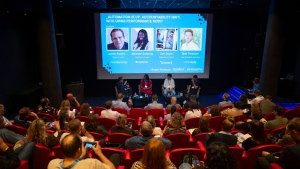
At the Programmatic Pioneers Summit, a panel moderated by Danny Holmes, Consulting Partner, Media & Agency at Experian, explored the delicate friction between this automation and essential human insight. The discussion brought together industry leaders to dissect what tasks are truly changing, where trust breaks down, and how the recent wave of tech consolidation alters the landscape.
Redefining roles across the agency spectrum
A common assumption in the industry is that automation will primarily swallow junior execution tasks. However, the panelists argued that agentic workflows are fundamentally reshaping management-level responsibilities as well.
Alys Donnelly, Head of Media Operations at WPP Media, observed that the transformation spans across systemic agency workflows rather than isolated tasks.
“It’s interesting now how it all connects together into systems and workflows. The main change is going to be that people will have to exercise sound judgement, just because there’s so much involved in that. We have access to so much more data than ever before, and people will have to have the ability to ask the right questions and decide from options,” Donnelly said.
This shifts the traditional responsibilities of middle management. Donnelly added, “I’d actually say that it’s going to affect managers as well. A lot of our role is around managing workload and optimising processes. We may be doing less of that, and instead focusing on mentoring, nurturing talent, and strategic oversight.”
Esme Wood, Head of Programmatic at The7stars, echoed this sentiment, noting that agentic flexibility will require teams to possess advanced strategic data literacy.
“We need to understand more data, how we are utilising it, and ensure that we get correct outputs. The strategic and comparable protection for decisions is a critical part of the human role,” Wood explained.
The reality of trust and human intervention
While the technical capability to deploy autonomous agents exists, building organisational trust remains a steep hurdle, particularly within complex ecosystems like retail media.
Ben O’Mahoney, Ad Tech & Data Partnerships Lead at Ocado Retail, raised doubts about completely removing human oversight from media planning in the near future.
“The data is there as retailers. If you put that into an agent and ask it to build a plan, would you feel comfortable enough to say, ‘Okay, now just go deploy that without a human eye?’ I don’t think that that’s quite there because media is a really critical function in terms of driving traffic and brand growth. I can’t see a world right now, until there are proven use cases of these automated plans, where there won’t be human intervention,” O’Mahoney remarked.
Stefan Kozel, Sales Director at Nexxen, agreed that trust is a spectrum built over time through rigorous transparency, but highlighted that certain parameters should remain strictly off-limits for autonomous systems.
“There are some things that you want to become comfortable with, but there are others you don’t. There are agents that go away with things like brand safety. When you are looking around at that, there will always be a need for humans,” Kozel noted.
Consolidation, compute costs, and the future horizon
The panel also addressed the recent flurry of data and technology acquisitions across the industry, questioning whether consolidation signals an era of rapid agentic innovation or a race to secure proprietary data ecosystems.
O’Mahoney viewed agency acquisitions as a clear strategic signal: “It’s a signal from the agencies as to what the direction of travel is. Our strategy is to plant our data into the right places so we can be leveraged by these agents. I think it’s just a new way for them to have ownership of their own technology.”
However, driving efficiencies through these technologies introduces a paradox: the skyrocketing cost of compute. Holmes pointed out a recent interview where the CEO of Nvidia suggested that businesses may soon need to factor the immense cost of AI compute directly into employee overheads, expecting those workers to become ten times more productive to offset the expense.
Looking two years into the future, the panel concluded that the industry risks overestimating the immediate independence of AI while severely underestimating the importance of data quality and foundational human governance. Ultimately, the future of programmatic planning lies not in choosing between machine speed and human oversight, but in mastering the orchestration of both.