The advertising industry has spent years trying to understand how to reach audiences in an increasingly fragmented digital landscape. Now, as users shift their search behaviour from Google to AI platforms, a London-based venture is focusing on capturing the high-intent traffic that flows out of those environments and into the open web.
This interview is part of NDA’s continued focus on companies launched by experienced industry figures, driving the next wave of innovation in our industry.
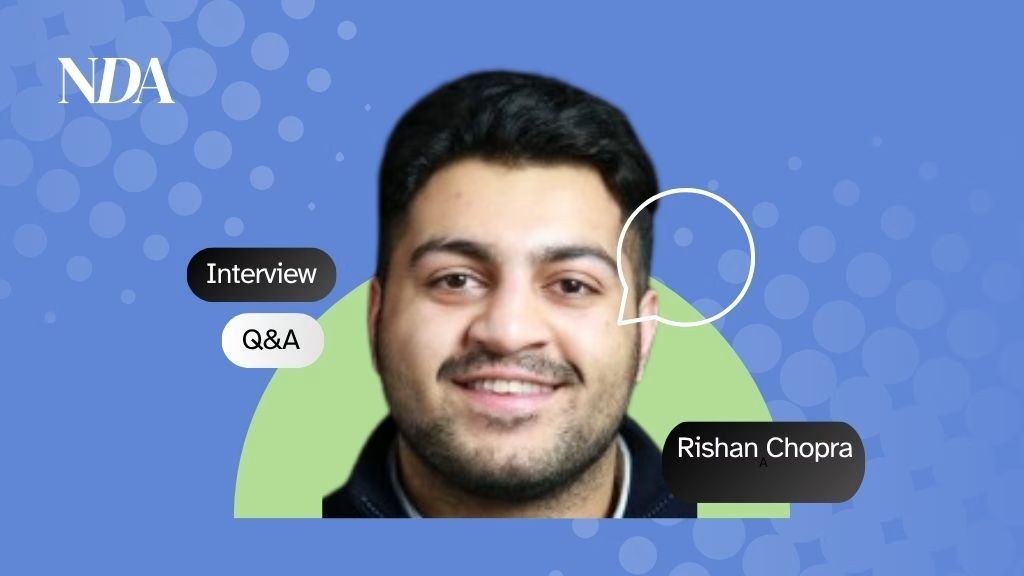
Adgent, founded by Rishan Chopra, a programmatic veteran with experience at MIQ and Amazon, launched towards the end of 2024 with a very different proposition to the one it operates today. The company’s original premise was to help smaller, longtail AI applications monetise through in-chat advertising, essentially replicating what ChatGPT has since begun exploring with ads inside its platform, but for the less prominent players in the space.
The pivots that led to the product
After more than 60 conversations with paid search teams across brands and agencies, Chopra identified three consistent blockers: the lack of scale in the smaller AI applications, brand safety concerns, and a fundamental question advertisers kept asking, which was why they should care about smaller AI platforms when the biggest ones were also free.
“The feedback was essentially, we don’t care that much about putting ads in the smaller AI platforms,” Chopra explains. “What we care about is how to influence the big ones.”
That prompted a pivot around May 2025 into the then-emerging world of generative engine optimisation (GEO), helping brands appear within AI-generated answers. It was a logical move, and a busy space. The GEO market quickly became commoditised, and Chopra found himself asking the same question again: where is the genuine, defensible opportunity?
The answer came from a trend he was already observing. Open web traffic was declining, because users were getting their answers inside AI environments without needing to click elsewhere. But at the same time, the traffic that AI platforms were sending to the open web was growing, and it was qualitatively different.
“These users arrive on site with much more intent,” Chopra says. “They’ve gone through their search in the AI environment and they’re only clicking out once they’re ready to go further in that search journey.”
Building the programmatic bridge
That insight became the foundation of Adgent’s current model. The company now connects advertisers with users as they transition from AI platforms to the open web, doing so through existing programmatic infrastructure rather than requiring any new direct relationships with the AI platforms themselves.
The execution works in layers. When a brand, a travel company targeting UK holiday bookers, for instance, comes to Adgent, the team begins by generating prompts at scale that reflect the kinds of questions their target audience might be asking an AI.
Those prompts are run through the relevant APIs, and the responses are analysed not just for content but for the publishers being cited within them. Adgent then builds an index of those publishers, filtering it down to those that are monetising programmatically and already seeing meaningful volumes of AI-referred traffic.
“We’ve identified these publishers have been cited for these types of prompts,” Chopra explains, “and of those publishers, these are the ones who are seeing growing amounts of AI traffic and are seen as premium environments.” From there, deals are set up within SSPs, with PubMatic currently onboarded, and impressions are routed through to the relevant DSP or media buyer.
The results so far, and what’s coming
The early signals are encouraging. An initial test with a travel brand focused on sailing holidays produced a 2x uplift in click-through rate alongside quality site visits at approximately 60% lower cost per click. The users arriving via this method, Chopra argues, have effectively been “qualified by AI” and are sitting at the mid-to-lower end of the purchase funnel by the time they encounter an ad.
A more precise layer of targeting is in development. Adgent is building deeper integrations with SSP partners that will allow real-time identification of AI-referred users as they exit those platforms and hit the open web, with a target launch around mid to late May.
“Advertising in ChatGPT is predominantly going to be a paid search opportunity,” Chopra says, addressing how agencies should think about budget allocation. “We’re going to help you reach the same users, the same AI users, but as they click and enter the open web.”
Chopra is confident the contextual, prompt-led approach gives Adgent a structural advantage. With active campaigns live and case studies expected by end of quarter, Adgent is on a mission to help advertisers use the power of AI to drive efficiency of advertising on the open web.