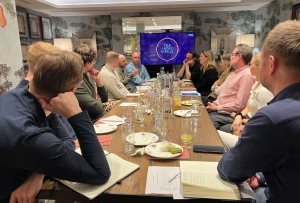
At the recent New Digital Age in partnership with Outra roundtable, guests from leading UK media agencies gathered to explore how location and household-level data are transforming modern marketing.
This is the second part of the writeup of the discussion. See part one here.
In an environment where personal identifiers are increasingly constrained, these data types are enabling better audience planning, channel activation and measurement.
Ilona Spilker, VP, Head of Partnerships at Choreograph, put it succinctly: “We’re no longer just trying to reach someone in a moment. We’re building a behavioural model based on where they go, what they do, and why.”
From individual IDs to household moments
Oli Bello of Outra emphasised the power of predicting real-life events.
“Moving house, having a child, retiring—these household-level moments are more powerful than an online behaviour that may or may not indicate intent.”
Lina Angelides of OMD UK added: “These signals let us move beyond the browser into planning with true behavioural context. It’s a more human way to understand audiences.”
Rebuilding omnichannel the right way
Chris Appleton of PHD said that location data has breathed new life into omnichannel thinking. “We used to talk about omnichannel, but struggled with execution. Location data lets us unify campaigns across out of home, CTV, audio and programmatic.”
Emma Glenn at Spark Foundry said charities and retail brands were already benefitting. “It’s especially useful in campaigns where driving footfall or event attendance is the objective. We’re seeing strong results.”
Layla Malki added that planning flexibility is key. “The beauty is, you can start with insight and scale it across all your media touchpoints, not just in programmatic silos.”
Planning and creative alignment still lags
Despite these benefits, many guests noted the ongoing difficulty of connecting data-led planning with execution.
Graham Field from Outra said: “Great ideas fall apart when execution teams can’t translate them into scalable action. It’s not about the data itself, but how you make it usable.”
Oliver Williams of Mediaplus UK pointed out another pain point: “Sometimes what sounds good on paper becomes commercially unviable in delivery. A segment of 2,000 postcodes might sound great, but without scale, it creates frequency issues.”
A more considered use of technology
Billy Brett of Walk-In Media proposed smaller, tactical steps. “It doesn’t always need a full transformation. Try weighted bidding scripts based on postcode value. You can demonstrate uplift without reinventing the strategy.”
David Ayre of Dentsu stressed that success requires bridging team expertise. “With data-led planning and buying maturing with tech advancements, skill sets within traditional media channels are evolving. Agencies have been upskilling, with data being the basis for planning, activating and measurement for a holistic omnichannel strategy.”
AI as both help and hurdle
As AI becomes part of every media conversation, guests noted both its promise and its friction.
Graham Field quipped, “The fastest-growing role thanks to AI? Compliance officer.” But he added, “With the right guardrails, AI will help unify data sources and scale performance.”
Charles Crotty of Digitas said AI was creating narrative urgency. “If clients want more FTEs or tech budgets, they’re wrapping the ask in AI. It gets board-level attention and funding.”
The road ahead: insight into action
Ultimately, the roundtable revealed a shared ambition: to shift from siloed media execution to holistic, data-led strategies grounded in real life.
Ilona Spilker summed it up: “Household and location data help you plan around real behaviours, not just digital signals. That’s the future, and it’s already here.”