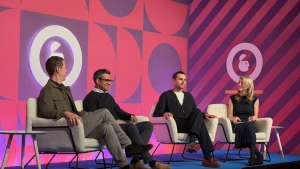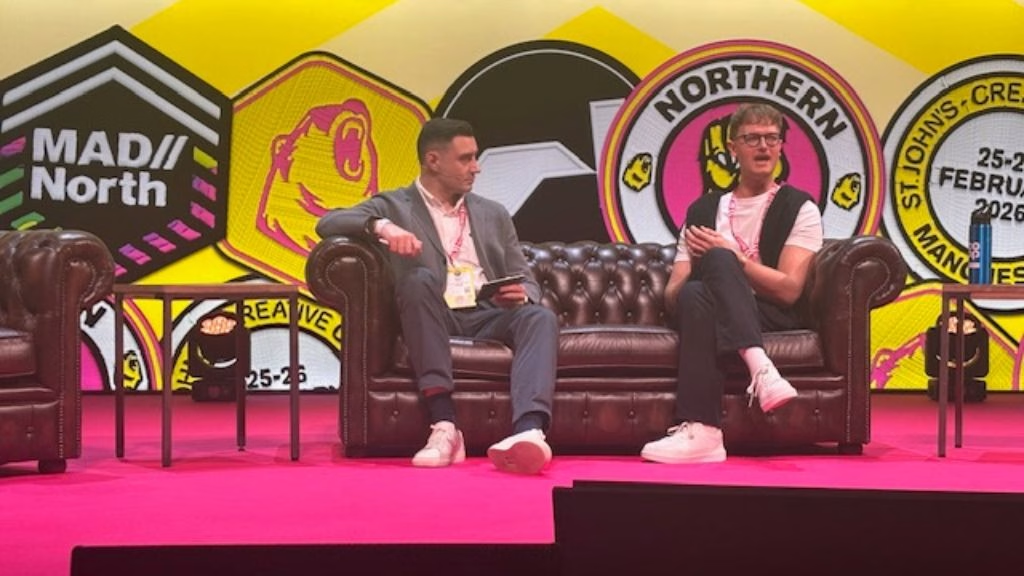
In an era of increasing concerns over data privacy, marketers are facing unprecedented challenges in how they use consumer information. At Madfest North, Rob Smart, Senior Vice President at LiveRamp, sat down with Dominic Adams, Performance Marketing Lead at the Co-op, to discuss how one of the UK’s oldest retailers is navigating this evolving landscape through a data-centric and customer-focused approach.
The drivers of change in retail marketing
The Co-op, with its 180-year history, is no stranger to adaptation. However, recent years have seen a significant shift in how the business approaches marketing, driven largely by external factors. Adams identified three key drivers: the depreciation of third-party cookies, increased regulation, and the economic pressures of food retail.
“The depreciation of the third-party cookie… how we used to market, how we used to use data signals and the kind of access to data that we once had, has depreciated,” Adams said. This industry-wide change has prompted a shift towards first and second-party data strategies.
Smart observed that these silos are beginning to break down, asking how Co-op is adapting to a world where first-party data is now central to “targeting and measurement”.
In the competitive food retail sector, where margins are thin, the need for efficiency is paramount. Adams explained, “As retailers, we’ve got to think about new ways that we can monetise, we’ve got to think about new ways that we can drive profit”.
Mission-based advertising and customer segmentation
Central to the Co-op’s strategy is a sophisticated approach to customer segmentation. Recognising they cannot be everything to everyone, the Co-op focuses on being the “retailer of convenience” for specific target segments, such as “members,” “make it simples,” and “creative cooks”.
Smart recognised the importance of these distinctions, specifically highlighting the “creative cooks” and “make it simple” categories. By understanding these different “missions,” the Co-op uses various data signals, location-based, behavioural, and offline versus online habits, to serve relevant advertisements.
“We’re using the right data signals to effectively show up in the right place, at the right time, to the right customer,” Adams said. This targeted approach has led to “great success in ROI,” even if it means sacrificing some reach in favour of specific, high-engagement messages.
The convergence of retail media and performance marketing
A significant organisational shift at the Co-op is the closer alignment of retail media and customer marketing teams. Smart pointed out that these two parts of a business “often have separate profit and loss” and “work very differently,” but are now moving “under the same banner”.
Adams described the relationship between these teams as having evolved from “cousins” to “brother and sister”. This integration allows for a more “omni-channel” approach, where retail media insights from the in-store journey are combined with the customer marketing team’s expertise in digital and data-led marketing.
This collaboration aims to improve media effectiveness for both the Co-op’s supplier base and its customers.
Addressing the talent gap and Gen Z expectations
The discussion also touched on the growing “talent gap” in the marketing industry. Smart said that Gen Z represents a “unique double threat” as both customers who expect seamless personalisation and employees who expect the technology to deliver those experiences.
Adams expressed concern over the 40% year-on-year decline in entry-level and graduate roles in marketing. He highlighted the unique value that Gen Z professionals bring: “They simplify… they almost bring it back to just the simplification of, you know, what are we trying to do? What does the customer want?”.
Smart echoed the need for empathy toward this new generation, noting, “Many people in this room… had to move away to get a first job… or get an extra qualification”. He warned against “pulling the drawbridge up” and shooting the industry in the foot by failing to support the next generation of talent.
The future: marketing to machines and humans
Looking ahead, Adams predicted that the focus for marketers will shift towards creating holistic experiences. This involves not only marketing to human beings but also “marketing to machines,” such as AI models, to ensure brands show up in the right spaces.
Smart asked what practices we might see disappear in the next two years. Adams suggested that the days of marketing teams driving their own isolated agendas are over. Success now requires “the buy-in and the collaboration between your commercial teams, your supply chains, finance”.
In this rapidly changing environment, the most important trait for a marketer is an open mind. “How things worked five years ago, it’s not how it works anymore,” Adams concluded, emphasizing the need for an environment where teams can “test, fail, but ultimately learn and grow”.