With multiple screens demanding equal attention in the living room, how can brands unlock cohesive ad experiences, no matter the touchpoint?
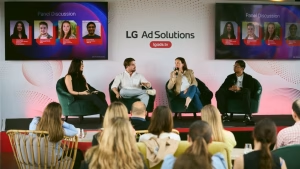
In a world where living rooms resemble control centres of digital media, a panel discussion From View to Value: Getting Results from the At-Home Viewing Experience brought together leaders from across the ecosystem to explore how brands are navigating this fragmented landscape. The panel, held at The Era of Omnichannel event from Adform, featured Alex Wright, Programmatic & Data Leader at Channel 4; Nathan-Taylor Billings, Kinesso UK & IE; and Peter Sensier, Growth Marketing Director at Carwow. The conversation was chaired by Paul Gubbins, VP Sales & Programmatic Partnerships, Tubi UK.
Understanding the multi-screen moment
The conversation opened with a look at how brands should respond to the increasingly fractured attention spans of at-home audiences. With viewers often watching TV while simultaneously using phones, tablets, or laptops, context is critical.
“75% of our views take place on a big screen,” said Alex Wright, Programmatic & Data Leader at Channel 4. “So it’s typically a shared viewing experience, reaching more than one set of eyeballs. For me, the answer is to make sure you’re putting the best premium content out there and allowing brands to be around that content.”
Nathan Taylor-Billings, Head of Addressable Activation at Kinesso, reinforced the idea that being screen-agnostic is essential. “Nowadays, I’m not only watching football on TV, but I’ve probably got my work laptop out, my work phone, and my personal phone too,” he said. “It’s not just about one device anymore, it’s about multiple touchpoints. So we look at how we can create a relevant, sequential messaging strategy across them.”
Data, targeting and context
On the brand side, Carwow’s Peter Sensier emphasized the critical role of first-party data. “We start with detailed audience segmentation using our own data. Then it’s about partnering with the right platforms to reach those segments in brand-safe, effective environments,” he said.
But it’s not just about data for retargeting and remarketing. “We use data in two lenses,” Sensier added. “Firstly, for direct marketing, reaching car buyers or remarketing. Secondly, our OEM partners, like car manufacturers, who want access to segments of our audience.”
Redefining ‘premium’
The discussion then turned to the changing perception of what constitutes ‘premium’ content in an era where YouTube and TikTok compete with traditional broadcasters.
“Premium is professionally produced and regulated content,” said Wright. “Channel 4 content is not only regulated by Ofcom, but also our ads go through Clearcast. That makes a difference.”
However, as user-generated content (UGC) continues to grow in sophistication, Nathan Taylor-Billings argued that premium can be subjective. “What’s premium to one brand might not be to another. We plan based on where our audiences are, and sometimes that’s with UGC creators.”
Fragmentation and the challenge of attribution
One of the more pressing issues raised was whether the growth in ad-supported streaming is leading to a more fragmented ecosystem for media buyers.
“TV buying is becoming more like an extension of digital,” said Taylor-Billings. “But the lack of cookies and the rise of different identifiers make the space harder to navigate.”
Wright highlighted Channel 4’s approach in countering this: “We didn’t want to create another walled garden. That’s why we made our inventory available programmatically, where agencies were already going. We’re tech-agnostic and available across platforms.”
Attribution was another hot topic. Sensier described Carwow’s layered approach to measuring impact. “We use MMM [media mix modelling], incrementality testing, and path-to-conversion studies. There’s no silver bullet, but a combined approach gives us confidence in what’s working.”
For Talor-Billings, the challenge is one of access and scale. “It’s easier for big advertisers with the budgets and internal teams to set this up. Smaller advertisers face barriers, but programmatic tools are starting to democratize that.”
Programmatic TV opens new doors
With the rise of addressable and programmatic TV, the panel agreed that we are entering a new era where performance marketers can play in traditionally brand-focused spaces.
“Programmatic has democratized the buying of TV,” said Wright. “We now offer programmatic guaranteed and preferred deals, with no minimum spend. AI is making creative easier, and tools like attribution are showing real ROI.
That opens the door for brands that never thought TV was accessible.”
Sensier welcomed the innovation but admitted the journey is still ongoing. “We’ve got lots of creative assets, but optimizing them across platforms is still a learning curve. We’re getting there, but it’s not yet perfect.”
Looking ahead
As the panel wrapped up, Gubbins asked the speakers to look ahead to what might improve across the industry.
Wright called for simplification: “It would be nice if, in future, we didn’t need all the acronyms. Just call it TV, wherever it’s watched.”
Taylor-Billings urged stronger brand safety controls for UGC environments. “More needs to be done to filter content properly and ensure brand-safe environments.”
For Sensier, the priority is getting internal data structures right. “Smart tech is great, but unless your data architecture is sound, you’re not going to get full value. We need to know our audiences, their value, their scale, and then find the right partners to engage them.”
In a landscape of shifting definitions, platforms, and formats, the panel was clear on one thing: a focus on audience, data, and premium content, however you define it, is the key to driving results in the at-home viewing experience.