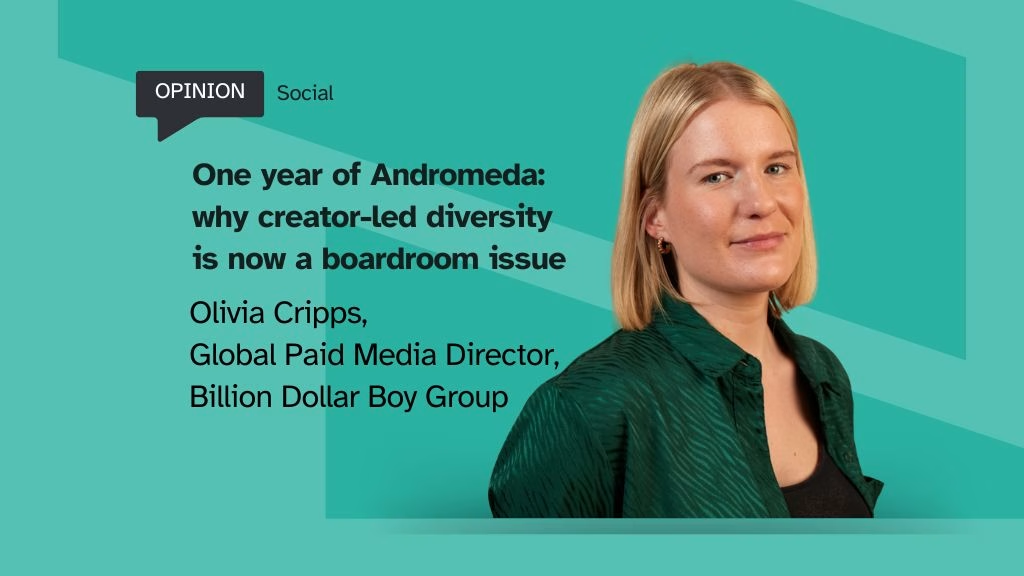
by Olivia Cripps, Global Paid Media Director, Billion Dollar Boy Group
A year on from the launch of Meta’s Andromeda, performance marketing on Meta has entered a new phase. This isn’t simply another platform update or optimisation lever. It’s a structural shift in how growth is achieved – and one that demands attention at a leadership level.
When Andromeda launched in December 2024, Meta described it as an AI-powered retrieval engine, designed to cope with the scale and speed of modern advertising. That description was technically accurate, but strategically incomplete. In practice, Andromeda has changed what the platform rewards and, by extension, what brands must prioritise to drive sustainable performance.
After twelve months of testing across global brands at Billion Dollar Boy, the conclusion is clear: the biggest driver of results on Meta today is not incremental optimisation, nor tighter targeting. It is creative diversity at scale – and creators have become one of the most reliable ways to deliver it.
What Andromeda actually changed
At its core, Andromeda dramatically improves the first stage of Meta’s ad delivery process: selection. It allows the platform to retrieve far more relevant ads from a vastly expanded pool of creative, with greater speed and accuracy. Paired with Meta’s newer ranking model, GEM, the system has already delivered measurable gains. Meta has reported a 5% increase in conversions from GEM alone, alongside a 14% improvement in ad quality on Facebook following Andromeda updates, backed by up to $65bn in AI infrastructure investment.
For marketers, the strategic implication is significant. The platform no longer needs brands to pre-engineer audiences through granular targeting. Instead, Meta’s AI can identify intent signals in real time and match them with the most relevant creative, across placements and formats.
In simple terms, the system has shifted value away from who you target – towards what you show.
Creative is now the primary growth lever but only if it is genuinely differentiated.
Why “more variations” is the wrong response
Many organisations have responded to increased automation by producing more of the same: multiple edits, new hooks, refreshed copy lines. While this approach once delivered crucial learnings to achieve incremental gains, it is increasingly ineffective under Andromeda.
Our performance data shows that minor variations of a single idea tend to peak quickly. The system doesn’t reward volume for its own sake. It rewards conceptual difference – distinct narratives, emotional cues, use cases and perspectives that allow the AI to match ideas to moments of intent.
This requires a mindset shift at leadership level.
A more commercial approach to creative testing
The most effective brands are approaching creative testing with the same rigour they apply to portfolio management.
Rather than launching one idea and iterating endlessly, they start with a clear commercial platform – for example, a core value proposition or growth objective – and then deliberately express it through multiple creative routes.
A robust testing framework might include:
- A mix of content styles: Lo-fi, phone-shot UGC that feels native and trust-building, alongside more polished creator-led content that reinforces brand positioning.
- Multiple narrative angles: Product education, problem-solution storytelling, lifestyle integration, expert validation and social proof – all rooted in the same strategic idea.
- Format and placement breadth: Video, static, Reels, Stories and Feed, giving the system real choice rather than superficial variation.
This approach allows Meta’s AI to do what it does best: identify which combinations of message, creator and format resonate with different customer mindsets at different points in their journey.
The commercial benefit is not just higher return on ad spend, but deeper insight into what actually drives growth.
Why creators now sit at the centre of performance
Creators are no longer a “nice-to-have” brand tactic. In the Andromeda era, they are a performance input.
They offer brands three things that automation alone cannot: cultural relevance, speed and built-in audience understanding. Each creator brings a distinct perspective, even when aligned to the same brief, giving the algorithm richer signals to learn from.
For senior marketers, the opportunity lies in integration. Creators should not sit in a siloed influencer budget, but operate across brand, commerce and performance channels as part of a single growth system.
Done well, this creates a scalable, insight-led engine that feeds Meta’s AI with what it needs most: originality at volume.
What this means for marketing leaders
As Meta continues to automate bidding, targeting and optimisation, human value moves upstream. Competitive advantage now sits in strategy, creative direction and the ability to operationalise diversity without losing focus.
The leadership challenge is clear. Stop trying to out-control the algorithm, and start investing in better inputs.
Brands that embrace creator-led diversification, trust intelligent automation and treat creative as a commercial asset – not a cosmetic one – will be best positioned to win in the next phase of performance marketing.
In a world where technology levels the playing field, it is the quality of ideas that determines who pulls ahead.