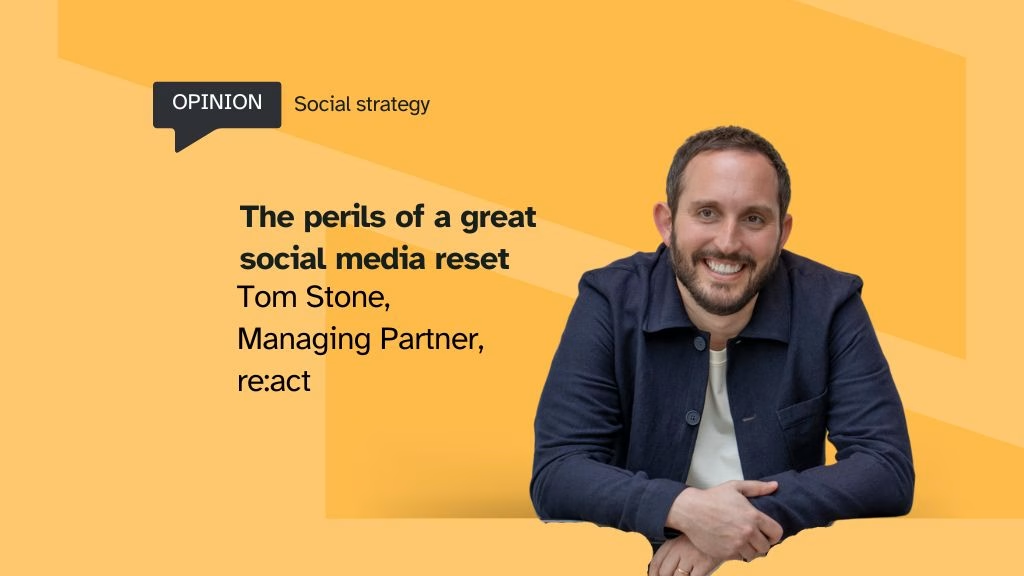
by Tom Stone, Managing Partner, re:act
Wiping a brand’s social feed has become the new way to grab attention, a digital blank slate that promises something new, some fresh thinking. But does starting afresh help or hurt?
Those that have gone down this route, like H&M did last year, use it as a powerful reset button that signals change and drives curiosity. Sceptics on the other hand fear that it wipes away hard-earned engagement, confuses customers and shrinks visibility overnight. The tactic may stop the scroll, but it doesn’t always drive sales, especially if the new content doesn’t live up to the hype.
So, why are some brands prepared to take the risk and what do they stand to lose? And are there smarter ways to refresh a brand’s social media image without erasing its past?
Why are brands tempted to wipe the social slate clean?
When everyone’s scrolling at lightning speed, getting attention is tough. Try launching a new product with a standard post. Sure, it’ll get some likes at the jump, but even more certain is that it will vanish into the algorithm by teatime. But if you delete everything and replace it with a mysterious black square, you suddenly have people talking.
The psychology makes sense as we’re hardwired to notice when something’s missing. And for marketing teams under pressure to make an impact, such a bold move can generate more conversation than months of regular content. If you factor in the media coverage garnered, it can seem worth it when showing off results in the next quarterly meeting.
How this strategy falls flat
While brands count the spike in website traffic and media mentions, they rarely think about what disappears along with those deleted posts. Your social feed is a lot more than promotional content. It’s a growing archive of your brand’s story. It is proof that real people engage with and love what you do, and it is now a powerful search engine tool.
Think about that customer you publicly thanked two years ago. When they go back to share that post as proof of your brilliant customer service, it no longer exists. That is a sure way to dim their enthusiasm. And as every post is potentially discoverable through Google, you’ve also lost a driver for organic traffic.
Consistency is an important factor when it comes to algorithms. Once you’ve deleted your social media history, you may as well be starting again in the eyes of the algorithm. So, any viral posts that once drove brand discovery no longer do so as their power is gone.
Perhaps the biggest risk is the expectation a feed wipe creates. By making such a dramatic gesture, you’re promising something equally dramatic is coming. If your new offering is standard fodder, you can inadvertently cause a disconnect among customers and that becomes the story. A social media wipe must never be used to compensate for a lack of genuine innovation.
There are scenarios where erasing a brand’s social feed can be the right way to go. If the brand is genuinely starting over with new ownership, new positioning or a completely new target audience, a clean slate could be the clearest communication. It is also justifiable when past content contains outdated information that could mislead customers. The question to ask in these scenarios is whether it serves the audience or the marketing team.
How else can brands refresh their look on social media?
Brands reinvent themselves all the time without deleting a single post. One way is to create a stark visual shift that’s impossible to miss. For instance, if your feed is usually minimalist with pastel tones, a switch to bold colours and maximalist styling can have a striking effect. The old content stays as proof of evolution, but the new direction is unmistakable. Instagram also lets you archive posts rather than delete them, removing them from your public grid while preserving them in your backend for potential restoration later.
A pinned post approach can also work. A dramatic announcement can be pinned to dominate the top of the feed while older content remains accessible below. Some brands even build anticipation with a countdown, announcing their change in advance and using their existing feed to tell the story of why they’re evolving. This transforms reinvention into a narrative rather than a mystery.
Your social feed is an ecosystem you’ve built through thousands of interactions. Wiping it clean might create a moment of attention, but attention isn’t the same as success. Before hitting delete on years of content, ask yourself: are you confident that what comes next is genuinely worthy of such a dramatic introduction? Most of the time, there’s a smarter way to signal change while respecting the community you’ve built.