Without question, the hottest topic in the world of marketing throughout 2025 has been the growing use of Generative AI-based solutions and their potential implications for marketers. McKinsey’s 2025 State of AI report, for example, found a large jump in gen-AI use across business functions (with ‘marketing’ among the leading users).
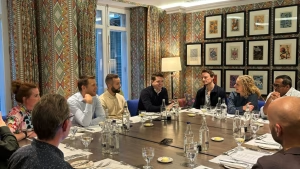
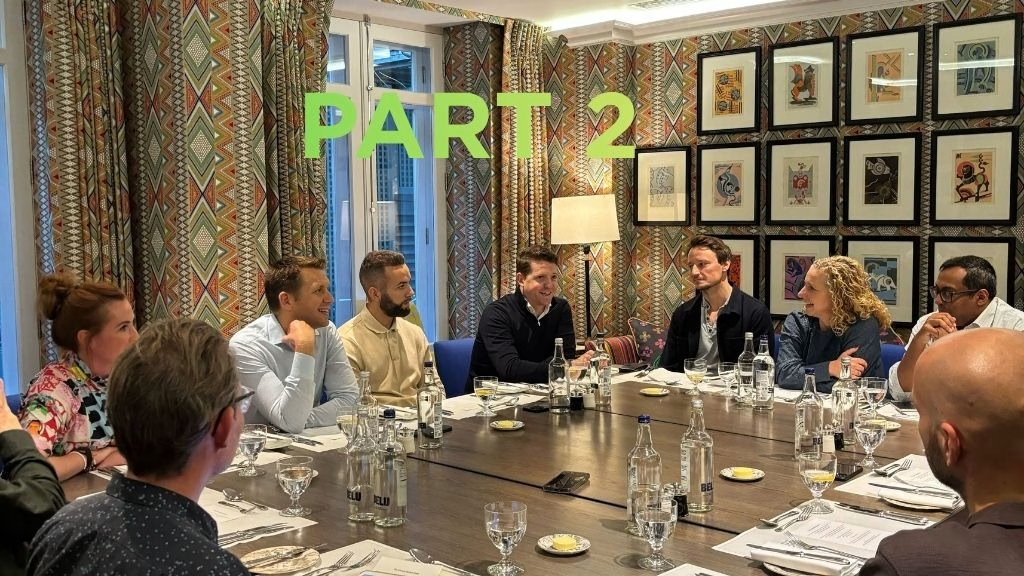
New Digital Age in partnership with LiveRamp recently hosted a roundtable discussion, featuring leading marketers from brands, agencies, publishers and technology partners, all of whom had previously featured as the subject of a Meet The Revolutionaries interview.
Having debated the current state of ‘data-based marketing’ in the first part of the conversation, the discussion inevitably turned to AI. The broad consensus among our collection of expert innovators was that, while AI is transforming marketing, it is not the whole story.
“AI is an accelerator of innovation, but not the only innovation surrounding us,” said Alexia Nakad, Vice President of Brands, UK and Middle East at LiveRamp. “We’re still at the early stage of real data collaboration between retailers, publishers and brands, and that too can be just as impactful as AI to many businesses..”
At Uber, Wright said AI supports the wider business but does not replace human strategy. “Data is still the driver,” he said. “AI enhances our ability to act on it faster.”
For Indranill Datta, Head of Technology Services and Omni Customisation at Annalect, the real shift is cultural. “AI has democratised innovation,” he said. “It’s not just data scientists experimenting now. People across organisations are building their own tools, bringing ideas to life that once needed technical teams. That’s a massive acceleration in creativity.”
Balancing control and creativity
Lena Arbery, Director of Destinations, Travel and Growth, EMEA at TripAdvisor, who described herself as “an AI lover, not a hater,” agreed. “AI is an enabler of other innovations,” she said. “It will become the bedrock of everything, but we’re still in the early chapters.”
For all its promise, AI also brings new risks. Bettinson highlighted brand safety and control as key concerns. “If you use AI to generate creative, you risk losing oversight,” he said. “You need to know how outputs are formed and whether they’re consistent with your brand.”
Eads pointed to Tesco’s use of AI for retail media creative as an experiment worth watching. “It removes friction, but human oversight remains crucial,” she said.
James Reynolds, Customer Success at LiveRamp, envisioned a solution in brand-voice AI agents that act as safeguards, ensuring outputs remain consistent and compliant.
Crotty offered a strategic caution. “The real risk isn’t just misuse, it’s moving too slowly,” he said. “Every CEO wants to know their company’s plan for AI. The organisations that overcome these concerns quickly will gain an edge.”
Arbery added that TripAdvisor moves fast but with structure. “We build internal guardrails to maintain trust and tone,” she said. “AI should accelerate creativity, not dilute it.”
Datta broadened the point. “The question isn’t just whether AI is ready for prime time,” he said. “It’s whether brands are ready to use it responsibly. History shows people gravitate to quality and authenticity. AI won’t change that, it’ll amplify it.”
Brand invisibility?
Another anxiety running through the discussion was whether brands could lose visibility in an AI-first world. Luke Fenney, SVP of Publishers and Platforms, International at LiveRamp, observed that “younger audiences are buying directly through social platforms like TikTok without caring who the brand is.”
Clinger warned of potential disintermediation. “If consumers find much of their daily information through ChatGPT or Perplexity, those platforms become critical intermediaries,” he said. “Brands have to make sure they show up inside those environments, not just on traditional search or social.”
For publishers, the challenge is turning that disruption into opportunity. “User-generated content dominates LLM results,” said Lamaa, “so we’re focusing on bringing the personalities behind our editorial brands to the forefront, creating content that works in short form, on social, and eventually in AI environments too.”
Authenticity, many agreed, may be the last true differentiator. As Arbery put it, “AI can’t replace human truth. It can enhance it, but it can’t fake it forever.”
The democratisation of data
Sarah Robertson, Chief Product Officer at Experian, grounded the tech debate in reality. “There are still organisations running on mainframes,” she said. “Until we modernise infrastructure, governance and cloud connectivity, AI’s potential will remain limited.” She added that marketing could borrow lessons from finance, where standardised data sharing has long supported the credit ecosystem. “It proves collaboration can be both powerful and safe,” she said.
Alexia Nakad, Vice President of Brands, UK and Middle East at LiveRamp, agreed that regulation must evolve alongside technology. “Technology always moves faster than law,” she said. “As custodians of technology it is our duty to partner with regulators to help find the right balance
. Transparency and education are critical.”
Indranill Datta, Head of Technology Services and Omni Customisation at Annalect, saw progress in boardrooms too. “Five years ago, AI was the geeks’ domain,” he said. “Now I hear executives asking about model training and identity graphs. Literacy has risen, and that helps innovation spread through the business.”
Read part one of this writeup here.
In attendance were: Lena Arbery, Director of Destinations, Travel and Growth, EMEA at Tripadvisor; Richard Bettinson, Senior Director of Media and Insights at Hilton Hotels; Paul Wright, Director and Head of EMEA at Uber Advertising; Alexia Nakad, Vice President of Brands, UK and Middle East at LiveRamp; Sarah Robertson, Chief Product Officer at Experian; Indranill Datta, Head of Technology Services and Omni Customisation at Annalect; Charles Crotty, Managing Partner at Digitas, Publicis Groupe; Mario Lamaa, Managing Director of Data and Revenue Operations at Immediate Media; Luke Fenney, SVP of Publishers and Platforms, International at LiveRamp; James Reynolds, Customer Success at LiveRamp; Sam Eads, Head of Ad Sales and Operations at Trainline; and Travis Clinger, Chief Connectivity & Ecosystem Officer and GM, International at LiveRamp.