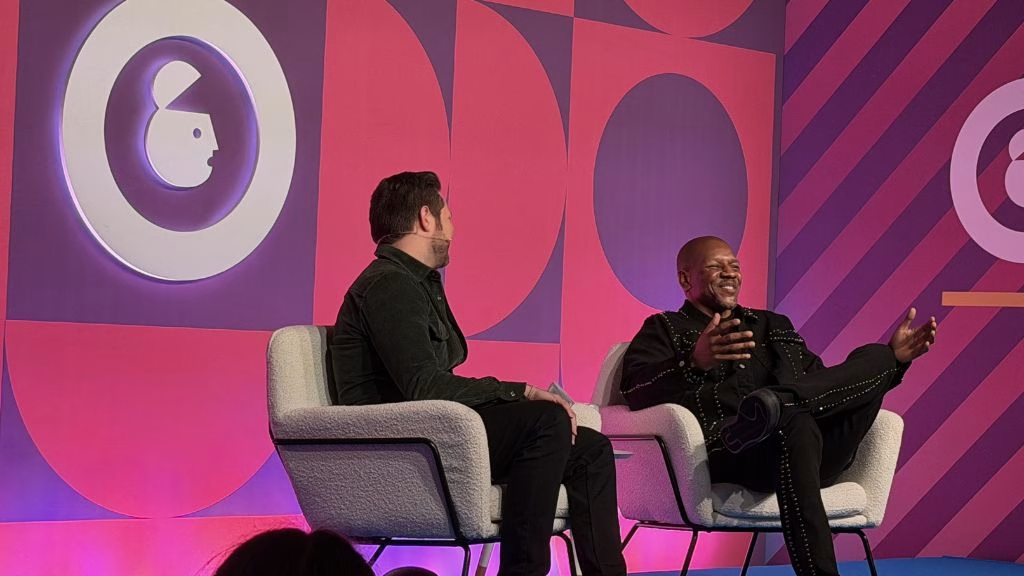
At Advertising Week Europe, a session brought into sharp focus a question that continues to challenge marketers: how do you build brand partnerships that feel genuinely authentic rather than opportunistic?
In conversation with YMU’s Leon Harlow, Giggs discussed how he approached brand partnerships, shaped by cultural credibility and an instinctive understanding of audience trust. The conversatinon offered a masterclass on how brands can embed themselves meaningfully into culture.
Giggs is one of the UK’s most influential music figures, a pioneering rapper whose career spans over a decade, with hundreds of millions of Spotify streams, sold-out shows in iconic venues, chart-topping albums, and a string of award-winning collaborations. He has shaped the UK rap scene while maintaining a fiercely authentic connection with his audience, making him a highly sought-after partner for global brands.
Authenticity starts with truth
A recurring theme throughout the session was that the most effective partnerships begin with something real. For Giggs, that often means drawing directly from his own life rather than responding to a brand brief.
Discussing his collaboration with plant based brand Oatly, he explained that the idea originated not from an agency but from his own experience of being lactose intolerant. “I tried it and I was like, yo, this is it,” he said, recalling how he rediscovered foods he had not been able to enjoy since childhood. “Their custard brought back my life.”
Rather than waiting to be approached, Giggs took the unusual step of initiating the partnership himself, even emailing the brand under a pseudonym to open the conversation. The motivation was not purely commercial. “More than anything, it was, I wanted to help them, so they would not stop selling it,” he said.
This personal investment shaped the resulting campaign, which leaned into humour, everyday scenarios and culturally-resonant storytelling rather than product messaging. The outcome was Oatly’s most successful social campaign to date, demonstrating that authenticity is not just a creative choice but a commercial advantage.
Culture over commerce
What distinguishes Giggs’ approach is a clear prioritisation of culture over conventional brand objectives. Across multiple collaborations, he repeatedly emphasised that partnerships must “mean something” beyond the transaction.
Reflecting on his work with brands including Nike and Stone Island, he pointed to the importance of grounding campaigns in real locations and experiences. A campaign set on Woolwich Road, for example, was not an arbitrary creative decision but a direct reference to the studio where he first made music. “That’s where I started,” he said, adding that the space now serves as a community facility for young people.
Similarly, his collaboration with Stone Island carried personal resonance, rooted in memories of not being able to afford the brand earlier in his career. “In one of my first videos I was wearing fake Stone Island,” he said. “Fast forward and now I’m doing an ad for them with my son involved. It’s sick.”
In both cases, the brand becomes part of a broader narrative, rather than the focal point. The audience is invited to make the connection themselves, reinforcing a sense of authenticity that cannot be manufactured.
The power of saying no
If authenticity is built on what you include, it is equally defined by what you reject. Giggs was candid about the importance of turning down opportunities that do not align, even when there is financial pressure.
Speaking about his immersive “Giggsmas” event, he described how brands were integrated into the experience in subtle, story-led ways, from themed environments to interactive installations. But not every proposal made the cut.
“A lot of things I have to say no to,” he explained. “That was a hard day for me, saying no and losing that money. But it’s about what’s right.”
This discipline is critical in maintaining credibility. In an era where audiences are quick to call out inauthenticity, a single misaligned partnership can undermine years of trust.
Risk and creative freedom
Another key theme was the role of risk taking in successful partnerships. Giggs suggested that many UK brands remain overly cautious, limiting the potential for standout work.
Reflecting on his experience with Oatly, he noted that the brand’s willingness to embrace unconventional ideas was central to the campaign’s success.
“They were like, that sounds cool, let’s do it,” he said. “There’s not a lot of risk takers in the business over here.”
This appetite for risk extends to format as well as messaging. Rather than traditional advertising, Giggs’ collaborations ხშირად take the form of short films, cultural moments or live experiences, blurring the line between content and campaign.
Nowhere is this more evident than in Giggsmas, an event that has evolved from a personal gesture into a highly curated cultural moment. Originally conceived as a way to bring together friends and collaborators, it has grown into an immersive experience where brands, music and storytelling intersect.
Crucially, brand integration is designed to enhance rather than interrupt the experience. “I didn’t just want it to be a brand thing,” Giggs explained. “I wanted to incorporate them in a cool way.”
This approach reflects a broader shift in how audiences engage with brands. Rather than passive consumption, there is an increasing expectation of participation and immersion. For marketers, this requires a rethink of how partnerships are structured and delivered.
A blueprint for the future
The session ultimately highlighted a fundamental shift in the dynamics of brand partnerships. Traditional models, built on reach and visibility, are being replaced by approaches that prioritise relevance, credibility and cultural connection.
Giggs’ perspective offers a clear set of principles, start with something real, embed the brand within culture, be prepared to take risks, and know when to walk away.
Or, as he put it more simply, “What are you into? What does the world need more of?”