By Roger van der Spek, Managing Director & Co-Founder, Brainsight
If advertising were dating, the human race would have died out long ago. Great looks, witty taglines and an invite for a second date would all count for nothing when that first impression needs to be made within half a second.
Even so, advertisers rely on measuring success by how many times they were remembered or whether the offer of getting to know one another better was followed up on. By launching campaigns and then focussing on the outcome, advertisers run the risk of being disappointed by how many adverts were momentarily viewable but didn’t get the attention required to land a message.
Campaign metrics are vital, of course, but they mean brands are always looking in the rear-view mirror. They launch a campaign and then measure response. They may well run real-time testing and hold consumer panels but valuable insight is gained once a campaign has already been paid for. With the help of predictive eye-tracking technology, though, a brand gets an insight into the attention it will attract before a single penny is spent on media.
Why pay now, learn later?
The sums involved with digital advertising are mind-boggling. In the UK alone, the IAB is forecasting digital ad spend will rise 7% in 2025 to hit £38bn. Behind that massive figure is a very inconvenient truth. Numerous studies have revealed the human brain needs to see an item for two seconds or more to start building memory, and yet only one in ten digital adverts are viewable for more than a second. Even then, there is no guarantee an advert is seen by a reader who is consuming content rather than concentrating on adverts.
It makes it all the more essential for campaigns to be launched ready to stand out and deliver what the advertiser is intending within half a second. This is where predictive eye-tracking comes in. It can tell advertisers where the eye will be drawn to in a fleeting glimpse. The technology is based on many years of neuroscience which understands how the old reptilian part of the brain reacts in that fleeting moment the eyes first see an object, such as an advert.
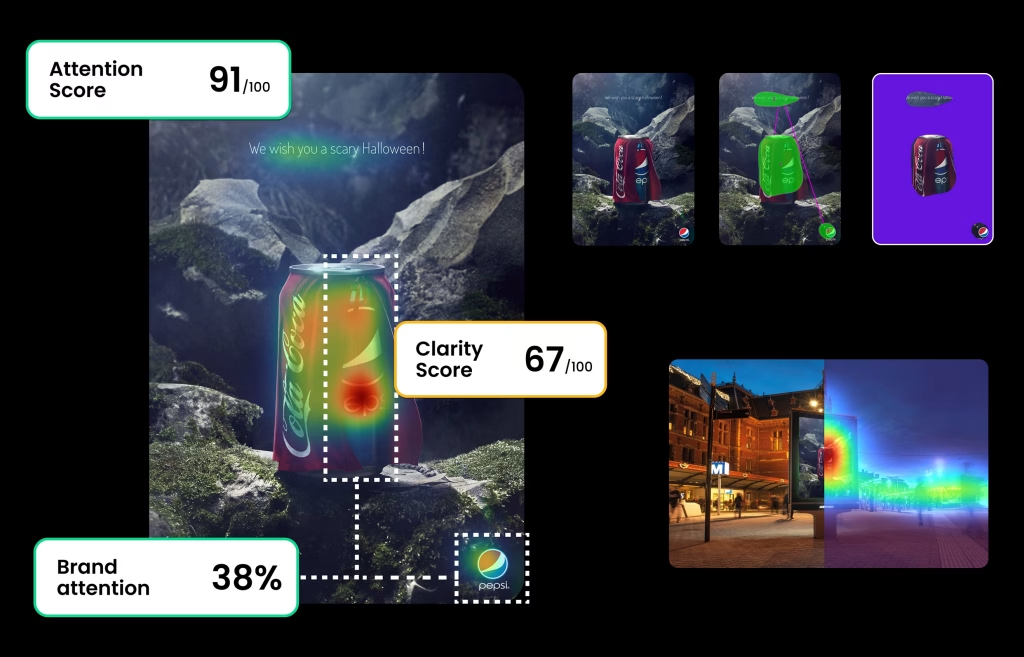
Imagery, messaging and logos can be changed or moved around to establish where the eye is drawn to, and then the creative can be measured for attention and clarity scores. Will the eye likely focus on the advert rather than its surroundings, giving it a high attention score. Does it ask too much for the viewer, leading to confusion, or do it deliver a clear message instantly? This will lead to either a low or high clarity score. Together, attention and clarity scores predict what will be seen first and whether the advertiser’s ambitions are met.
Optimise before kick-off
Nobody would ever suggest that metrics gleaned once a campaign is underway are not useful. It is clear they give agencies a steer on how well the planning and media buying is going, while offering insight into which imagery and messaging worked best. It is vital brands get this feedback to carry on investing in advertising.
The lesson is, so much budget could be better optimised by also testing what part of the creative will be seen first and whether it conveys the intended message, or will the eye just be drawn to a pretty mountain sunset with no idea whom the advert is for?
The new football season will prove the point. Nearly all the top teams now employ data analysts who measure performance so they can help a club realise gaps and ensure the right players are in the optimum position before the whistle is blown. Each player will have an ‘x’ score for each ‘expected’ outcome, such as how many passes they complete, how many tackles they win and how likely it is they should score or assist a goal.
The full-time result is still the main metric which will show each team where improvements are required. But the point is, none will rely on that alone, they will each be using data analysis to put out the best team for the upcoming match. This is exactly how advertising needs to evolve.
When the industry starts launching campaigns with impact-related metrics, it will start to better understand pre-optimisation, rather than rear view metrics. There will always be the equivalent of dodgy referee decisions and fluffed chances to deal with, but at least a campaign will be set out with the best chance of optimising budget before the whistle is blown.