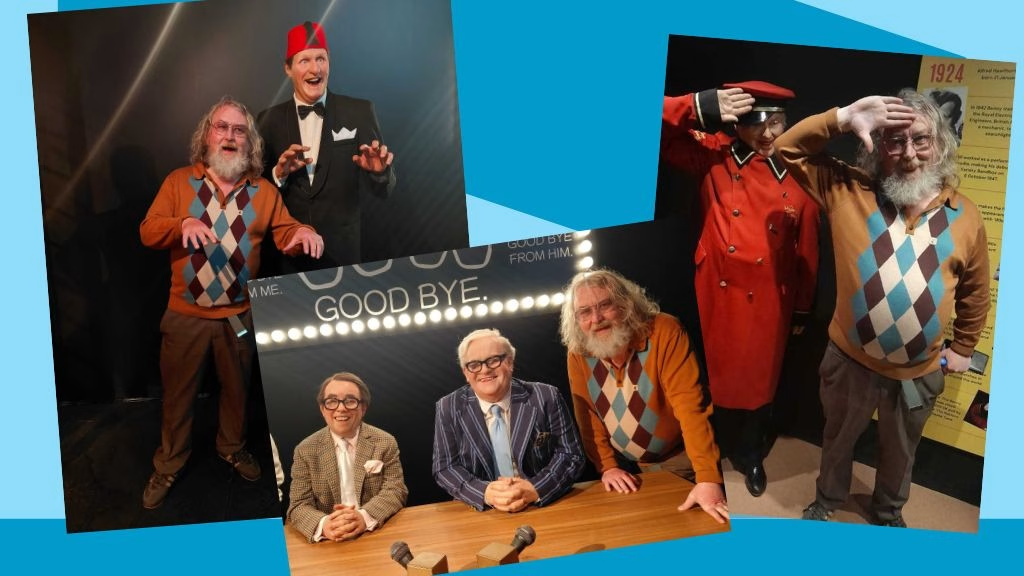
Earlier this month, I was lucky enough to spend a few days in Blackpool with my family, including a trip to the Madame Tussauds attraction that’s based there. As a boy, I had spent many a summer holiday in Blackpool but it had been 40 years since I had last visited the famous waxworks.
When I was little, the wax figures of the rich and famous had been impressive for sure, but they were invariably roped off and inaccessible, with prominent signs everywhere warning you not to touch. In 2025, however, to my delight, things were very, very different.
Indeed, the modern incarnation of Madame Tussauds actively encourages you to interact with the waxwork figures, from a recreation of the Strictly Come Dancing set, including Tess and Claudia, to famous popstars like Harry Styles and Lady Gaga, or, my own favourite, UK comedy legends such as the Two Ronnies and Tommy Cooper (pictured above).
I have to say that I absolutely loved it. I also noted with interest that the general public (despite their freedom to get up close and personal) behaved with respect and care towards the waxworks, enjoying their chance to mingle with the stars while avoiding any damage to the delicate doppelgangers. There was an unspoken agreement among the humans that kept things ticking along nicely.
The experience made me think of how digital marketing has had a similar impact in removing many of the barriers that we used to take for granted. Once upon a time, a fashion ad on an out-of-home billboard might have hoped to prompt a customer to visit the retailer’s nearest physical store, whenever they next had a chance. Today, in 2025, that same ad might include a QR code that (via the smartphone in your pocket) takes you to an online store or social media portal where you can actually purchase the item you saw advertised moments before.
So much of the digital marketing industry’s brainpower is dedicated to getting the right messages in front of the right people at the right time, helping brands to make the conversions they need in as efficient a way as possible. However, there have been unexpected side-effects too. In removing the barriers between brand and customer, making things as convenient as possible for customers to buy, we’ve unwittingly created a variety of new problems for human beings, such as the impacts of ecommerce on our struggling high streets and city centres or on our national tax revenues.
Now, with the use of AI and “agentic” systems the hottest topics in marketing and adtech, there’s potential for more changes that could be massively disruptive to how we all live our lives and earn our livings. Marketers are already adjusting to AI search (e.g. ChatGPT-like models becoming primary search interfaces) and rethinking how content is structured, presented, and optimised.
With “agentic marketing” (i.e. marketing agents or autonomous systems that can make decisions) being presented as the next frontier and new generative models being proposed to power ad bidding, adtech is moving into more advanced AI territory. My worry is that, in making this transition, many of the unspoken agreements that have existed at a human and societal level will be impacted or swept away as a consequence.
Brands and platforms that successfully integrate AI in decisioning, content management, and ad bidding will undoubtedly gain an edge. However, striking the right “human + AI” balance, and thinking through the implications in advance, will be critical in avoiding over-automation or losing brand voice and human connection.
Until next time
Here’s to a prosperous November!
Michael Feeley
Editor, NDA