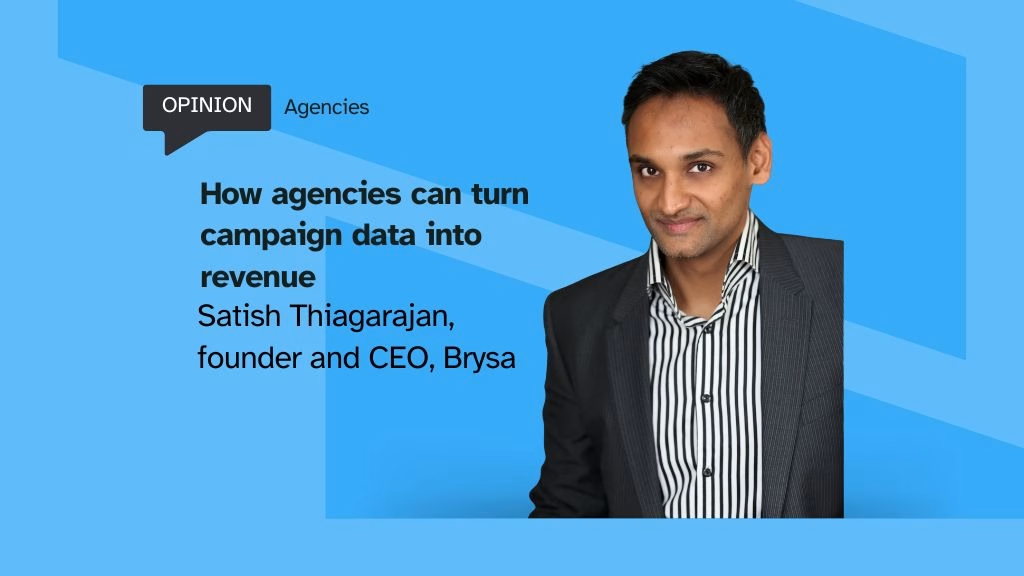
By Satish Thiagarajan, founder and CEO of Brysa
Agencies are drowning in tech, but few of them are using it properly. With platforms for everything –social, search, creative, CRM, media, analytics – it’s easy to become overwhelmed by what is ultimately a fragmented system, leaving you with missed prompts, missed information, outdated insights, and a lack of clarity. All of which means significant missed opportunity. That has to change. It’s time for agencies to reprioritise insight.
As a marketing agency, you run campaigns across every channel. And that means endless data, scattered across disparate platforms, spreadsheets, and tools. You can stitch that data together, but the process is slow and unwieldy, creating a barrier to unified insights and prediction, which is only worsened when you try to overcome the problem with multiple copies of data in multiple platforms. You miss the opportunity to improve and optimise. You pivot more slowly. And you lose revenue because of it. The most frustrating part? With the right tech stack, you could do so much better.
Tech tools and AI
Everyone is using AI, but they’re not necessarily using it for the right things. With well-chosen AI and tech tools, you can move from a state of reactivity to proactivity, predicting, planning, testing, and evolving campaigns before they even launch.
So, you’ll start with hypothesis building, test it in the market, measure the results, and learn from them. You’ll feed those results into AI, tweak, and try again. Repeating and scaling as your ROI builds.
It’s a virtuous cycle, which will turn campaigns management into a continuous process of experimentation and improvement over the brand’s lifecycle, getting smarter and faster with every loop.
AI only works if it has clean, connected, and consistent data – a single source of truth infrastructure, if you will. Most agencies don’t have that. More often than not, the various metrics are scattered across CRMs and Google Drives, and this makes insight management near impossible.
But when you have an AI system that can access data across platforms, structured campaign metadata, and clean inputs – a zero-copy data lake with metadata lookups – AI becomes a whole lot more useful. Enabling AI or agent access and training relatively uncomplicated, and helping you to create long-term value for your agency. The problem is that AI is no longer a one-size-fits-all tool. You need to pick tools that fit the way your agency works.
Assessing your AI and tech stack
Where do you even start? Every business is different. I can’t explicitly tell you what will work for your company, but there are tools that I use endlessly for core business processes.
- ChatGPT supports everyday brainstorming and ideation.
- Perplexity is there for smarter search and research.
- Claude provides deeper document analysis.
- Gemini is the go-to for creative content generation.
And if you’re looking to build AI agents, you’re spoilt for choice, with platforms such as Copilot Studio, CrewAI, Salesforce Agentforce, and Stack AI all waiting for you to jump in. The thing with all of this is that you need to choose tools that support experimentation and are easy to use. They need to deliver fast time to value, and be able to scale with your clients and team. Those are the criteria that matter most to your business.
Amazon DSP’s Predictive Audiences and Performance+ tools use supervised learning models trained on cohort behaviour and historical campaign outcomes to forecast ROAS across inventory sources and adjust bids accordingly. Agencies use these tools to automatically adjust bids and allocate spend based on machine learning models that predict ROAS across audience segments and inventory types.
LTV models incorporate recency, frequency, and monetary value along with campaign exposure to forecast future revenue contribution. Agencies use predictive models to prioritise high-value customer segments for targeting, ensuring media spend is focused on users with the greatest projected revenue impact.
Closed-loop optimisation frameworks enabled by Einstein Attribution and Salesforce Marketing Cloud Personalisation allow model parameters to be updated continuously based on observed performance data. For example, predictive lead and opportunity scores are refined using live conversion data, while dynamic content delivery models are retrained on real-time behavioural data. These feedback loops enable campaign and sales operations teams to dynamically adjust targeting, messaging, and budget assignments in response to model-driven performance insights.
Making the shift
To make this shift work for your agency, you need to change on three fronts:
Culture: Move from reporting to continuous learning. That’s what data is for. Used well, it can help you evolve.
Tech: Investing in flexible, connected tools, you can create an infrastructure that grows with you. Completely silo-free.
Method: When you adopt a test-learn-repeat model, every campaign becomes an experiment. And every result benefits your next campaign.
Data is an asset. Few agencies treat it like one. To get ahead, you need to stop obsessing over past performance and instead focus on building real-time AI learning systems that can turn your data into something truly useful. Because the ground is shifting beneath agencies now. Action is needed now – if you don’t start to adapt right away, investing in the right technology and change, it’s going to be impossible to survive, let alone grow.