In November 2025, AI Search Intelligence platform, Adthena, announced that, for the first time, it had observed ads appearing in Google’s AI Overview (AIO) search results – marking a major milestone in the evolution of paid search.
These early placements closely mirror traditional Google text ads – featuring a blue headline, description, and brand name as the URL – but with an added thumbnail hero image relevant to the query (e.g., “Women’s Rain Coat”) and were placed directly beneath the AI Overview summary.
Adthena’s own analysis found that Paid Search click-through rates could decline by 8–12 percentage points (roughly a 20–40% relative drop) as AI-generated answers take up more space on the SERP.
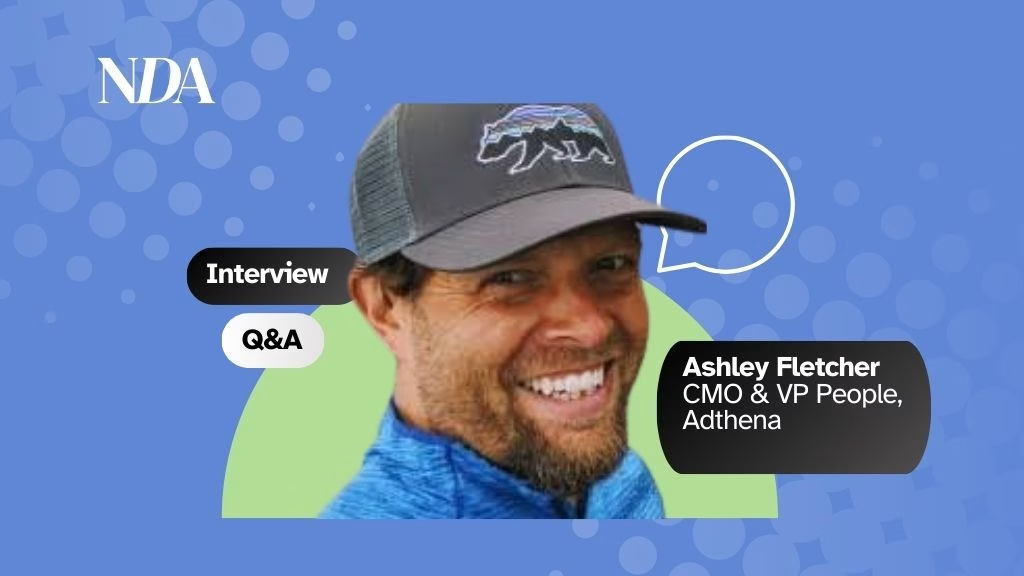
NDA spoke with Ashley Fletcher, Chief Marketing Officer & VP People at Adthena, to find out more…
Adthena has described ads appearing in Google’s AI Overview (AIO) search results as a “pivotal moment” in paid search. Why is it so important?
Ads appearing on AI Overviews is a pivotal moment in paid search because AIOs fundamentally change where attention goes on the SERP. For the first time, paid ads aren’t just competing with other ads or organic listings — they’re competing with Google’s own AI-generated answer. Adthena’s own research shows that ad visibility is lost around 25% of the time when AI Overviews appear, with significant variation by industry, device, and query type. That loss of above-the-fold presence directly impacts click-through rates, revenue, and ROI. For brands investing millions in search, even a 20–30% erosion in visibility creates immediate instability, making ad position relative to AI Overviews a critical new performance metric.
How can brand marketers best respond to this new shift? Is traditional search marketing activity suddenly out-of-date?
Traditional search marketing isn’t out of date — but it does need to become far more precise. It isn’t about matching search terms anymore, it’s about understanding user conversations in search which is fundamentally different. Our data shows that the impact of AI Overviews is highly segmented. Some industries, devices, and query types still offer strong opportunities to appear above the AI result, while others are far more volatile. The most effective response is not blanket pullback, but smarter strategy: auditing keywords regularly, testing device-specific bidding and expanding coverage into mid- and upper-funnel queries where ads often outperform expectations. Just as importantly, ad copy needs to do what AI cannot — inject brand, emotion, urgency, and trust to give users a compelling reason to click beyond Google’s summary.
Our enterprise clients are already leveraging Adthena’s AI Overview (AIO) visibility data to measure CTR shifts and budget impact as AI reshapes user behaviour. We believe ours is the first solution to track and analyze ad placements within AI Overviews, allowing marketers to understand how paid and organic content interact in the generative SERP.
What would be your key piece of advice for marketers in relation to 2026?
Don’t optimise blindly. In 2026, AI-driven SERPs will become the default, not the exception. Marketers who succeed will be those who have real-time visibility into where their ads sit relative to AI Overviews and can act quickly on that intelligence. That means moving beyond average position or impression share, and focusing on true above-the-fold visibility across devices and intents. Brands that embrace contextual targeting and continuously test, adapt, and exploit pockets of opportunity will protect performance and gain a competitive edge.
What are Adthena’s big priorities for the year ahead?
Adthena’s priority is to help marketers navigate evolving AI involvement in online search behaviour to enable data driven paid search ROI. As ads become more prevalent on AIOs and LLMs, we’re expanding our offering to deliver granular, real-time insight into ad position, competitor behaviour, and visibility risks across industries, devices, and query types. Our goal is to empower brands to identify where they can still win above the AI result, uncover overlooked keyword opportunities, and adapt strategy faster than competitors. In a rapidly changing search landscape, we can turn uncertainty into actionable advantage.