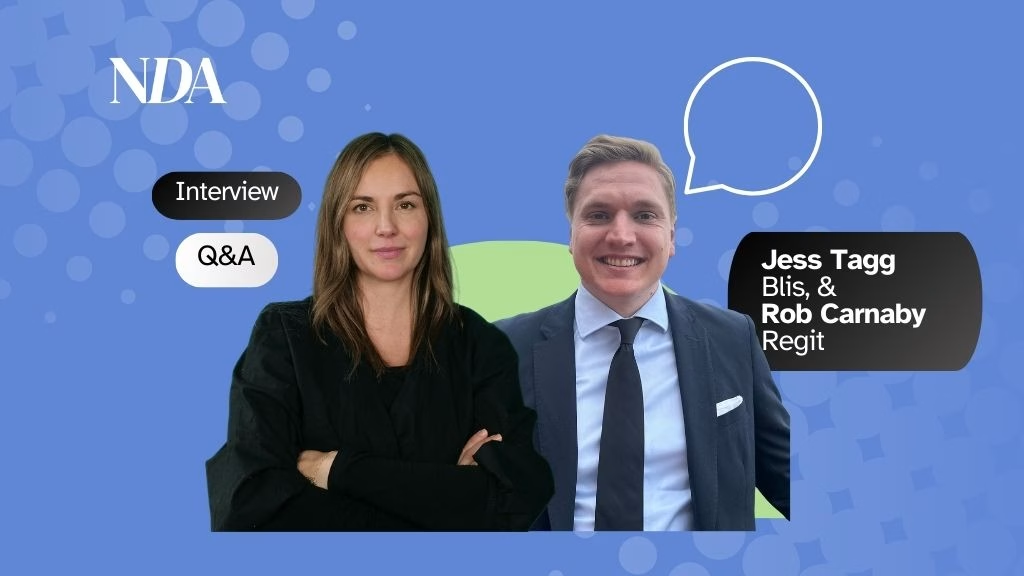
Regit, the UK-based ‘digital garage’ platform, has partnered with Blis, the omnichannel platform, to redefine automotive advertising in the region. By combining Regit’s first-party vehicle data with Blis’s unique mix of aggregated real-world movement, telco-derived insights, spending and digital behaviour data, the collaboration gives automotive brands the opportunity to reach the right drivers at pivotal moments in their ownership journey.
New Digital Age spoke with Rob Carnaby, Head of Agency & OEM Partnerships, Regit, and Jess Tagg, UK Director of Sales, Blis, to find out more about the new partnership…
How did the new partnership between Blis and Regit come into being?
Rob Carnaby (RC): The partnership really came off the back of our Sky AdSmart partnership. At the time, we were doing PR around a world-first activation across Sky AdSmart, using our first-party data across Sky households.
I was already very familiar with Blis, their capabilities, and the people there. Through the power of LinkedIn, you naturally end up congratulating people on partnerships and announcements. That’s how Will Priston and I started connecting and talking about the possibilities.
We both expressed a strong interest in working together and it all came about very naturally through conversation. We took it back to our respective teams and the prospect of a partnership went down an absolute treat.
For us, the opportunity to enrich the Blis proposition within automotive was fantastic. It also came at a great time, as we were looking to partner with a select few specialists in their respective industries. Blis was always going to be on my radar.
Jess Tagg (JT): It really did feel like a very organic partnership. As Rob mentioned, Will Priston on my team has worked in automotive for years, so he understands the landscape well, be it the targeting approaches or the challenges the industry faces.
It just felt like a natural fit. Nothing needed to be forced. It’s a great marriage of capabilities: we work with real-world data such as location and telco data, which gives us online signals, as well as spend data. When you combine that with Regit’s first-party data, it genuinely felt like a no-brainer.
From a marketer or advertiser perspective, what key challenges does this new offering address?
JT: These challenges aren’t exclusive to automotive – they’re issues facing marketing more broadly. It’s about being able to reach audiences accurately and at scale, while also dealing with shrinking addressable audiences as privacy regulations tighten.
As an industry, we’re moving away from device IDs and cookie-led solutions. In automotive specifically, audience modelling has traditionally relied heavily on probabilistic data. While that’s valuable, it doesn’t always scale cleanly or consistently.
By contrast, this partnership brings in robust deterministic data. We’re talking about over four million opted-in Regit users, alongside hundreds of additional data points and our own targeting capabilities.
When we activate campaigns, they’re cookie-less and device ID-less, which allows us to instantly scale those high-value audiences. For me, this really helps address the impact of privacy change. We’re facing reduced visibility, shrinking audiences, but brands still need strong performance from their marketing budgets.
Starting with Regit’s opted-in user base gives us an incredibly powerful seed audience. We can then enrich that with our own data and provide true omnichannel activation. That solves a lot of problems for marketers today.
What types of brand is this proposition most attractive to?
RC: There’s a lot of flexibility here. One of the biggest benefits of our first-party data is that we understand where people are in their vehicle lifecycle, and what their next step is likely to be.
There’s a huge focus right now on retention for OEMs, whether that’s getting customers back into dealerships or driving aftersales activity. Competition has intensified, particularly with new Chinese brands entering the UK market with very strong offers. Brand loyalty is becoming much harder to maintain.
Using our data, we can understand when someone is in-market for an MOT or a service, which is ideal for retention strategies. We can also see when someone is looking to sell their car, which places them into in-market audience segments.
Importantly, this doesn’t stop with OEMs. We can identify users driving premium or luxury vehicles and target them with relevant luxury brands. If someone is driving a larger SUV or seven-seater, there’s a strong likelihood they’re part of a family household. So there’s a significant opportunity beyond pure automotive.
JT: We’re actually seeing a lot of interest from agencies beyond automotive teams. While auto is the core of the offering, if a brand wants to reach high-net-worth or luxury audiences, vehicle ownership is one of the strongest signals you can have.
When you combine that with spend data and movement data, you get incredibly strong signals to build highly effective audiences.
RC: Insurance is another big area. When users are approaching insurance renewal deadlines, Regit can dive deeply into vehicle history using MOT data and our MOT checker. That allows us to understand potential issues a user might face at their next MOT.
It puts us in a strong position to support a wide range of market categories.
What’s your key piece of advice for marketers targeting automotive audiences in 2026?
JT: From my point of view, especially in automotive, I’d say don’t rely purely on bottom-of-the-funnel activity.
When you’re working with rich data signals, it’s easy to become increasingly niche and focus only on those closest to conversion. But using these signals earlier in the purchase journey is incredibly valuable—it gives brands the chance to get ahead.
Regit’s data shows that 76% of drivers are actively considering switching to EVs, which means loyalty to familiar brands is weakening. That insight is powerful, because it allows brands to start engaging audiences earlier—not just when leases are ending or people are actively selling.
So my advice would be: don’t rely solely on niche publishers, dealership-based activity or in-market moments. Be smart with the data and reach people earlier in the journey.
RC: I think 2026 will be a decisive year for the UK automotive market. Product choice will expand, regulation will tighten, and electrified vehicles will continue to dominate headlines and sales.
For consumers, the landscape is becoming harder to interpret than ever. That makes retention absolutely critical, particularly for legacy brands that have been in the UK market for years.
Understanding your audience segments is key. Knowing where customers are coming from, and using tools like ours to pass that insight into Blis – particularly using postcode-level data – allows brands to re-engage current owners, previous owners, and even those who have recently moved to competitors.
Retention really is the priority this year.